

Class: Primary Four
Term: Frist Term
Subject: History
Curriculum Theme:
Previous Lesson: The Four Early Regions In Nigeria, Major Ethnic Groups In The Region
Topic: The Four Early Regions in Nigeria
Content/Learning Area: Naming three states in each of the four early regions, Understanding the historical importance of these regions
Time Allocation:
Performance Objectives
By the end of the lesson, pupils should be able to:
- Cognitive Domain:
1. Name three states in each of the four early regions.
2. Explain the historical meaning of the four early regions.
- Affective Domain:
1. Show interest in learning about Nigerian history.
2. Appreciate the diversity of Nigeria.
- Psychomotor Domain:
1. Actively participate in class discussions.
2. Take notes on the lesson.
- Social Domain:
1. Work cooperatively with classmates.
2. Share ideas and facts respectfully.
Reference Materials
- 9 – Years Basic Education Curriculum
- Abuja Educational Resource Center Scheme of Work
- NAPPS National Unified Scheme of Work
- Relevant Textbooks
Instructional Materials
To deliver this lesson,the teacher will use a whiteboard or chart paper,markers or pens.
rationale for the Lesson
Understanding the four early regions is crucial for comprehending nigeria’s historical advancement and its diverse cultural landscape. This knowledge provides a foundation for future lessons on Nigerian politics and society.
Prerequisite/Previous Knowledge
Pupils have prior knowledge of the history of Nigeria.
Lesson Content
The Four Early Regions In Nigeria
The British colonial administration created the four early regions of Nigeria in the 1940s. these regions were:
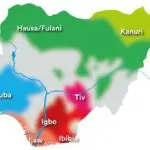
- Northern Region: Primarily inhabited by Hausa and Fulani people.
- Eastern Region: Located in southeastern Nigeria, primarily inhabited by Igbo people.
- Western Region: Located in southwestern Nigeria, primarily inhabited by Yoruba people.
- Mid-Western Region: created in 1963 from the western Region,primarily inhabited by Edo and Delta people.
States In Each Of the Four Early Regions In Nigeria
North Nigeria
States that were part of the Northern Region include Adamawa, Bauchi, Benue, Borno, Gombe, jigawa, kaduna, Kano, Katsina, Kebbi, kogi, Kwara, Nasarawa, Niger, Plateau, Sokoto, Taraba, Yobe, and Zamfara.
East Nigeria
The Eastern Region included Abia, Anambra, Ebonyi, Enugu, and imo states.
West Nigeria
The Western Region comprised Ekiti, Lagos, Ogun, Ondo, Osun, and Oyo states.
South Nigeria
The Mid-Western Region, later referred to as South, included Akwa Ibom, Bayelsa, cross River, Delta, Edo, and Rivers states.
Teaching Methods
To deliver this lesson, the teacher will adopt the following methods: Discussion, Question and Answer, and Storytelling.
Instructional Procedures
To deliver this lesson,the teacher will adopt the following steps:
Step 1: Introduction
Time: 5 minutes
Teaching Skill: Set Induction
Teacher’s Activity: Review the previous lesson and introduce the topic of the four early regions.
Pupils’ Activity: Answer questions and listen attentively.
Step 2: Clarification of Key Concepts
Time: 15 minutes
Teaching Skill: Explaining
Teacher’s Activity: Explain the creation of the four regions by the British and their geographical locations.
Pupils’ Activity: Listen attentively and ask clarifying questions.
Step 3: Presentation/Guided practice
Time: 10 minutes
Teaching Skill: Modeling
Teacher’s Activity: Guide pupils in identifying three states from each region on a map.Pupils’ Activity: Participate in identifying states and discuss their locations.
Step 4: Autonomous Practice
time: 5 minutes
Teaching Skill: Monitoring
Teacher’s Activity: Observe pupils as they individually list three states from each region.
Pupils’ Activity: Independently list three states from each region.
Step 5: Note-Taking
Time: 2 minutes
Teaching Skill: Guiding
Teacher’s Activity: Guide pupils in taking notes on key facts about each region.
Pupils’ Activity: Take notes on key facts.
Step 6: Evaluation/Review
Time: 3 minutes
Teaching Skill: Questioning
Teacher’s Activity: Ask review questions to assess understanding.
Pupils’ Activity: Answer review questions.
Objective-aligned checks:
- Name three states in each of the four early regions.
- Explain the historical meaning of the four early regions.
- Show interest in learning about Nigerian history.
Step 7: Conclusion
Time: 5 minutes
Teaching Skill: Summarizing
Teacher’s Activity: Summarize the key points about the four early regions and assign a short homework activity.
Pupils’ Activity: Listen to the summary and note the homework assignment.
Lesson Keywords
- Region – An area or division, especially a country or part of the world having definable characteristics but not always fixed boundaries.
- Colonialism – The policy or practice of acquiring full or partial political control over another country, occupying it with settlers, and exploiting it economically.
- Ethnic Groups – A community or population made up of people who share a common cultural background or descent.
- Historical Significance – The quality of being crucial or likely to have a long-lasting effect on history.
Lesson evaluation
To evaluate the learning, the teacher asks pupils to:
- name three states in each of the four early regions.
- What were the main ethnic groups in each region?
- When was the Mid-western Region created?
Assignment/Homework
- Research one state from each of the four early regions.
- Write a short paragraph about the cultural aspects of each state.
Differentiation
- For slower learners: Provide one-on-one assistance and simplified explanations.
- For advanced learners: Encourage them to research further into the cultural aspects of each region.
- For visual/auditory/kinesthetic learners: Use maps, discussions, and hands-on activities to cater to different learning styles.
Note for Teachers
Ensure to use visual aids such as maps and charts to enhance pupils’ understanding of the geographical locations of the regions and states. encourage active participation through discussions and questions.

Community Join the conversation Open discussion +