

Class: Senior Secondary School 1 (SS1, SS 1, SSS1, SSS 1)
Term: 1st Term
Week: 5
Age: 15 years
Duration: 45 minutes
Subject: Computer Studies
Curriculum Theme: Computer Studies
Previous Lesson: Data and Information II.
Topic: Computing Devices 1 (Pre-Computer Age to 19th Century)
Subject Matter: Abacus, slide rule, Napier’s bones, Pascal calculator, Leibniz multiplier, Jacquard’s loom, Charles Babbage, Analytical Engine, Hollerith census machine, Burroughs machine, features/components/uses of early computing devices
Specific Objectives
By the end of the lesson, pupils should be able to:
Cognitive Domain:
- Define early computing devices and state why they were developed.
- Identify and describe at least six pre-computer and 19th century computing devices.
- State key features/components of each device discussed.
- State the uses of each device and the problem it solved.
Affective Domain:
- Show interest in the history of technology and invention.
- Appreciate that modern computers developed from earlier devices.
Psychomotor Domain:
- Recognize pictures/models of early devices and label main parts correctly.
- Arrange early computing devices in a simple timeline from oldest to newer.
- Use a simple counting aid (e.g., abacus illustration) to represent a calculation.
Social Domain:
- Work in groups to discuss features and uses of assigned devices.
- Present group findings clearly and listen to other groups.
Reference Materials
The following resources were used in planning this lesson:
- 9 Years Basic Education Curriculum
- State Unified Scheme of Work
- New Computer Studies for Senior Secondary Schools (SSS 1)
- Computer History Museum: Computing Timeline
- Encyclopaedia Britannica: Abacus
- Encyclopaedia Britannica: Analytical Engine
Instructional Materials
The teacher will teach this lesson with the aid of:
- Charts and pictures of early computing devices
- Timeline chart (pre-computer age to 19th century)
- Any available models (e.g., abacus or slide rule if available)
- Card labels for device names and uses
- Whiteboard/marker
Rationale for the Lesson
This lesson helps pupils understand how modern computers developed from earlier counting and calculating tools. It also helps pupils connect inventions to real needs such as counting, calculations, weaving patterns, and population records.
Prerequisite/Previous Knowledge
Pupils have basic knowledge of computer systems and understand that computers are used to process data and solve problems.
Lesson Content/Board Summary
Computing Devices 1 (Pre-Computer Age to 19th Century)
Meaning of Early Computing Devices
Early computing devices are tools and machines used before modern computers to count, calculate, store results, or process information.
Abacus
The following are features/components of the abacus:
- Frame with rods or wires.
- Beads that move on the rods.
- Place-value arrangement for counting.
The following are uses of the abacus:
- Counting numbers and doing basic arithmetic.
- Teaching place value and simple calculations.
Slide Rule
The following are features/components of the slide rule:
- Sliding scales marked with numbers.
- Logarithmic scale arrangement.
- Cursor/indicator on some types.
The following are uses of the slide rule:
- Multiplication and division.
- Working with ratios, roots, and logarithms in science and engineering.
Napier’s Bones
The following are features/components of Napier’s bones:
- Set of rods/sticks marked with numbers.
- Grid-like number arrangement to support multiplication.
The following are uses of Napier’s bones:
- Making multiplication and division easier.
- Supporting calculations using arranged number patterns.
Pascal Calculator (Pascaline)
The following are features/components of the Pascal calculator:
- Wheels/gears with digits on them.
- Carry mechanism that moves to the next wheel.
- Windows/display area for results.
The following are uses of the Pascal calculator:
- Addition and subtraction of numbers.
- Reducing errors and time in manual calculations.
Leibniz Multiplier (Stepped Reckoner)
The following are features/components of the Leibniz multiplier:
- Stepped drum or gear mechanism.
- Crank/handle for turning the mechanism.
- Result display section.
The following are uses of the Leibniz multiplier:
- Multiplication and division using repeated addition/subtraction.
- Performing more advanced calculations than simple adding machines.
Jacquard’s Loom
Jacquard’s loom is a weaving machine that used punched cards to control patterns in cloth production.
The following are key features/components of Jacquard’s loom:
- Punched cards with holes representing instructions.
- Card reader mechanism that follows the pattern of holes.
- Weaving control system that lifts threads based on the cards.
The following are uses of Jacquard’s loom:
- Producing repeated cloth patterns automatically.
- Introducing the idea of instructions/data controlling a machine.
Charles Babbage and the Analytical Engine
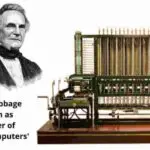
Charles Babbage is known for designing early mechanical computer ideas. The Analytical Engine was a planned machine that could perform general calculations using instructions.
The following are key features/components of the Analytical Engine:
- Input method using punched cards.
- Memory store for holding numbers and results.
- Processing unit (mill) for calculations.
- Control unit idea for step-by-step instructions.
The following are uses/importance of the Analytical Engine:
- It introduced major computer ideas: input, processing, memory, and output.
- It showed that machines could follow instructions to solve different problems.
Hollerith Census Machine
The Hollerith census machine was used to process large amounts of data using punched cards for population counting and records.
The following are features/components of the Hollerith machine:
- Punched cards used to store data.
- Card reader and sorting system.
- Counting/tabulating mechanism for totals.
The following are uses of the Hollerith machine:
- Processing census and statistical data faster.
- Reducing time needed for large record calculations.
Burroughs Machine (Adding/Calculating Machine)
The Burroughs machine is an early calculating device used mainly for business arithmetic and record work.
The following are features/components of the Burroughs machine:
- Keyboard for entering numbers.
- Mechanical calculating parts inside the machine.
- Printing/record section on some versions.
The following are uses of the Burroughs machine:
- Adding and recording totals for accounts and business work.
- Supporting office calculations with better speed and accuracy.
General Uses of Early Computing Devices
The following are general uses of early computing devices:
- Counting and arithmetic calculations.
- Reducing errors in manual calculations.
- Processing records such as business accounts and census data.
- Introducing input methods like punched cards used later in computers.
Teaching Methods/Instructional Techniques
Discussion, Lecture, Demonstration, Question and Answer, Visual Aids
Instructional Procedures
Step 1: Introduction
Time: 5 minutes
Teaching Skill: Set Induction
Teacher’s Activity: The teacher displays pictures of an abacus, slide rule, and modern computer, and asks pupils to describe what each might be used for. The teacher links responses to the topic of early computing devices.
Pupils’ Activity: Pupils observe the pictures and suggest what the tools are used for.
Learning Point: Modern computing developed from earlier counting and calculating tools.
Step 2: Explanation of Meaning and Timeline
Time: 6 minutes
Teaching Skill: Explanation
Teacher’s Activity: The teacher defines early computing devices and introduces a simple timeline from pre-computer age to the 19th century using a chart.
Pupils’ Activity: Pupils listen, ask questions, and copy the meaning and timeline points.
Learning Point: Early devices were created to solve calculation and record problems before modern computers.
Step 3: Teaching of Selected Devices (Part 1)
Time: 10 minutes
Teaching Skill: Presentation
Teacher’s Activity: The teacher explains the abacus, slide rule, and Napier’s bones, stating features/components and uses, and shows charts or models where available.
Pupils’ Activity: Pupils identify each device from pictures and state one use for each.
Learning Point: Different early devices were designed for different kinds of calculations.
Step 4: Teaching of Selected Devices (Part 2)
Time: 10 minutes
Teaching Skill: Explanation and Illustration
Teacher’s Activity: The teacher explains Pascal calculator and Leibniz multiplier and guides pupils to compare their functions with earlier tools.
Pupils’ Activity: Pupils compare devices and write key points on features and uses.
Learning Point: Mechanical calculators improved speed and accuracy in arithmetic.
Step 5: Devices that Introduced Instruction Control
Time: 6 minutes
Teaching Skill: Demonstration
Teacher’s Activity: The teacher explains Jacquard’s loom and how punched cards controlled weaving patterns, linking it to the idea of instructions controlling a machine.
Pupils’ Activity: Pupils describe how holes on cards can represent instructions and discuss examples of patterns or choices.
Learning Point: Punched cards introduced the idea of data/instructions controlling machines.
Step 6: 19th Century Record Processing Devices
Time: 3 minutes
Teaching Skill: Summary Explanation
Teacher’s Activity: The teacher explains the Analytical Engine idea, Hollerith census machine, and Burroughs machine, focusing on their main features and uses in records and calculation.
Pupils’ Activity: Pupils mention where such devices could be used (census, accounts, offices) and copy key points.
Learning Point: Later devices moved toward data processing and office record calculations.
Step 7: Evaluation/Review
Time: 5 minutes
Teaching Skill: Questioning/Assessment
Teacher’s Activity: The teacher evaluates the learning by asking the following questions:
- Define early computing devices.
- List four early computing devices and state one use of each.
- State three features/components of the Pascal calculator or Leibniz multiplier.
- Explain how punched cards were used in Jacquard’s loom or the Hollerith machine.
Pupils’ Activity: Pupils answer orally and in writing.
Learning Point: Pupils demonstrate understanding of the lesson.
Step 8: Conclusion
Time: 0 minutes
Teaching Skill: Summarization
Teacher’s Activity: The teacher summarizes key devices, their features, and uses, and emphasizes the link between early tools and modern computers. Assignment: write a short timeline of six devices and state one feature and one use for each.
Pupils’ Activity: Pupils copy the summary points and assignment.
Learning Point: Early computing devices laid the foundation for modern computer concepts.
Lesson Keywords
- Abacus – A counting frame with beads used for arithmetic.
- Slide Rule – A calculating tool with sliding scales for multiplication and division.
- Punched Card – A card with holes used to store data or instructions for a machine.
- Analytical Engine – A proposed machine design with input, processing, and memory ideas.
- Tabulating Machine – A machine used to process large records such as census data.
Differentiation
Pupils who need support will work with picture labels and a guided timeline, while advanced pupils will add two additional facts on each device and compare any two devices based on features and uses.
Note for teachers using this lesson plan
Use clear pictures and short notes for each device, and emphasize examinable points: meaning, features/components, and uses. Encourage pupils to link punched cards and record processing to modern computer input and data processing.


Community Join the conversation Open discussion +