

Class: Primary 3
Term: 3rd Term
Week: 7
Age: 9 years
Duration: 40 minutes
Subject: Christian Religion Studies
Curriculum Theme: Christian Religion Studies
Previous Lesson: Showing Desire For Peaceful Coexistence
Topic: Biblical Example Of Peaceful Coexistence: Abraham And Lot
Content/Learning Area: Abraham and Lot Genesis 13:1-12, Philemon and Onesimus Philemon 1:8, Isaac and Abimelech Genesis 26:2-29
Performance Objectives
By the end of the lesson, pupils should be able to:
Cognitive Domain:
Identify and explain biblical stories that show peaceful coexistence such as Abraham and Lot, Isaac and Abimelech, and Philemon and Onesimus.
Affective Domain:
Demonstrate willingness to live peacefully with others by appreciating the value of peace in relationships.
Psychomotor Domain:
Role-play a Bible story that teaches peaceful coexistence.
Social Domain:
Participate in group discussions on how to live peacefully with classmates and family members.
Reference Materials
The following resources were used in planning this lesson:
- 9 Years Basic Education Curriculum
- Abuja Educational Resource Centre Scheme of Work
- NAPPS National Unified Scheme of Work
- Online Information from: wikipedia – Abraham and Lot’s conflict
- Relevant Textbooks
Instructional Materials
The teacher will teach this lesson with the aid of:
- Holy Bible
- Illustrated storybooks or charts of Abraham and Lot, Philemon and Onesimus, Isaac and Abimelech
- Flashcards with memory verse
- Role-play props (tunics, head coverings, staff)
- Chalkboard and chalk
Rationale for the Lesson
To help pupils understand how biblical characters lived in peace and to encourage peaceful behavior in their daily lives.
Prerequisite/Previous Knowledge
Pupils are familiar with Bible stories and understand the importance of living in love and unity with others.
Lesson Content
Biblical Example Of Peaceful Coexistence: Abraham And Lot
Sometimes people have problems or disagreements, but the Bible teaches us that we should choose peace. Some people in the Bible lived in peace with others even when there were problems.
Memory Verse: Blessed are the peacemakers: for they shall be called the children of God.” — Matthew 5:9
Bible Readings
- Genesis 13:1–12
- Genesis 26:2–29
- Philemon 1:8
Abraham and Lot
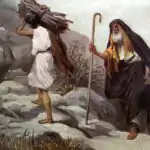
Abraham and Lot were family. They traveled together and had many animals and servants. One day, their workers began to quarrel because there was not enough space for all their animals.
Instead of fighting, Abraham told Lot to choose any land he wanted. Lot chose the greener land, and Abraham went the other way. This made peace between them.
Isaac and Abimelech
Isaac became very rich, and the Philistines were jealous. They stopped his wells with sand. Isaac moved away and dug new wells. Each time there was a fight over the water, Isaac moved again without fighting.
Later, Abimelech saw that God was with Isaac and made peace with him.
Lessons from the Stories
These Bible stories show that:
- We should not fight when there is a problem
- Choosing peace brings blessings
- Forgiving others helps us live in peace
- God loves people who live peacefully with others
Teaching Methods
To deliver this lesson, the teacher will adopt the following methods: Storytelling, Discussion, Explanation, Role Play, Visual Aids, Group Work
Instructional Procedures
To deliver this lesson, the teacher will adopt the following steps:
Step 1: Introduction
Time: 5 mins
Teaching Skill: Set Induction
Teacher’s Activity: Tells a short story of two children fighting over toys, then asks pupils what they would do to stop the fight. Links story to today’s topic.
Pupils’ Activity: Pupils listen and answer the teacher’s questions.
Learning Point: Introduction to peaceful coexistence.
Step 2: Abraham and Lot
Time: 8 mins
Teaching Skill: Storytelling
Teacher’s Activity: Reads Genesis 13:1–12, explains the story using illustrations, and highlights how Abraham chose peace.
Pupils’ Activity: Pupils listen, observe illustrations, and discuss Abraham’s action.
Learning Point: Learns the importance of avoiding quarrels.
Step 3: Isaac and Abimelech
Time: 8 mins
Teaching Skill: Explanation
Teacher’s Activity: Reads Genesis 26:2–29 aloud, explains how Isaac avoided conflict and made peace.
Pupils’ Activity: Pupils listen and respond to questions.
Learning Point: Understands how peace can be chosen repeatedly.
Step 4: Philemon and Onesimus
Time: 5 mins
Teaching Skill: Discussion
Teacher’s Activity: Narrates story of Onesimus and Paul’s letter. Explains the lesson of forgiveness and peace.
Pupils’ Activity: Pupils discuss what they would do in Philemon’s place.
Learning Point: Learns to forgive and welcome others.
Step 5: Note Taking
Time: 4 mins
Teaching Skill: Writing
Teacher’s Activity: Dictates or displays summary notes of the three stories and their lessons.
Pupils’ Activity: Pupils write the notes into their books.
Learning Point: Records key ideas from the lesson.
Step 6: Evaluation
Time: 5 mins
Teaching Skill: Assessment
Teacher’s Activity: Asks oral questions based on the stories and memory verse.
Pupils’ Activity: Pupils respond to the teacher’s questions.
Learning Point: Assesses pupils’ understanding of peaceful living.
Step 7: Conclusion
Time: 5 mins
Teaching Skill: Instructional, Social
Teacher’s Activity: Reviews the main stories, encourages pupils to live peacefully, and leads a short prayer.
Pupils’ Activity: Pupils repeat memory verse and share one way they will live in peace.
Learning Point: Reinforces lesson and promotes peaceful behavior.
Home Task: Write three lessons learned about Biblical Example Of Peaceful Coexistence: Abraham And Lot and one suitable way to apply the teaching responsibly.
Lesson Keywords
- Peace – Living without fighting or quarrelling
- Quarrel – A fight or disagreement
- Forgive – To stop being angry with someone who did wrong
- Coexistence – Living together peacefully
- Blessed – Made happy or favored by God
Lesson Evaluation
To evaluate the learning, the teacher asks pupils to:
- Who were Abraham and Lot?
- What did Abraham do to avoid fighting?
- What did Isaac do when people fought over his wells?
- Who was Onesimus, and what did Paul tell Philemon?
- Recite the memory verse.
- Mention two things you have learnt from today’s lesson.
Differentiation
The teacher will simplify vocabulary, use pictures and Bible storytelling, and pair slow learners with peers for group activities.
Note for teachers using this lesson plan
Use clear Bible-based illustrations, maintain an engaging pace, and encourage every child to express how they can choose peace in school and at home.


Community Join the conversation Open discussion +