

Class: Primary 3
Term: First Term
Week: 7
Age: 8 years
Duration: 45 minutes
Subject: Christian Religion Studies
Curriculum Theme: Christian Religion Studies
Previous Lesson: The Promise of the Comforter.
Topic: The Coming of the Holy Spirit
Subject Matter: Acts 2:1 – 14, Mark 16:17
Specific Objectives
By the end of the lesson, pupils should be able to:
Cognitive Domain:
- Describe how the Holy Spirit came upon the disciples in the upper room.
- Explain what speaking in tongues means as an evidence of the Holy Spirit.
- State that the Holy Spirit gives power to Christians.
Affective Domain:
- Appreciate the presence and power of the Holy Spirit in the lives of believers.
- Believe in Jesus Christ as a result of the Holy Spirit’s work.
Psychomotor Domain:
- Read the scriptures related to the coming of the Holy Spirit (Acts 2:1-14, Mark 16:17).
- Participate actively in class discussions about the Holy Spirit.
Social Domain:
- Share their understanding of the Holy Spirit’s coming with their peers.
Reference Materials
The following resources were used in planning this lesson:
- 9 Years Basic Education Curriculum for Christian Religious Studies.
- State Unified Scheme of Work for Primary 3.
- Christian Religious Studies for Primary 3, A New Approach.
- The Holy Bible (King James Version).
Instructional Materials
The teacher will teach this lesson with the aid of:
- A copy of the Holy Bible.
- Pictures depicting the event of Pentecost.
- A chart showing key points about the Holy Spirit.
Rationale for the Lesson
This lesson helps pupils understand the significant event of the Holy Spirit’s arrival, which empowered the early Christians. It enables them to grasp the importance of the Holy Spirit in their Christian lives and how it grants believers spiritual power.
Prerequisite/Previous Knowledge
Pupils are familiar with the life of Jesus Christ, His ascension into heaven, and His promise to send a Helper, the Holy Spirit.
Lesson Content/Board Summary
The Coming of the Holy Spirit
Introduction to the Holy Spirit’s Coming
After Jesus ascended into heaven, He promised His disciples that He would send the Holy Spirit to be their Helper. This promise was fulfilled on the day of Pentecost.
Memory Verse
Acts 2:4 – “And they were all filled with the Holy Ghost, and began to speak with other tongues, as the Spirit gave them utterance.”
Bible Reading
- Acts 2:1-14
- Mark 16:17
The Event of Pentecost (Acts 2:1-14)
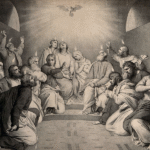
On the day of Pentecost, the disciples were gathered together in one place. Suddenly, there came a sound from heaven like a rushing mighty wind, and it filled the whole house where they were sitting. Then there appeared to them cloven tongues like as of fire, and it sat upon each of them. They were all filled with the Holy Spirit and began to speak in other languages as the Spirit enabled them. Many people from different nations heard them speaking in their own native languages and were amazed.
Speaking in Tongues
Speaking in tongues is a spiritual gift and an evidence of having the Holy Spirit. It shows that a person believes in Jesus Christ and has received His Spirit. The disciples spoke in languages they had not learned, allowing people from various countries to understand the message of God.
The Power of the Holy Spirit (Mark 16:17)
The Holy Spirit gives power to Christians. This power enables believers to:
- Preach the gospel boldly.
- Perform miracles and heal the sick.
- Cast out demons.
- Live a holy life.
- Understand God’s word.
Teaching Methods/Instructional Techniques
Discussion, Lecture, Demonstration, Question and Answer, Visual Aids
Instructional Procedures
The Coming of the Holy Spirit
Step 1: Introduction
Time: 5 minutes
Teaching Skill: Set Induction
Teacher’s Activity: The teacher greets the pupils and reminds them about Jesus’ promise to send a Helper after His ascension. The teacher then introduces the topic: “The Coming of the Holy Spirit.”
Pupils’ Activity: Pupils greet the teacher and recall the previous lesson about Jesus’ promise. They listen attentively to the new topic.
Learning Point: Pupils are prepared for the day’s lesson and connect it to previous knowledge.
Step 2: Explanation of the Coming of the Holy Spirit
Time: 10 minutes
Teaching Skill: Narration/Explanation
Teacher’s Activity: The teacher narrates the event of the Holy Spirit’s coming as described in Acts 2:1-4, using pictures to illustrate the sound like a rushing wind and the tongues of fire.
Pupils’ Activity: Pupils listen to the narration and observe the pictures, asking questions for clarification.
Learning Point: Pupils understand the sequence of events during the coming of the Holy Spirit.
Step 3: Bible Reading
Time: 5 minutes
Teaching Skill: Reading/Observation
Teacher’s Activity: The teacher asks pupils to open their Bibles to Acts 2:1-14 and Mark 16:17 and leads them in reading the passages aloud.
Pupils’ Activity: Pupils open their Bibles and read the assigned scriptures.
Learning Point: Pupils practice reading the Bible and confirm the biblical account of the Holy Spirit’s coming and power.
Step 4: Discussion on Speaking in Tongues
Time: 7 minutes
Teaching Skill: Discussion/Explanation
Teacher’s Activity: The teacher explains what speaking in tongues means, emphasizing that it is an evidence of having the Holy Spirit and a sign of belief in Jesus Christ.
Pupils’ Activity: Pupils listen to the explanation and contribute to the discussion by sharing their understanding.
Learning Point: Pupils understand that speaking in tongues is a manifestation of the Holy Spirit.
Step 5: The Power of the Holy Spirit
Time: 5 minutes
Teaching Skill: Elucidation
Teacher’s Activity: The teacher explains how the Holy Spirit gives power to Christians, using examples from the Bible and daily life.
Pupils’ Activity: Pupils listen and identify ways the Holy Spirit empowers Christians.
Learning Point: Pupils recognize that the Holy Spirit provides power for Christian living and service.
Step 6: Memory Verse Recitation
Time: 3 minutes
Teaching Skill: Memorization
Teacher’s Activity: The teacher writes Acts 2:4 on the board and leads the pupils in reciting it several times until they can say it by heart.
Pupils’ Activity: Pupils copy the memory verse and recite it with the teacher.
Learning Point: Pupils memorize a key scripture related to the lesson.
Step 7: Evaluation/Review
Time: 5 minutes
Teaching Skill: Questioning/Assessment
Teacher’s Activity: The teacher evaluates the learning by asking the following questions:
- Describe how the Holy Spirit came upon the disciples.
- What is one evidence of having the Holy Spirit?
- Mention two ways the Holy Spirit gives power to Christians.
Pupils’ Activity: Pupils answer orally and in writing.
Learning Point: Pupils demonstrate understanding of the lesson.
Step 8: Conclusion
Time: 5 minutes
Teaching Skill: Summarization/Assignment
Teacher’s Activity: The teacher summarizes the lesson, reiterating the importance of the Holy Spirit in a Christian’s life. The teacher then gives an assignment: “Draw a picture showing the disciples receiving the Holy Spirit.”
Pupils’ Activity: Pupils listen to the summary and copy the assignment.
Learning Point: Pupils consolidate their learning and are given a task to reinforce understanding.
Home Task: Write three lessons learned about The Coming of the Holy Spirit and one suitable way to apply the teaching responsibly.
Lesson Keywords
- Holy Spirit – The third person of the Trinity, God’s power and presence on earth.
- Pentecost – The day the Holy Spirit descended upon the apostles and other followers of Jesus Christ.
- Tongues – Different languages spoken by the disciples under the influence of the Holy Spirit.
- Disciples – The followers of Jesus Christ.
- Power – The ability given by the Holy Spirit to Christians to do God’s will.
- Evidence – A sign or proof that something is true, like speaking in tongues for the Holy Spirit.
Differentiation
For pupils who grasp concepts quickly, the teacher can encourage them to find other Bible verses that talk about the Holy Spirit’s work. For those who need more support, the teacher will provide simplified explanations and guide them in reading the scriptures, focusing on key words and phrases.
Note for teachers using this lesson plan
Ensure that the narration of the Pentecost event is vivid and engaging for primary school pupils. Encourage active participation and questions. Emphasize that the Holy Spirit is still at work today, empowering believers.


Community Join the conversation Open discussion +