

Class: Primary Two
Term: second Term
subject: Pre-vocational Studies
Curriculum Theme: Agricultural science
Previous Lesson:
Topic: Uses of Plants
Content/Learning Area: What are the uses of plants?, Plants Used for Food:, Plants Used for Medicine:
Time Allocation: 40 minutes
Performance Objectives
By the end of the lesson, pupils should be able to:
- Cognitive Domain:
1. Identify various uses of plants.
2. List examples of plants used for food and medicine.
3. Explain the importance of plants to humans.
- Affective Domain:
1. Show gratitude for the importance of plants.
2. Develop a sense of obligation towards plant conservation.
- Psychomotor Domain:
1. Participate actively in class discussions.
2. Complete the evaluation questions accurately.
- Social Domain:
1. Work collaboratively with peers during activities.
2. share ideas and knowledge respectfully.
Reference Materials
- 9 – Years Basic Education Curriculum
- Abuja Educational Resource Centre Scheme of Work
- NAPPS National Unified Scheme of Work
- Relevant Textbooks
Instructional Materials
To deliver this lesson, the teacher will employ the help of the following materials:
- Whiteboard or chart paper
- Markers or crayons
- Pictures or real examples of plants (if available)
Rationale for the Lesson
Understanding the uses of plants is crucial for appreciating their importance in our lives and environment. this lesson lays the foundation for future learning about plant biology, ecology, and lasting practices.
Prerequisite/Previous Knowledge
The teacher will start by asking pupils to name plants they see around their homes or school. This will spark their interest and connect the lesson to their everyday experiences. A brief review of the previous lesson on plant parts can also be included.
Lesson Content
What are the uses of plants?
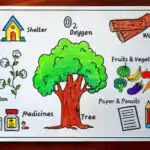
Plants are essential to human life and the environment, serving various purposes. These include:
The following are some of the uses of plants:
- Food: Plants provide us with many foods like fruits,vegetables,grains,and roots.
- Medicine: Some plants have healing properties and are used to make medicines.
- Oxygen Production: Plants produce the oxygen we breathe.
- Shade and Shelter: Trees offer shade and materials for building.
- Decoration: Plants beautify our homes and surroundings.
- Clothing: Plants like cotton provide fibers for making clothes.
- Fuel: Wood from trees is used as fuel for cooking and heating.
Plants Used for Food:
Plants are a primary source of food for humans, providing essential nutrients and energy.
Examples are:
- Apple Tree: We eat the apples that grow on apple trees.
- Carrot Plant: We eat the orange root of the carrot plant.
- Rice Plant: We eat the seeds of the rice plant, processed into rice.
- Yam Plant: We eat the tubers of the yam plant, which are rich in carbohydrates.
- Maize Plant: We eat the kernels of the maize plant,either fresh or processed into various products.
- Orange Tree: We eat the juicy fruits of the orange tree, which are rich in Vitamin C.
Plants Used for medicine:
Many plants possess medicinal properties and have been used for centuries to treat various ailments.
These include:
- Aloe Vera Plant: Aloe vera’s gel soothes burns and skin problems.
- Peppermint Plant: peppermint is used in medicine for stomach issues and headaches.
- Eucalyptus Tree: Eucalyptus leaves help with respiratory problems.
- Ginger Plant: Ginger is used to relieve nausea and reduce inflammation.
- Neem Tree: Neem leaves have antiseptic properties and are used to treat skin infections.
- Garlic Plant: Garlic is known for it’s antibacterial and antiviral properties.
Teaching Methods
To deliver this lesson, the teacher will adopt the following methods: Discussion, Question and answer, Visual aids
Instructional Procedures
To deliver this lesson, the teacher will adopt the following steps:
Step 1: Introduction
Time: 5 minutes
Teaching Skill: Set Induction
Teacher’s activity: Ask pupils to name plants they know and initiate a discussion about plants.
Pupils’ Activity: Respond to the teacher’s questions and participate in the discussion.
Step 2: Clarification of Key Concepts
Time: 10 minutes
Teaching Skill: Explanation
Teacher’s Activity: Explain the various uses of plants, using visual aids if available.
Pupils’ Activity: Listen attentively and ask clarifying questions.
Step 3: Presentation/Guided Practice
Time: 10 minutes
Teaching Skill: Guided Practice
Teacher’s Activity: Provide examples of plants used for food and medicine, guiding pupils to identify them.Pupils’ Activity: Participate in identifying plants and their uses.
Step 4: Independent Practice
Time: 5 minutes
Teaching Skill: Independent Practice
Teacher’s Activity: Ask pupils to answer the evaluation questions individually.
Pupils’ Activity: Answer the evaluation questions independently.
Step 5: Note-Taking
Time: 5 minutes
Teaching Skill: Note-Taking
Teacher’s Activity: Guide pupils in summarizing key points of the lesson.
Pupils’ Activity: Take notes on the key points of the lesson.
Step 6: Evaluation/Review
Time: 5 minutes
Teaching Skill: Review
Teacher’s Activity: Review the answers to the evaluation questions with the class.
Pupils’ Activity: Participate in the review and clarify any doubts.
Objective-aligned checks:
- Identify various uses of plants.
- List examples of plants used for food and medicine.
- Explain the importance of plants to humans.
Step 7: Conclusion
Time: 5 minutes
Teaching Skill: Summarizing
Teacher’s Activity: Summarize the key points about the uses of plants and emphasize their importance in our lives.Encourage pupils to continue learning about plants and their environment.
Pupils’ Activity: Listen to the summary and ask any remaining questions.
lesson Keywords
- Food – Plants provide essential nutrients and energy.
- Medicine – Plants have healing properties.
- Oxygen – plants produce the air we breathe.
- Shelter – Plants provide materials for building.
- Decoration – Plants beautify our surroundings.
Lesson Evaluation
To evaluate the learning,the teacher asks pupils to:
- Name two plants you see in your neighborhood.
- List two plants used for food and one used for medicine.
- What are some other ways plants are useful to us?
Assignment/Homework
- List five plants found in your home or school environment.
- Research and write down one medicinal use of each plant listed.
- Draw and label three plants that provide food.
Differentiation
- For slower learners: Provide one-on-one assistance and use simpler language.
- For advanced learners: Encourage them to research additional examples of plants and their uses.
- For visual/auditory/kinesthetic learners: Use visual aids, songs, and hands-on activities to reinforce learning.
Note for Teachers
Ensure to bring real plant samples or pictures to make the lesson more engaging. Encourage pupils to share their personal experiences with plants to foster a deeper connection with the topic.

Community Join the conversation Open discussion +