

Class: Primary 4
Term: 2nd Term
Subject: pre-Vocational Studies
Curriculum Theme: Home Economics
Previous Lesson: Reasons For Laundering Personal Clothes
Topic: Ways Of Mending Clothes
Content/Learning Area: Darning and Patching
Time Allocation: 40 minutes
Performance Objectives
By the end of the lesson, pupils should be able to:
- Cognitive Domain: Define mending and explain darning and patching.
- Affective Domain: appreciate the importance of taking care of clothes.
- Psychomotor Domain: Demonstrate how to mend a small tear in fabric using darning or patching.
- Social Domain: Work collaboratively to share ideas on mending techniques.
Reference materials
The following resources were used in planning this lesson:
- 9 – Years Basic Education Curriculum, abuja Educational Resource Center
- Scheme of Work, NAPPS National Unified Scheme of Work
- Online information from weallsew – Three Ways of Mending
- Relevant Textbooks
Instructional Materials
To deliver this lesson, the teacher will use the following materials:
- Needle and thread
- A small piece of torn fabric
- Fabric patches
- Sample mended clothes
- Visual aids (diagrams of darning and patching)
Rationale for the Lesson
This lesson helps pupils understand the importance of repairing clothes to save money, reduce waste, and maintain personal neatness. These skills promote self-reliance and duty.
Prerequisite/Previous Knowledge
Pupils have prior knowledge of why it is important to wash and care for their personal clothes.
Lesson Content
Ways of Mending Clothes
Mending is the act of repairing torn or damaged clothes to make them usable again. This means that we can fix small tears or holes by sewing them up.
Darning and patching are two common methods of mending clothes. They are:
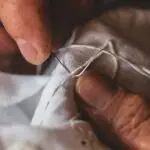
- Darning: This involves sewing over a tear or hole with a needle and thread to cover it.
It is useful for small holes, especially in socks or sweaters. Darning can also be used to reinforce weak areas in fabric to prevent tears.
Different darning techniques can create decorative patterns on the fabric.
- Patching: This involves attaching a piece of fabric (a patch) over a hole or tear.
It is great for large tears and gives the fabric extra strength.
Patches can be made from similar or contrasting fabrics to add style.
Iron-on patches are a quick and easy alternative to sewing.
Teaching Methods
To deliver this lesson, the teacher will adopt the following methods: Interactive Discussion, Presentation, Lecture, Questioning, Hands-on Activity, Collaborative Learning.
Instructional Procedures
To deliver this lesson, the teacher will adopt the following steps:
Step 1: Introduction (Set Induction)
time: 5 minutes
Teaching Skill: Set Induction
teacher’s Activity: Ask pupils questions about what they do when their clothes tear.Pupils’ Activity: Respond to questions with personal experiences.
Step 2: Description of Mending
Time: 10 minutes
Teaching Skill: Explanation
Teacher’s Activity: Explain mending as repairing torn clothes.Demonstrate darning and patching with materials.
Pupils’ Activity: Watch attentively and ask questions.
Step 3: guided Practice
Time: 10 minutes
Teaching Skill: Guided Practice
Teacher’s Activity: Guide pupils to practice darning and patching on torn fabric.
Pupils’ Activity: follow teacher’s instructions to mend fabrics.
Step 4: Class Discussion
Time: 5 minutes
Teaching Skill: Discussion
Teacher’s Activity: Facilitate a discussion on the importance of mending clothes.
Pupils’ Activity: Share opinions on why mending clothes is useful.
Step 5: Note-Taking
Time: 5 minutes
Teaching Skill: Explanation
Teacher’s Activity: Dictate a short note on mending clothes for pupils to copy.
Pupils’ Activity: Copy the note in their books.
Step 6: Evaluation/Review
Time: 3 minutes
Teaching Skill: Questioning
Teacher’s Activity: ask pupils questions to check understanding of mending clothes.
Pupils’ Activity: Answer the teacher’s questions.
Objective-aligned checks:
- Define mending and explain darning and patching.
- Demonstrate how to mend a small tear in fabric using darning or patching.
step 7: Conclusion
Time: 2 minutes
Teaching Skill: Recap
Teacher’s Activity: Summarize the key points of the lesson.
Pupils’ Activity: Listen attentively and ask follow-up questions.
Lesson Keywords
- Mending – Repairing torn or damaged clothes.
- Darning – Sewing over a tear or hole with thread.
- Patching – Attaching a piece of fabric over a hole or tear.
- Fabric – Material made by weaving or knitting fibers.
- Needle – A small, slender tool with a pointed end and an eye for thread.
Lesson Evaluation
To evaluate the learning, the teacher asks pupils to:
- Define mending and name two ways to mend clothes.
- explain the difference between darning and patching.
- Describe one situation where they would use darning.
- List two reasons why it is important to mend clothes.
- demonstrate how to patch a torn fabric.
Assignment/Homework
- Find a piece of clothing at home with a small tear or hole.
- Describe whether you would use darning or patching to mend it and why.
- With the help of an adult, try to mend the clothing using the chosen method.
- Write a short paragraph explaining the process and what you learned.
Differentiation
- For slower learners: Provide pre-cut fabric patches and simplified instructions with visual aids.
- For advanced learners: Encourage them to explore different stitching techniques for darning and patching, and to create decorative mends.
- For visual/auditory/kinesthetic learners: use diagrams and videos to demonstrate mending techniques, provide verbal instructions, and allow hands-on practice with different materials.
Note for Teachers
Demonstrating the skills yourself will make it easier for pupils to understand. Allow time for pupils to practice and guide them patiently. Be sure to encourage their efforts. Happy teaching!


Community Join the conversation Open discussion +