

Class: Senior Secondary School 1 (SS1, SS 1, SSS1, SSS 1)
Term: 2nd Term
Week: 8
Age: 15 years
Duration: 45 minutes
Subject: Visual Art
Curriculum Theme: Visual Art
Previous Lesson: Life Drawing: Human Figure Proportion, Composition and Tonality.
Topic: Landscape Drawing
Subject Matter: Meaning of landscape drawing, outdoor scenery drawing, showing space in landscape, composition in landscape, perspective in landscape, foreground, middle ground, background
Specific Objectives
By the end of the lesson, pupils should be able to:
Cognitive Domain:
- Define landscape drawing.
- List examples of features found in an outdoor landscape scene.
- Explain foreground, middle ground, and background in landscape drawing.
- State ways of showing space in a landscape drawing.
- Explain simple perspective rules used in landscape drawing.
Affective Domain:
- Show interest in observing outdoor scenery before drawing.
- Appreciate neat and balanced landscape drawings.
- Demonstrate care for the environment during outdoor drawing activities.
Psychomotor Domain:
- Sketch an outdoor scenery showing foreground, middle ground, and background.
- Apply simple perspective to show distance in a landscape.
- Arrange landscape features on paper using good composition.
Social Domain:
- Work in groups during outdoor observation and drawing.
- Share drawing materials responsibly and keep the area tidy.
- Discuss observed scenery features and give feedback politely.
Reference Materials
The following resources were used in planning this lesson:
- 9 Years Basic Education Curriculum
- State Unified Scheme of Work
- Recommended textbook on Fine Art/Visual Art for Senior Secondary Schools
- Encyclopaedia Britannica: Landscape
- The Met: Landscape Painting
- Tate: Landscape
Instructional Materials
The teacher will teach this lesson with the aid of:
- Outdoor landscape scene within the school environment (trees, buildings, paths, fences, sky)
- Pencils, erasers, sharpeners
- Drawing paper or sketch pads
- Cardboard or drawing board as support
- Ruler (optional for checking horizon line)
- Sample landscape sketches or pictures (optional)
Rationale for the Lesson
This lesson helps pupils draw their environment by observing outdoor scenes and arranging them on paper. It also builds skill in showing distance and space, which is useful for art practicals and design work.
Prerequisite/Previous Knowledge
Pupils have learnt basic drawing skills, shading techniques, and drawing from observation.
Lesson Content/Board Summary
LANDSCAPE DRAWING
Meaning of Landscape Drawing
Landscape drawing is the drawing of outdoor scenery such as land, trees, buildings, roads, and the sky as seen in the environment.
Outdoor Scenery Features
The following are common features found in an outdoor landscape scene:
- Land surfaces (ground, hills, paths)
- Trees, shrubs, and grasses
- Buildings, fences, poles, and bridges
- Roads and footpaths
- Sky, clouds, and sunlight
- Water bodies where available (river, pond)
Foreground, Middle Ground, and Background
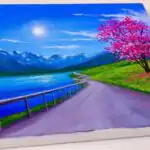
Foreground is the part of the scene closest to the viewer, middle ground is the area between the foreground and background, and background is the farthest part of the scene.
The following are features of the three areas:
- Foreground: bigger objects, sharper details, stronger lines and tones
- Middle ground: medium sizes, moderate details, balanced tones
- Background: small objects, fewer details, lighter tones
Composition in Landscape Drawing
Composition is the arrangement of landscape features on paper to make the drawing balanced and clear.
The following are guidelines for good composition in landscape drawing:
- Select a clear centre of interest (main focus).
- Place the horizon line correctly (not too high or too low).
- Balance objects on both sides of the drawing.
- Use overlapping to show depth.
- Avoid overcrowding one part of the page.
Showing Space in Landscape Drawing
The following are ways of showing space and distance in a landscape drawing:
- Make near objects larger and far objects smaller.
- Use overlapping of objects to show depth.
- Reduce details as objects move farther away.
- Use lighter tones for distant objects and darker tones for nearer objects.
- Use lines that lead into the distance (paths, roads, fences).
Perspective in Landscape Drawing
Perspective is the method of showing depth by making objects appear smaller and closer together as they move into the distance.
The following are simple perspective rules used in landscape drawing:
- Parallel lines appear to meet at a vanishing point on the horizon.
- Objects become smaller as they get farther away.
- Spacing between objects reduces with distance.
- Roads, paths, and fences narrow as they go into the distance.
Teaching Methods/Instructional Techniques
Discussion, Lecture, Demonstration, Question and Answer, Visual Aids
Instructional Procedures
Step 1: Introduction
Time: 5 minutes
Teaching Skill: Set Induction
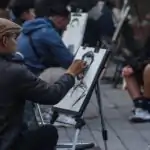
Teacher’s Activity: The teacher takes pupils to a safe outdoor spot or shows a picture of a landscape and asks pupils to mention what they can see in the scenery, then introduces landscape drawing.
Pupils’ Activity: Pupils observe and mention features such as trees, buildings, roads, sky, and fences.
Learning Point: Landscape drawing is based on observing outdoor scenery.
Step 2: Meaning and Features of Landscape Scenery
Time: 6 minutes
Teaching Skill: Explanation
Teacher’s Activity: The teacher defines landscape drawing and lists common scenery features, guiding pupils to identify them in the environment.
Pupils’ Activity: Pupils copy notes and point out features seen in the selected outdoor scene.
Learning Point: Outdoor scenery contains natural and man-made features used in landscape drawing.
Step 3: Foreground, Middle Ground, and Background
Time: 7 minutes
Teaching Skill: Explanation
Teacher’s Activity: The teacher explains the three areas and uses the environment to show which objects fall into each area.
Pupils’ Activity: Pupils identify objects in the foreground, middle ground, and background of the scene.
Learning Point: Landscape space is organised into foreground, middle ground, and background.
Step 4: Composition in Landscape Drawing
Time: 6 minutes
Teaching Skill: Demonstration
Teacher’s Activity: The teacher demonstrates placing a horizon line, selecting a centre of interest, and arranging major objects lightly on the page.
Pupils’ Activity: Pupils draw a light horizon line and block in major objects in correct positions.
Learning Point: Good composition makes the landscape balanced and clear.
Step 5: Showing Space and Perspective
Time: 7 minutes
Teaching Skill: Demonstration
Teacher’s Activity: The teacher demonstrates making near objects bigger, far objects smaller, using overlap, and drawing lines that narrow into the distance to show perspective.
Pupils’ Activity: Pupils apply the methods by drawing a path or fence line that narrows into the distance and adjusting object sizes.
Learning Point: Space and distance are shown using size change, overlap, and perspective lines.
Step 6: Outdoor Practical Drawing
Time: 9 minutes
Teaching Skill: Guided Practice/Supervision
Teacher’s Activity: The teacher supervises pupils as they complete a simple landscape sketch, guiding them to reduce details in the background and improve balance and neatness.
Pupils’ Activity: Pupils complete their landscape drawings, showing foreground, middle ground, background, and simple perspective.
Learning Point: A good landscape sketch shows correct space arrangement and perspective.
Step 7: Evaluation/Review
Time: 5 minutes
Teaching Skill: Questioning/Assessment
Teacher’s Activity: The teacher evaluates the learning by asking the following questions:
- Define landscape drawing.
- List five features found in an outdoor landscape scene.
- Explain foreground, middle ground, and background.
- State four ways of showing space in landscape drawing.
Pupils’ Activity: Pupils answer orally and in writing.
Learning Point: Pupils demonstrate understanding of the lesson.
Step 8: Conclusion
Time: 5 minutes
Teaching Skill: Summary
Teacher’s Activity: The teacher summarizes the lesson, checks a few drawings, corrects mistakes, and gives an assignment to draw a simple landscape of the home area showing foreground, middle ground, and background.
Pupils’ Activity: Pupils submit classwork for checking and write the assignment.
Learning Point: Landscape drawing shows outdoor scenery using composition, space, and perspective.
Lesson Keywords
- Landscape – Outdoor scenery such as land, trees, buildings, and sky.
- Horizon Line – The level where the sky seems to meet the land in a landscape.
- Foreground – The nearest part of a landscape scene.
- Middle Ground – The area between the foreground and background.
- Background – The farthest part of a landscape scene.
- Perspective – Method of showing depth by making far objects appear smaller.
- Composition – Arrangement of features to make the drawing balanced.
Differentiation
Pupils who learn faster will include more landscape details and show a clear vanishing point with strong perspective lines, while pupils who need support will draw fewer major objects and focus on correct placement of foreground, middle ground, and background.
Note for teachers using this lesson plan
Select a safe outdoor location and ensure pupils remain within supervision. Encourage pupils to start with light outlines, place the horizon line early, and use simple perspective and size reduction to show distance clearly.


Community Join the conversation Open discussion +