

Class: Senior Secondary School 1 (SS1, SS 1, SSS1, SSS 1)
Term: 3rd Term
Week: 1
Age: 15 years
Duration: 45 minutes
Subject: Visual Art
Curriculum Theme: Visual Art
Previous Lesson: .
Topic: ART TERMINOLOGIES
Subject Matter: Three Dimensional Art Terminologies (Terracotta, Sculpture in the Round, Greenware, Leather Hard, Relief)
Specific Objectives
By the end of the lesson, pupils should be able to:
Cognitive Domain:
- Define Terracotta, Sculpture in the Round, Greenware, Leather Hard, and Relief.
- Explain the characteristics of each terminology.
- Identify examples of artworks related to these terms.
Affective Domain:
- Appreciate the importance of correct terminology in Visual Art.
- Show interest in learning and discussing art terms.
Psychomotor Domain:
- Discuss the meanings of the terminologies accurately.
- Differentiate between the various stages of clay work.
Social Domain:
- Participate actively in class discussions about art terminologies.
- Collaborate with peers to understand complex terms.
Reference Materials
The following resources were used in planning this lesson:
- 9 Years Basic Education Curriculum for Visual Arts (Senior Secondary Education).
- State Unified Scheme of Work for Visual Arts SSS 1.
- Creative Arts for Senior Secondary Schools 1 by J.B. Adebayo and F.O. Olubunmi.
- https://en.wikipedia.org/wiki/Terracotta
- https://www.theartstory.org/definition/sculpture-in-the-round/
Instructional Materials
The teacher will teach this lesson with the aid of:
- Art review materials.
- Art essay charts.
- Images or actual examples of three-dimensional artworks (e.g., terracotta pot, relief carving).
Rationale for the Lesson
This lesson helps pupils to understand the correct vocabulary used in three-dimensional art. Knowing these terms enables pupils to describe and discuss artworks accurately, which is important for their studies and appreciation of art.
Prerequisite/Previous Knowledge
Pupils have a basic understanding of art forms and may have encountered some art terms in previous classes.
Lesson Content/Board Summary
ART TERMINOLOGIES IN THREE-DIMENSIONAL ART
Terracotta
Terracotta refers to a type of earthenware, a clay-based unglazed or glazed ceramic, where the fired body is porous. It is commonly used for sculpture and decorative purposes, as well as in building construction.
Sculpture in the Round
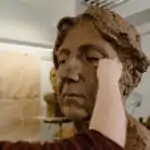
Sculpture in the round is a type of sculpture that is completely detached from its background and is meant to be viewed from all sides. It stands freely and can be walked around, allowing the viewer to experience it from multiple perspectives.
Greenware
Greenware is the term for unfired pottery. At this stage, the clay object is very fragile and can be easily damaged. It has not yet undergone firing in a kiln.
Leather Hard
Leather hard describes a stage in the drying of clay when it has lost some moisture but is still damp enough to be carved, trimmed, or joined to other pieces. The clay is firm but not completely dry, resembling the consistency of leather.
Relief
Relief is a sculptural technique where the sculpted elements remain attached to a solid background of the same material. It gives the impression that the sculpted material has been raised above the background plane.
The following are types of relief sculpture:
- Bas-relief (low relief): The projection from the background is slight.
- High relief: More than half of the sculpted form projects from the background.
- Sunken relief: The image is carved below the surface of the background.
Teaching Methods/Instructional Techniques
Discussion, Lecture, Demonstration, Question and Answer, Visual Aids
Instructional Procedures
Step 1: Introduction
Time: 5 minutes
Teaching Skill: Set Induction
Teacher’s Activity: The teacher greets the pupils and reviews the previous lesson briefly. The teacher then asks pupils what they understand by “art terms” or “vocabulary in art.” The teacher introduces the topic, “ART TERMINOLOGIES IN THREE-DIMENSIONAL ART.”
Pupils’ Activity: Pupils respond to the teacher’s questions and listen attentively to the introduction.
Learning Point: Pupils recall previous knowledge and are introduced to the new topic.
Step 2: Explanation of Terracotta
Time: 7 minutes
Teaching Skill: Explanation/Demonstration
Teacher’s Activity: The teacher defines Terracotta, explaining its origin and common uses in art and construction. The teacher shows images or a sample of a terracotta object.
Pupils’ Activity: Pupils listen, observe the visuals, and ask questions for clarification.
Learning Point: Pupils understand the meaning and application of Terracotta.
Step 3: Explanation of Sculpture in the Round
Time: 7 minutes
Teaching Skill: Explanation/Illustration
Teacher’s Activity: The teacher defines Sculpture in the Round, emphasizing that it is free-standing and can be viewed from all angles. The teacher uses examples from art history or images to illustrate this concept.
Pupils’ Activity: Pupils listen and contribute by mentioning any sculptures they know that fit this description.
Learning Point: Pupils grasp the concept of Sculpture in the Round as a three-dimensional art form.
Step 4: Explanation of Greenware
Time: 5 minutes
Teaching Skill: Explanation
Teacher’s Activity: The teacher explains Greenware as the unfired state of a clay object, highlighting its fragility. The teacher may compare it to raw dough before baking.
Pupils’ Activity: Pupils listen and understand the characteristics of Greenware.
Learning Point: Pupils identify Greenware as an important stage in ceramic production.
Step 5: Explanation of Leather Hard
Time: 5 minutes
Teaching Skill: Explanation/Comparison
Teacher’s Activity: The teacher defines Leather Hard, contrasting it with Greenware. The teacher explains that at this stage, the clay is firm enough for carving but still workable, likening it to the texture of leather.
Pupils’ Activity: Pupils listen and note the differences between Greenware and Leather Hard stages.
Learning Point: Pupils understand another critical stage in working with clay.
Step 6: Explanation of Relief
Time: 8 minutes
Teaching Skill: Explanation/Classification
Teacher’s Activity: The teacher defines Relief sculpture, explaining that it is attached to a background. The teacher then explains and illustrates the different types of relief: bas-relief, high relief, and sunken relief, using visual aids.
Pupils’ Activity: Pupils listen, observe the examples, and differentiate between the types of relief.
Learning Point: Pupils learn about Relief sculpture and its variations.
Step 7: Evaluation/Review
Time: 5 minutes
Teaching Skill: Questioning/Assessment
Teacher’s Activity: The teacher evaluates the learning by asking the following questions:
- Define the term “Terracotta.”
- Explain what is meant by “Sculpture in the Round.”
- Distinguish between “Greenware” and “Leather Hard” clay.
- Mention two types of “Relief” sculpture.
Pupils’ Activity: Pupils answer orally and in writing.
Learning Point: Pupils demonstrate understanding of the lesson.
Step 8: Conclusion
Time: 3 minutes
Teaching Skill: Summarization
Teacher’s Activity: The teacher summarizes the key terminologies discussed in the lesson and emphasizes their importance in understanding and discussing three-dimensional art. The teacher gives homework to research other art terminologies related to sculpture.
Pupils’ Activity: Pupils listen to the summary and copy down the homework.
Learning Point: Pupils consolidate their learning and are encouraged to continue exploring art terms.
Lesson Keywords
- Terracotta – A type of earthenware, a clay-based unglazed or glazed ceramic, often used for sculpture.
- Sculpture in the Round – A free-standing sculpture that can be viewed from all sides.
- Greenware – Unfired pottery that is very fragile.
- Leather Hard – A stage in clay drying where it is firm but still workable for carving or joining.
- Relief – A sculptural technique where elements remain attached to a solid background, projecting outwards.
Differentiation
For pupils who grasp concepts quickly, the teacher can challenge them to find historical examples of each terminology. For those who need more support, the teacher will provide simplified definitions and more visual aids, allowing them to work in pairs to discuss the terms.
Note for teachers using this lesson plan
Teachers should ensure they have adequate visual aids, either physical examples or clear images, for each terminology to aid understanding. Encourage pupils to actively participate and share their prior knowledge or observations. Focus on clear, concise definitions suitable for recall and application.


Community Join the conversation Open discussion +