

Class: Primary 4
Term: 3rd Term
Subject: Pre-Vocational Studies
Curriculum Theme: Agricultural Science
Previous Lesson: Types Of Tools, Carrying Tools
Topic: Gathering Tools And Their Uses
Content/Learning Area: Gathering tools: rake, garden-fork
Time Allocation: 40 minutes
Performance Objectives
By the end of the lesson, pupils should be able to:
- Cognitive Domain: Identify and name common gathering tools used on a farm.
- Affective Domain: Show interest and appreciation for the importance of gathering tools in agriculture.
- Psychomotor Domain: Demonstrate how to hold and use selected gathering tools properly.
- Social Domain: Participate in group discussions and cooperative activities involving gathering tools.
Reference Materials
The following resources were used in planning this lesson:
- 9 Years Basic Education Curriculum
- Abuja educational Resource Center Scheme of Work
- NAPPS National Unified Scheme of Work
- Online Data from: Wikipedia – Rake (tool)
- Relevant Textbooks
Instructional Materials
To deliver this lesson,the teacher will use the following materials:
- Real samples of rake,garden-fork,shovel,wheelbarrow
- Charts showing pictures of gathering tools
- Flashcards with tool names and pictures
- Whiteboard and marker
Rationale for the Lesson
understanding gathering tools helps pupils learn how farmers clean and prepare the farm for planting,making farm work easier and more organized.
prerequisite/Previous Knowledge
Pupils have seen or used basic tools like brooms and dustpans during house chores, and they know farms need cleaning and care.
Lesson Content
Gathering Tools and their Uses
Gathering tools are tools used on the farm to gather or collect things like leaves, dirt, or waste. Farmers use them to clean and keep the farm tidy.
Examples of Gathering Tools
The following are examples of gathering tools:
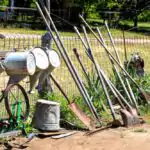
- rake
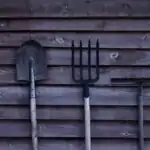
- Garden-fork
- Shovel
- Broom
- Wheelbarrow
Uses of Gathering Tools
The following are the uses of gathering tools:
- Rake is used to gather dry leaves or grasses
- Garden-fork is used to lift and move rubbish or hay
- Shovel is used to scoop and pack sand or dirt
- Broom is used to sweep the floor of the farm shed
- Wheelbarrow is used to carry waste or gathered items
Gathering Tools
A rake gathers leaves, cut grass and light debris and may level loose soil. A garden fork can gather or lift some plant material, while baskets, trays or wheelbarrows carry collected produce and waste.
Gathering differs from digging: the tool collects material already loose or harvested. Wear gloves where necessary, avoid sharp waste and do not burn gathered refuse without lawful adult control.
Teaching methods
To deliver this lesson, the teacher will adopt the following methods: Discussion,Description,Demonstration,Group Work,Visual Aids
Instructional Procedures
To deliver this lesson,the teacher will adopt the following steps:
Step 1: Introduction (Set Induction)
Time: 5 mins
Teaching Skill: Set Induction
Teacher’s Activity: Tells a story about a dirty farm and asks how to clean it,shows real tools
Pupils’ Activity: Listen to story,answer questions,observe the tools
Step 2: meaning of Gathering Tools
Time: 7 mins
Teaching Skill: Explanation
Teacher’s Activity: Explains what gathering tools are with flashcards
Pupils’ Activity: Listen attentively and ask questions
Step 3: Examples of Gathering Tools
Time: 8 mins
Teaching Skill: Visual Aids
Teacher’s activity: shows real tools and charts,names each tool one by one
Pupils’ Activity: Observe,repeat names of tools,ask and answer questions
Step 4: Uses of Gathering Tools
Time: 10 mins
Teaching Skill: demonstration
Teacher’s Activity: Demonstrates how each tool is used and what it is used for
Pupils’ Activity: Participate by mimicking tool usage and discussing in groups
Step 5: Note-Taking
Time: 3 mins
Teaching Skill: Writng skill
Teacher’s Activity: Dictates or writes notes on the board
Pupils’ Activity: Copy notes into notebooks
step 6: Evaluation/review
Time: 4 mins
Teaching Skill: Questioning
Teacher’s Activity: Asks pupils to mention tools and say their uses
Pupils’ Activity: Answer questions and demonstrate tool use where possible
Objective-aligned checks:
- Identify and name common gathering tools used on a farm.
- Demonstrate how to hold and use selected gathering tools properly.
Step 7: Conclusion
Time: 3 mins
Teaching Skill: Cognitive Closure
Teacher’s Activity: Summarizes lesson,encourages keeping tools clean,gives praise and feedback
Pupils’ Activity: Listen,clap,and respond to praise
Lesson Keywords
- Rake – A tool with teeth used to gather leaves
- Shovel – A tool for scooping sand or dirt
- Wheelbarrow – A small cart for carrying things
- Garden-fork – A tool with prongs for lifting waste
- broom – A sweeping tool used for cleaning
Lesson Evaluation
To evaluate the learning,the teacher asks pupils to:
- Mention three gathering tools they learned today
- Say one use of each gathering tool
- Match each tool to its picture
- demonstrate how to use a rake or broom
- Work in groups to identify tools shown on flashcards
Assignment/Homework
- Draw and label three gathering tools.
- Ask your parents about other tools used in the garden or farm and write them down.
- Explain why it is important to keep our gathering tools clean.
Differentiation
- For slower learners: Provide one-on-one assistance and repeat demonstrations. Use simplified explanations and focus on identifying just a few key tools.
- for advanced learners: Encourage them to research other types of gathering tools and their specific uses. Have them lead group discussions and assist their peers.
- For visual/auditory/kinesthetic learners: Use visual aids like charts and real tools. incorporate auditory learning through discussions and verbal explanations. Engage kinesthetic learners through hands-on activities and demonstrations.
Note for Teachers
Ensure all tools used are safe and child-amiable. Use simple words, and be patient during demonstrations to enhance understanding.

Community Join the conversation Open discussion +