

Class: Junior Secondary School 3 (JSS3, JSS 3)
Term: 1st Term
Week: 1
Age: 14 years
Duration: 45 minutes
Subject: Mathematics
Curriculum Theme: Mathematics
Previous Lesson:
Topic: Binary Numbers (part 1)
Subject Matter: Addition and subtraction of binary numbers, Multiplication and division of binary numbers
Specific Objectives
By the end of the lesson, pupils should be able to:
- Cognitive Domain:
(a) Add and subtract binary numbers correctly.
(b) Multiply and divide binary numbers accurately.
(c) Solve simple quantitative reasoning problems involving binary operations. - Affective Domain:
(a) Show interest and enthusiasm in performing binary number operations. - Psychomotor Domain:
(a) Demonstrate skills in calculating binary numbers using examples and exercises. - Social Domain:
(a) Work cooperatively with peers to solve binary operation problems in groups.
Reference Materials
The following resources was used in planning this lesson:
- 9 Years Basic Education Curriculum
- Lagos State Unified Scheme of Work for Junior Secondary Schools
- Math Is Fun – “Binary Numbers and Arithmetic” (https://www.mathsisfun.com/binary-number-system.html)
- Relevant Textbooks
Instructional Materials
The teacher will teach this lesson with the aid of:
- Chart showing binary digits (0 and 1)
- Whiteboard and marker
- Flash cards of binary examples
- Projector or slide of worked examples
- Worksheets for practice exercises
Rationale for the Lesson
This lesson enables students to understand how to perform basic arithmetic operations in binary form, which is the foundation of computer operations and digital systems.
Prerequisite/Previous Knowledge
Pupils already know how to convert numbers between base 10 and base 2, and can perform simple arithmetic operations in base 10.
Lesson Content/Board Summary
Binary Numbers
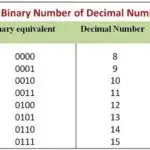
Binary numbers are numbers expressed in base two (2), using only two digits: 0 and 1. These numbers are used by computers and digital systems to process data.
Addition of Binary Numbers
Addition in binary follows simple rules similar to base ten but limited to digits 0 and 1.
The following are the rules of binary addition:
- 0 + 0 = 0
- 0 + 1 = 1
- 1 + 0 = 1
- 1 + 1 = 10 (which means 0 with a carry of 1)
Examples:
(a) 1011 + 110 =
   1011
+   0110
= 10001
(b) 1101 + 111 =
   1101
+  0111
= 10100
Subtraction of Binary Numbers
Binary subtraction uses simple rules similar to decimal subtraction but applies borrowing in base two.
The following are the rules of binary subtraction:
- 0 − 0 = 0
- 1 − 0 = 1
- 1 − 1 = 0
- 0 − 1 = 1 (borrow 1 from the next higher bit)
Examples:
(a) 1011 − 100 =
   1011
−  0100
=   0111
(b) 1100 − 101 =
   1100
−  0101
=   0111
Multiplication of Binary Numbers
Binary multiplication is simpler because it only involves multiplying by 0 or 1.
The following are the rules of binary multiplication:
- 0 × 0 = 0
- 0 × 1 = 0
- 1 × 0 = 0
- 1 × 1 = 1
Example:
Multiply 101 by 11
     101
×     11
------------
     101
+   1010
------------
   1111
Division of Binary Numbers
Binary division follows the same process as long division in base ten, using subtraction and shifting.
Example:
Divide 11010 by 10
10 )11010
    -10
     10
    -10
      10
    -10
      0
Quotient = 1101
Teaching Methods/Instructional Techniques:
Lecture, Discussion, Demonstration, Explanation, Question and Answer, Group Work, Drill and Practice
Instructional Procedures
To deliver this lesson, the teacher will adopt the following steps:
Step 1: Introduction
Time: 5 minutes
Teaching Skill: Set Induction
Teacher’s Activity: Teacher revises the previous lesson on number base conversion and asks pupils how computers store numbers.
Pupils’ Activity: Pupils respond by mentioning binary digits 0 and 1.
Learning Point: Pupils are reminded that computers use binary numbers to process information.
Step 2: Binary Addition and Subtraction
Time: 10 minutes
Teaching Skill: Explanation
Teacher’s Activity: Teacher explains and demonstrates binary addition and subtraction using examples on the board.
Pupils’ Activity: Pupils listen, take notes, and solve guided examples.
Learning Point: Pupils understand how to perform addition and subtraction of binary numbers.
Step 3: Multiplication and Division of Binary Numbers
Time: 10 minutes
Teaching Skill: Demonstration
Teacher’s Activity: Teacher shows the process of multiplying and dividing binary numbers using worked examples.
Pupils’ Activity: Pupils practice similar problems in pairs.
Learning Point: Pupils can multiply and divide binary numbers accurately.
Step 4: Note-Taking
Time: 5 minutes
Teaching Skill: Explanation
Teacher’s Activity: Teacher writes the board summary for pupils to copy.
Pupils’ Activity: Pupils write the notes neatly in their exercise books.
Learning Point: Pupils retain key points from the lesson.
Step 5: Evaluation/Review
Time: 3 minutes
Teaching Skill: Questioning
Teacher’s Activity: The teacher evaluates the learning by asking the following questions:
- State the rules of binary addition and subtraction.
- Multiply 101 by 11 in binary.
- Divide 11010 by 10 in binary.
- Solve 1010 − 110 in binary.
Pupils’ Activity: Pupils answer orally and on the board.
Learning Point: Pupils demonstrate understanding of binary operations.
Step 6: Conclusion
Time: 2 minutes
Teaching Skill: Reinforcement
Teacher’s Activity: Teacher summarizes the key concepts and encourages students to practice more binary problems at home.
Pupils’ Activity: Pupils listen and ask questions where necessary.
Learning Point: Pupils appreciate the importance of binary arithmetic.
Lesson Keywords
- Binary – number system with base 2 using 0 and 1
- Addition – combining two binary numbers
- Subtraction – taking one binary number from another
- Multiplication – repeated addition in binary form
- Division – sharing or separating binary numbers into equal parts
Differentiation
Provide extra examples for slower learners and peer support groups; give challenging binary reasoning problems to advanced learners for enrichment.
Note for teachers using this lesson plan
Use visual aids and ensure pupils understand each step before moving to the next. Encourage active participation through group problem-solving.

Community Join the conversation Open discussion +