

Class: Junior Secondary School 1 (JSS1, JSS 1)
Term: 1st Term
Week: 5
Age: 12 years
Duration: 45 minutes
Subject: Mathematics
Curriculum Theme: Mathematics
Previous Lesson: Lowest Common Multiple (LCM), Multiples and LCM of Whole Numbers
Topic: Fractions (Part 2)
Subject Matter: Equivalent fractions in showing commodities and problem solving in quantitative.
Specific Objectives
By the end of the lesson, pupils should be able to:
- Cognitive Domain:
(a) Identify and generate equivalent fractions.
(b) Apply equivalent fractions in solving quantitative problems. - Affective Domain:
(a) Appreciate the use of fractions in daily life situations involving commodities. - Psychomotor Domain:
(a) Demonstrate how to simplify fractions to their lowest terms.
(b) Illustrate fractions using diagrams and real objects. - Social Domain:
(a) Work in groups to solve word problems involving equivalent fractions.
Reference Materials
The following resources were used in planning this lesson:
- 9 Years Basic Education Curriculum
- Lagos State Unified Scheme of work for Junior Secondary Schools
- Math is Fun – Equivalent Fractions (https://www.mathsisfun.com/equivalent_fractions.html)
- Relevant Textbooks
Instructional Materials
The teacher will teach this lesson with the aid of:
- Fraction charts and fraction strips
- Flash cards with examples of fractions
- Bags of beans, rice, or bottle tops to demonstrate commodities
- Whiteboard and markers
- Rulers and graph paper
Rationale for the Lesson
Fractions are essential in daily life, especially in buying and selling commodities. Understanding equivalent fractions helps learners simplify problems and apply mathematics to real-life situations.
Prerequisite/Previous Knowledge
Pupils already know the basic concept of fractions, including numerators and denominators, and can identify simple fractions from everyday life examples.
Lesson Content/Board Summary
Fractions
Equivalent Fractions
Equivalent fractions are fractions that represent the same value or proportion even though they have different numerators and denominators. For example, 1/2 is the same as 2/4 or 3/6.
The following are ways of identifying equivalent fractions:
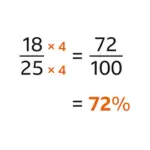
- Multiplying the numerator and denominator of a fraction by the same number.
- Dividing the numerator and denominator of a fraction by the same number.
- Representing fractions with diagrams or shapes showing equal parts.
Examples include:
- 1/3 = 2/6 = 3/9
- 2/5 = 4/10 = 6/15
- 3/4 = 6/8 = 9/12
Equivalent Fractions in Commodities
In buying and selling, equivalent fractions are used to share commodities fairly or to compare quantities.
Examples include:
- If 1/2 of a bag of rice is the same as 2/4 of the bag.
- If 1/3 of a tin of milk is the same as 2/6 of the tin.
- If 3/5 of an orange is equivalent to 6/10 of the same orange.
Problem Solving in Quantitative with Equivalent Fractions
Equivalent fractions help in solving mathematical word problems involving quantities.
Examples are:
- If a student drinks 1/2 of a bottle of juice and another drinks 2/4 of the same bottle, show that they drank the same amount.
- A trader sells 2/3 of a bag of beans in the morning and 4/6 in the evening. Show that the quantities are equal.
- Simplify 12/18 to its lowest terms using equivalent fractions.
Teaching Methods/Instructional Techniques:
Lecture, Discussion, Explanation, Demonstration, Group Work, Question and Answer, Use of Visual Aids
Instructional Procedures
To deliver this lesson, the teacher will adopt the following steps:
Step 1: Introduction
Time: 5 minutes
Teaching Skill: Set Induction
Teacher’s Activity: Teacher recalls the previous lesson on basic fractions by showing a fraction chart and asking pupils to mention examples.
Pupils’ Activity: Pupils respond with examples of fractions and share what they learned previously.
Learning Point: Pupils are reminded of the foundation of fractions.
Step 2: Equivalent Fractions
Time: 10 minutes
Teaching Skill: Explanation
Teacher’s Activity: Teacher explains the meaning of equivalent fractions and shows examples using charts.
Pupils’ Activity: Pupils listen and give examples of equivalent fractions.
Learning Point: Pupils understand the concept of equivalent fractions.
Step 3: Equivalent Fractions in Commodities
Time: 10 minutes
Teaching Skill: Demonstration
Teacher’s Activity: Teacher uses commodities such as rice, beans, or bottle tops to demonstrate how fractions can represent the same value in different forms.
Pupils’ Activity: Pupils observe and repeat examples.
Learning Point: Pupils see practical uses of equivalent fractions in real life.
Step 4: Problem Solving with Equivalent Fractions
Time: 10 minutes
Teaching Skill: Discussion
Teacher’s Activity: Teacher writes word problems on the board and guides pupils through solving them step by step.
Pupils’ Activity: Pupils attempt solving problems in groups and present answers.
Learning Point: Pupils apply equivalent fractions in solving quantitative problems.
Step 5: Note-Taking
Time: 5 minutes
Teaching Skill: Explanation
Teacher’s Activity: Teacher dictates or writes the board summary for pupils to copy.
Pupils’ Activity: Pupils copy the summary into their exercise books.
Learning Point: Pupils have a written record of the lesson.
Step 6: Evaluation/Review
Time: 3 minutes
Teaching Skill: Questioning
Teacher’s Activity: The teacher evaluates the learning by asking the following questions:
- Define equivalent fractions.
- Give three examples of equivalent fractions.
- State one example of equivalent fractions in commodities.
- Simplify 10/15 to its lowest form.
Pupils’ Activity: Pupils answer questions orally and in writing.
Learning Point: Pupils demonstrate understanding of equivalent fractions.
Step 7: Conclusion
Time: 2 minutes
Teaching Skill: Reinforcement
Teacher’s Activity: Teacher summarizes the lesson and encourages pupils to practice more problems on equivalent fractions.
Pupils’ Activity: Pupils listen and ask questions.
Learning Point: Pupils reinforce their understanding of equivalent fractions.
Home Task: Solve three new exercises on Fractions (Part 2). Show each step and check each answer.
Lesson Keywords
- Fraction – a part of a whole written with numerator and denominator
- Equivalent – having the same value though written differently
- Simplify – reducing a fraction to its lowest terms
- Numerator – the top number of a fraction showing parts taken
- Denominator – the bottom number of a fraction showing total equal parts
Differentiation
Teacher provides simpler examples and visual aids for slower learners, while advanced learners solve complex word problems involving equivalent fractions.
Note for teachers using this lesson plan
Encourage pupils to use real-life examples when explaining fractions. Ensure group work is properly supervised, and stress accuracy when simplifying fractions.


Community Join the conversation Open discussion +