

Class: Primary Three
Term: Third Term
Subject: Basic Science and Technology
Curriculum Theme: Computer Studies
previous Lesson: Identification and Description of Floppy Disk
Topic: Types of Diskette
Content/Learning Area: identification and description of different types of diskettes
Time Allocation: 40 minutes
Performance Objectives
By the end of the lesson, pupils should be able too:
- Cognitive Domain:
1. Identify different types of diskettes (8-inch, 5.25-inch, 3.5-inch).
2. Describe the characteristics of each diskette type (size, storage capacity).
3. Explain the concept of diskette density (single, double, high).
- Affective Domain:
1. Show appreciation for the evolution of storage devices.
- Psychomotor Domain:
1. Differentiate between diskette sizes using visual aids.
- Social Domain:
1. Participate actively in class discussions.
Reference Materials
- 9 – years Basic Education Curriculum
- Abuja Educational Resource Center Scheme of work
- NAPPS National Unified Scheme of Work
- Online Details
- Relevant textbooks
Instructional Materials
To deliver this lesson, the teacher will use the following materials: Pictures of different types of diskettes, Chart showing diskette sizes and capacities, Whiteboard or chart paper.
Rationale for the Lesson
Understanding the evolution of storage devices helps pupils appreciate technological advancements. This lesson provides a foundation for understanding data storage and its history, relevant to future science and technology lessons.
Prerequisite/Previous Knowledge
Pupils have prior knowledge of floppy disks and their basic functions from the previous lesson.
lesson Content
Types of Diskette
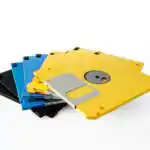
Floppy diskettes, also called diskettes, were used to store and move data before USB drives and cloud storage became common. They were made of flexible magnetic material inside a protective cover.
What are the different types of diskettes?
Diskettes came in various sizes and storage capacities, each with its own characteristics. These include:
- 8-inch Diskette: The first type, large, storing about 80KB, mainly used in the 1970s.
- 5.25-inch Diskette: Smaller than the 8-inch, storing 360KB to 1.2MB, common in the 1980s.
- 3.5-inch Diskette: The most recent and well-known, storing up to 1.44MB, with a durable hard plastic cover.
- 2-inch diskette: A less common format, primarily used in some early digital cameras and portable devices.
- Zip Disk: Although not technically a floppy diskette, it was a higher-capacity alternative, storing up to 100MB or 250MB.
Densities of Diskettes
Diskette density refers to the amount of data that can be stored per unit area on the disk. A floppy disk’s storage is also resolute by its density:
- Single Density (SD): Least storage capacity.
- Double Density (DD): Twice the storage of single density.
- High density (HD): highest storage capacity, up to 1.44MB.
- Extended Density (ED): An even higher density format used primarily with 3.5-inch diskettes, offering larger storage capacities than HD.
Teaching Methods
To deliver this lesson, the teacher will adopt the following methods: Discussion, Description, Question and Answer, Use of visual Aids.
Instructional Procedures
To deliver this lesson, the teacher will adopt the following steps:
Step 1: Introduction
Time: 5 minutes
Teaching Skill: Set Induction
Teacher’s Activity: Review previous lesson on floppy disks. Introduce the topic: “Different types of Diskettes.”
Pupils’ Activity: Respond to teacher’s questions, listen attentively.
Step 2: Explanation of Key Concepts
Time: 10 minutes
Teaching Skill: Explanation, Exhibition
Teacher’s Activity: Explain the different types of diskettes (8-inch, 5.25-inch,3.5-inch) using pictures and charts. Explain the concept of diskette density (single, double, high).
Pupils’ Activity: Listen attentively, ask clarifying questions.
Step 3: Exhibition/Guided Practice
time: 10 minutes
Teaching Skill: Guided Practice, Demonstration
Teacher’s Activity: Show pictures of different diskettes and guide pupils in identifying their sizes and capacities.
Pupils’ Activity: participate in identifying diskette types and sizes.
step 4: Self-Reliant Practice
Time: 5 minutes
Teaching Skill: Independent practice
Teacher’s Activity: Ask pupils to draw and label the different types of diskettes.Pupils’ Activity: Draw and label the different types of diskettes.
Step 5: Note-Taking
Time: 5 minutes
Teaching Skill: Note-Taking
Teacher’s Activity: Guide pupils in taking notes on the key features of each diskette type.
Pupils’ Activity: Take notes on the key features of each diskette type.
Step 6: Evaluation/Review
Time: 5 minutes
Teaching Skill: Questioning, Review
Teacher’s Activity: ask review questions to assess understanding.
Pupils’ Activity: Answer review questions.
Objective-aligned checks:
- Identify different types of diskettes (8-inch, 5.
- Describe the characteristics of each diskette type (size, storage capacity).
- Explain the concept of diskette density (single, double, high).
Step 7: Conclusion
Time: 2 minutes
Teaching Skill: Summarization
Teacher’s Activity: Summarize the key points about different types of diskettes and their importance in the history of computing. Assign a short homework activity where pupils draw and label the different types of diskettes.
Pupils’ Activity: Listen to the summary and note the homework assignment.
Lesson Keywords
- Diskette – A removable magnetic disk used for storing data.
- Density – The amount of data that can be stored per unit area on a disk.
- Storage Capacity – The amount of data a diskette can hold, measured in kilobytes (KB) or megabytes (MB).
- Evolution – The development or gradual change of technology over time.
Lesson Evaluation
To evaluate the learning, the teacher asks pupils to:
- Name three main types of floppy diskettes.
- How are 5.25-inch and 3.5-inch diskettes different?
- What does single, double, and high density mean for diskettes?
- Which diskette type do you think is best,and why?
Assignment/homework
- Draw and label the different types of diskettes discussed in class.
- Research and write a short paragraph on why floppy diskettes are no longer commonly used today.
Differentiation
- For slower learners: Provide one-on-one assistance and use simpler language.
- For advanced learners: Encourage them to research further on the history of data storage and the development of newer storage technologies.
- For visual/auditory/kinesthetic learners: Use visual aids, verbal explanations, and hands-on activities to cater to different learning styles.
Note for Teachers
Ensure to bring visual aids like pictures or actual diskettes to class to enhance understanding. encourage pupils to participate actively in discussions and ask questions.

Community Join the conversation Open discussion +