

Class: Primary Three
Term: Third Term
Subject: Basic Science and Technology
Curriculum Theme: Basic Technology
Previous Lesson: Meaning, Types and Examples of Mechanical Energy
Topic: Uses of Mechanical Energy
Content/Learning Area: Examples of Mechanical Energy in Action, Evaluation Questions
Time Allocation: 40 minutes
Performance Objectives
by the end of the lesson, pupils should be able to:
- Cognitive domain: Identify at least three uses of mechanical energy.
- Affective Domain: Express recognition for the importance of mechanical energy in daily life.
- Psychomotor Domain: Demonstrate through drawing or modeling how mechanical energy is used in one common machine.
- Social Domain: Participate actively in class discussions and activities.
Reference Materials
- 9 – Years Basic Education Curriculum
- Abuja Educational Resource Centre Scheme of Work
- NAPPS National Unified Scheme of Work
- Relevant Textbooks
Instructional Materials
To deliver this lesson, the teacher will employ the help of the following materials:
- whiteboard or chart paper
- Markers or crayons
- Pictures or diagrams of machines
- Optional: Simple models of machines
rationale for the Lesson
understanding the uses of mechanical energy helps pupils appreciate how energy works in the world around them.This knowledge is foundational for future learning in science and technology, and it fosters an appreciation for everyday machines and their functions.
Prerequisite/Previous Knowledge
The teacher will begin by asking pupils what they remember about mechanical energy from the previous lesson. A brief review will be conducted, followed by introducing the topic of the day: the uses of mechanical energy. the teacher will then ask pupils to think about machines or activities they see every day that involve movement.
Lesson Content
examples of Mechanical Energy in action
Mechanical energy is the energy that makes things move. It’s used in many everyday things and machines.
The following are examples of mechanical energy in action:
- Bicycles: Pedaling creates mechanical energy to move the wheels.
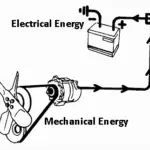
- Fans: Electrical energy changes into mechanical energy to spin the blades.
- Cars: The engine makes mechanical energy to turn the wheels.
- Windmills: Wind turns the blades, creating mechanical energy to make electricity.
- Elevators: Mechanical energy moves people up and down.
- Roller Coasters: Potential energy at the top changes to kinetic energy as it moves.
- Cranes: Lift heavy things using mechanical energy.
- Water Wheels: Flowing water turns the wheel and makes energy.
- Seesaws: One side going up makes the other go down, showing mechanical energy.
- Jackhammers: Mechanical energy makes powerful blows to break hard surfaces.
- blenders: Mechanical energy is used to rotate the blades to mix or blend ingredients.
- Lawnmowers: Mechanical energy powers the blades to cut grass.
These examples show how mechanical energy works in many tools, machines, and everyday things.
Teaching Methods
To deliver this lesson, the teacher will adopt the following methods: Discussion, Demonstration, question and Answer, Activity-based learning.
Instructional Procedures
To deliver this lesson, the teacher will adopt the following steps:
Step 1: Introduction
Time: 5 minutes
Teaching skill: Set Induction
Teacher’s Activity: Briefly review the concept of mechanical energy.Introduce the topic: Uses of Mechanical Energy.
Pupils’ Activity: Respond to teacher’s questions, listen attentively.
Step 2: Clarification of Key Concepts
Time: 10 minutes
Teaching Skill: Explaining, illustrating
Teacher’s Activity: Explain that mechanical energy is the energy of movement and give examples.
Pupils’ activity: Listen attentively, ask clarifying questions.
Step 3: Demonstration/Guided Practice
Time: 10 minutes
Teaching Skill: Demonstrating, Guiding
Teacher’s Activity: Show pictures or models of machines that use mechanical energy. Guide pupils in identifying how mechanical energy is used in each.
Pupils’ Activity: Observe demonstrations, participate in discussions.
Step 4: Autonomous Practice
Time: 5 minutes
Teaching skill: Monitoring,Providing Feedback
Teacher’s Activity: Ask pupils to draw a machine that uses mechanical energy and explain how it works.
Pupils’ Activity: Draw and explain their chosen machine.
Step 5: Note-Taking
Time: 5 minutes
Teaching Skill: Summarizing, Note-Taking
Teacher’s Activity: Summarize key concepts and encourage pupils to take notes.
Pupils’ Activity: Take notes, ask clarifying questions.
Step 6: Evaluation/Review
Time: 5 minutes
Teaching Skill: Questioning, Assessing
Teacher’s Activity: Ask evaluation questions to assess understanding.
Pupils’ activity: Answer evaluation questions.
Objective-aligned checks:
- Identify at least three uses of mechanical energy.
- Demonstrate through drawing or modeling how mechanical energy is used in one common machine.
Step 7: Conclusion
Time: 5 minutes
Teaching Skill: Summarizing, Encouraging
Teacher’s Activity: To conclude the lesson, the teacher will review the key concepts and answer any remaining questions. The teacher will also praise pupils for their participation and encourage them to continue exploring the world of mechanical energy.Pupils’ Activity: Listen to the summary, ask any remaining questions, and appreciate the teacher’s praise.
Lesson Keywords
- Mechanical Energy – The energy of motion or movement.
- Kinetic Energy – the energy an object has because of its motion.
- Potential Energy – Stored energy that has the potential to do work.
- Machines – Devices that use energy to perform tasks.
- Movement – The act of changing position or location.
Lesson Evaluation
To evaluate the learning, the teacher asks pupils to:
- Name three uses of mechanical energy.
- How does a bicycle use mechanical energy?
- Draw a picture of a machine that uses mechanical energy.
Assignment/Homework
- List five additional examples of machines or devices that use mechanical energy in your home or community.
- Write a short paragraph explaining how a specific machine (e.g., a fan, a car) uses mechanical energy to perform its function.
- Observe and describe how mechanical energy is used in a local industry or workshop.
Differentiation
- For slower learners: The teacher will provide one-on-one assistance and use simpler examples.
- For advanced learners: The teacher will encourage them to research and present additional examples of mechanical energy in action.
- For visual/auditory/kinesthetic learners: Use visual aids like diagrams and videos, encourage verbal explanations, and incorporate hands-on activities like building simple models.
Note for Teachers
Ensure to use real-life examples that pupils can relate to, making the lesson more engaging and understandable.Encourage active participation and provide constructive feedback to reinforce learning.


Community Join the conversation Open discussion +