

Class: Primary 5
Term: 1st Term
Week: 1
Age: 10 years
Duration: 45 minutes
Subject: General Mathematics
Previous Lesson:
Curriculum Theme: Number and Numeration
Previous Lesson: Basic Counting and Number Recognition.
Topic: WHOLE NUMBER
Subject Matter: Meaningful counting in thousands and millions, writing numbers in thousands and millions in words and figures, identification of prime numbers less than 100, expressing numbers as product of prime factors, quantitative aptitude on counting in thousands and millions.
Specific Objectives
By the end of the lesson, pupils should be able to:
Cognitive Domain:
- Count numbers meaningfully in thousands and millions.
- Write numbers in thousands and millions in words and figures.
- Identify prime numbers less than 100.
- Express numbers as a product of prime factors.
- Solve quantitative aptitude problems involving thousands and millions.
Affective Domain:
- Show interest in learning about whole numbers.
- Appreciate the importance of numbers in daily life.
Psychomotor Domain:
- Accurately use an abacus to form and read numbers.
- Write numbers neatly in words and figures.
Social Domain:
- Collaborate with peers to solve number problems.
Reference Materials
The following resources were used in planning this lesson:
- 9 Years Basic Education Curriculum for Primary Schools.
- State Unified Scheme of Work for Primary 5 Mathematics.
- New Concept Mathematics for Primary Schools Book 5.
Instructional Materials
The teacher will teach this lesson with the aid of:
- Abacus
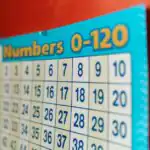
- Number chart
- Quantitative aptitude book
Rationale for the Lesson
Whole numbers are fundamental to everyday calculations and understanding quantities. This lesson helps pupils to read, write, and manipulate large numbers, and to understand the building blocks of numbers through prime factors, which are important skills for daily life.
Prerequisite/Previous Knowledge
Pupils have prior knowledge of basic counting and number recognition up to hundreds of thousands.
Lesson Content/Board Summary
WHOLE NUMBER
Meaningful Counting in Thousands and Millions
Whole numbers are basic counting numbers that include 0, 1, 2, 3, and so on, without fractions or decimals. Numbers are generally grouped in threes (units, tens, hundreds) within larger periods such as thousands, millions, and billions. To count meaningfully, it is important to identify the place value of each digit within these periods.
Example: The number 1,234,567 is read as “One million, two hundred and thirty-four thousand, five hundred and sixty-seven.”
Writing Numbers in Words and Figures (Thousands and Millions)
To write numbers in words:
- Read the number in each period (millions, thousands, units) from left to right.
- State the period name after reading the numbers in that period, except for the units period.
Example 1: 5,021,304 is written as “Five million, twenty-one thousand, three hundred and four.”
To write numbers in figures:
- Identify the periods mentioned in the word form (millions, thousands, units).
- Write the digits for each period.
- Use zeros as placeholders if a period or a place value within a period is not mentioned.
Example 2: “Six million, forty thousand, two hundred and five” is written as 6,040,205.
Identification of Prime Numbers Less Than 100
A prime number is a whole number greater than 1 that has exactly two distinct positive divisors: 1 and itself. The number 1 is not a prime number. The number 2 is the only even prime number.
To identify prime numbers, test if a number can be divided evenly by any number other than 1 and itself.
The prime numbers less than 100 are:
- 2, 3, 5, 7, 11, 13, 17, 19, 23, 29, 31, 37, 41, 43, 47, 53, 59, 61, 67, 71, 73, 79, 83, 89, 97.
Expressing Numbers as Product of Prime Factors
A prime factor is a prime number that divides a given number exactly. To express a number as a product of its prime factors, divide the number repeatedly by the smallest possible prime number until the result is 1.
Steps to find prime factors:
- Start by dividing the given number by the smallest prime number (2).
- Continue dividing the quotient by 2 until it is no longer divisible by 2.
- Move to the next smallest prime number (3) and repeat the process.
- Continue with subsequent prime numbers (5, 7, 11, etc.) until the final quotient is 1.
- Write the original number as the product of all the prime divisors.
Example 1: Express 12 as a product of its prime factors.
- 12 ÷ 2 = 6
- 6 ÷ 2 = 3
- 3 ÷ 3 = 1
Therefore, 12 = 2 × 2 × 3.
Example 2: Express 30 as a product of its prime factors.
- 30 ÷ 2 = 15
- 15 ÷ 3 = 5
- 5 ÷ 5 = 1
Therefore, 30 = 2 × 3 × 5.
Quantitative Aptitude on Counting in Thousands and Millions
Quantitative aptitude problems involve applying number concepts to solve practical questions. These problems often test understanding of place value, number comparison, and basic operations with large numbers.
Example 1: What is the place value of 7 in 4,725,100?
Answer: Hundred thousands.
Example 2: Write the number that is one million more than 2,500,000.
Answer: 3,500,000.
Teaching Methods/Instructional Techniques
Discussion, Lecture, Demonstration, Question and Answer, Visual Aids
Instructional Procedures
Step 1: Introduction
Time: 5 minutes
Teaching Skill: Set Induction
Teacher’s Activity: The teacher greets the pupils and reviews the previous lesson on basic number recognition. The teacher introduces the new topic by asking pupils to count large numbers they encounter in daily life, such as populations or prices of expensive items, and then states the topic “WHOLE NUMBER”.
Pupils’ Activity: Pupils respond to greetings, recall previous knowledge, and listen attentively to the introduction of the new topic.
Learning Point: Pupils are prepared for the new lesson and understand its relevance.
Step 2: Meaningful Counting in Thousands and Millions
Time: 7 minutes
Teaching Skill: Explanation/Demonstration
Teacher’s Activity: The teacher uses an abacus and a number chart to demonstrate how to form and read numbers up to millions. The teacher guides pupils to identify the place value of digits in large numbers, emphasizing the grouping of numbers in threes for thousands and millions periods.
Pupils’ Activity: Pupils observe the teacher’s demonstration, practice forming and reading numbers using the abacus, and identify place values.
Learning Point: Pupils learn to count and read numbers meaningfully in thousands and millions.
Step 3: Writing Numbers in Words and Figures (Thousands and Millions)
Time: 8 minutes
Teaching Skill: Explanation/Guided Practice
Teacher’s Activity: The teacher explains the rules for writing numbers in words from figures and vice-versa, using examples on the board. The teacher provides exercises for pupils to practice writing numbers like 1,540,200 in words and “Two million, five hundred thousand, six hundred and ten” in figures.
Pupils’ Activity: Pupils listen to the explanation, copy notes, and attempt to write numbers in words and figures on their slates or notebooks.
Learning Point: Pupils are able to write numbers in thousands and millions in words and figures correctly.
Step 4: Identification of Prime Numbers Less Than 100
Time: 7 minutes
Teaching Skill: Definition/Listing
Teacher’s Activity: The teacher defines a prime number and explains how to identify them. The teacher guides pupils to list prime numbers less than 100, emphasizing that 1 is not a prime number and 2 is the only even prime number.
Pupils’ Activity: Pupils listen to the definition, copy notes, and participate in listing prime numbers less than 100.
Learning Point: Pupils can define a prime number and identify prime numbers less than 100.
Step 5: Expressing Numbers as Product of Prime Factors
Time: 8 minutes
Teaching Skill: Explanation/Problem Solving
Teacher’s Activity: The teacher explains what prime factors are and demonstrates the steps to express a number as a product of its prime factors using examples like 12 and 30. The teacher ensures pupils understand the process of repeated division by prime numbers.
Pupils’ Activity: Pupils pay attention to the explanation and examples, copy the steps, and solve similar problems with guidance from the teacher.
Learning Point: Pupils learn to express numbers as a product of their prime factors.
Step 6: Quantitative Aptitude on Counting in Thousands and Millions
Time: 4 minutes
Teaching Skill: Application/Problem Solving
Teacher’s Activity: The teacher introduces simple quantitative aptitude problems related to counting in thousands and millions, such as place value questions or simple additions/subtractions involving large numbers. The teacher guides pupils through solving these problems.
Pupils’ Activity: Pupils attempt to solve the quantitative aptitude problems presented by the teacher.
Learning Point: Pupils apply their understanding of large numbers to solve practical problems.
Step 7: Evaluation/Review
Time: 5 minutes
Teaching Skill: Questioning/Assessment
Teacher’s Activity: The teacher evaluates the learning by asking the following questions:
- Write the number 3,456,789 in words.
- Write “Seven million, two hundred and five thousand, thirty-one” in figures.
- Define a prime number.
- List all prime numbers between 10 and 20.
- Express 24 as a product of its prime factors.
Pupils’ Activity: Pupils answer orally and in writing.
Learning Point: Pupils demonstrate understanding of the lesson.
Step 8: Conclusion
Time: 1 minute
Teaching Skill: Summarization
Teacher’s Activity: The teacher summarizes the key points of the lesson, reinforcing the importance of understanding whole numbers, prime numbers, and prime factors. The teacher assigns homework for pupils to practice writing and identifying numbers and factors.
Pupils’ Activity: Pupils listen to the summary and copy down the homework.
Learning Point: The lesson is concluded, and pupils are given practice work.
Home Task: Solve three new exercises on WHOLE NUMBER. Show each step and check each answer.
Lesson Keywords
- Whole Number – Any positive number that does not include a fractional or decimal part, including zero (0, 1, 2, 3…).
- Thousands – A unit of number equal to 1,000.
- Millions – A unit of number equal to 1,000,000.
- Prime Number – A whole number greater than 1 that has exactly two distinct positive divisors: 1 and itself.
- Prime Factor – A prime number that divides a given number exactly.
Differentiation
For pupils who grasp concepts quickly, the teacher will provide more complex numbers for conversion and additional quantitative aptitude challenges. For pupils who need extra support, the teacher will offer one-on-one guidance, simplify examples, and provide visual aids like more detailed number charts to reinforce understanding.
Note for teachers using this lesson plan
Ensure that the abacus and number charts are clearly visible to all pupils. Encourage active participation and peer learning. Pay close attention to pupils’ understanding of place value, as it is foundational for handling large numbers. Provide ample opportunities for practice, especially in writing numbers and finding prime factors, as these skills require repetition for mastery.
Community Join the conversation Open discussion +