

Class: Primary 5
Term: 1st Term
Week: 2
Age: 10 years
Duration: 45 minutes
Subject: General Mathematics
Curriculum Theme: Numbers and Numeration
Previous Lesson: Whole Number, Counting, Number Names, Primes and Factors.
Topic: FRACTIONS
Subject Matter: Meaning of fraction and percentage with examples, changing fractions to decimals, changing decimals to fractions, changing decimals to percentage and percentage to decimals, quantitative aptitude on percentages.
Specific Objectives
By the end of the lesson, pupils should be able to:
Cognitive Domain:
- State the meanings of fraction and percentage with examples.
- Convert fractions to decimals.
- Convert decimals to fractions.
- Change decimals to percentage and percentage to decimals.
- Solve quantitative aptitude problems on percentages and fractions.
Affective Domain:
- Appreciate the importance of fractions and percentages in daily life.
- Participate actively in converting numbers and solving problems.
Psychomotor Domain:
- Accurately convert fractions, decimals, and percentages.
- Solve mathematical problems involving fractions and percentages correctly.
Social Domain:
- Collaborate with peers to solve quantitative aptitude problems.
Reference Materials
The following resources were used in planning this lesson:
- 9 Years Basic Education Curriculum (Primary 4-6)
- State Unified Scheme of Work for Primary 5 Mathematics
- New General Mathematics for Primary Schools Book 5
Instructional Materials
The teacher will teach this lesson with the aid of:
- Chart showing examples of fractions and percentages
- Flash cards with different fractions, decimals, and percentages
- Counters or fraction cards to represent parts of a whole
- Abacus chart
- Quantitative aptitude book
Rationale for the Lesson
This lesson helps pupils understand how parts of a whole are represented in different ways, either as fractions, decimals, or percentages. This knowledge is important for everyday activities like sharing items, understanding discounts, or interpreting statistics.
Prerequisite/Previous Knowledge
Pupils have prior knowledge of basic division, multiplication, and understanding of whole numbers.
Lesson Content/Board Summary
FRACTIONS
Meaning of Fraction
A fraction represents a part of a whole. It shows how many equal parts of a whole are being considered.
A fraction has two parts:
- Numerator: The top number, which shows how many parts are taken.
- Denominator: The bottom number, which shows the total number of equal parts in the whole.
Example: 1/2 means 1 part out of 2 equal parts.
Meaning of Percentage
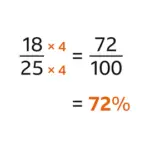
Percentage means “out of one hundred” or “per hundred”. It is a way of expressing a number as a fraction of 100.
The symbol for percentage is %.
Example: 50% means 50 out of 100, which is equal to 50/100.
Changing Fractions to Decimals
To change a fraction to a decimal, divide the numerator by the denominator.
Example 1: Change 1/2 to a decimal.
- Step 1: Divide the numerator (1) by the denominator (2).
- 1 ÷ 2 = 0.5
- Answer: 1/2 = 0.5
Example 2: Change 3/4 to a decimal.
- Step 1: Divide 3 by 4.
- 3 ÷ 4 = 0.75
- Answer: 3/4 = 0.75
Changing Decimals to Fractions
To change a decimal to a fraction:
- Step 1: Write the decimal as a fraction with the decimal number as the numerator. The denominator will be a power of 10 (10, 100, 1000, etc.) depending on the number of decimal places.
- Step 2: Simplify the fraction to its lowest terms.
Example 1: Change 0.5 to a fraction.
- Step 1: 0.5 has one decimal place, so the denominator is 10. Write as 5/10.
- Step 2: Simplify 5/10 by dividing both numerator and denominator by 5.
- 5 ÷ 5 = 1, 10 ÷ 5 = 2.
- Answer: 0.5 = 1/2
Example 2: Change 0.75 to a fraction.
- Step 1: 0.75 has two decimal places, so the denominator is 100. Write as 75/100.
- Step 2: Simplify 75/100 by dividing both numerator and denominator by 25.
- 75 ÷ 25 = 3, 100 ÷ 25 = 4.
- Answer: 0.75 = 3/4
Changing Decimals to Percentage
To change a decimal to a percentage, multiply the decimal by 100 and add the % symbol.
Example 1: Change 0.25 to a percentage.
- Step 1: Multiply 0.25 by 100.
- 0.25 × 100 = 25
- Step 2: Add the % symbol.
- Answer: 0.25 = 25%
Example 2: Change 0.7 to a percentage.
- Step 1: Multiply 0.7 by 100.
- 0.7 × 100 = 70
- Step 2: Add the % symbol.
- Answer: 0.7 = 70%
Changing Percentage to Decimals
To change a percentage to a decimal, divide the percentage by 100 and remove the % symbol.
Example 1: Change 50% to a decimal.
- Step 1: Divide 50 by 100.
- 50 ÷ 100 = 0.5
- Step 2: Remove the % symbol.
- Answer: 50% = 0.5
Example 2: Change 75% to a decimal.
- Step 1: Divide 75 by 100.
- 75 ÷ 100 = 0.75
- Step 2: Remove the % symbol.
- Answer: 75% = 0.75
Quantitative Aptitude on Percentages
Quantitative aptitude problems on percentages involve finding a part of a whole, finding the whole when a part and percentage are given, or finding the percentage.
To find a percentage of a number: Convert the percentage to a decimal or fraction and multiply by the number.
Example 1: Find 20% of 80.
- Method 1 (Decimal):
- Step 1: Change 20% to a decimal: 20 ÷ 100 = 0.20.
- Step 2: Multiply 0.20 by 80: 0.20 × 80 = 16.
- Answer: 20% of 80 is 16.
- Method 2 (Fraction):
- Step 1: Change 20% to a fraction: 20/100 = 1/5.
- Step 2: Multiply 1/5 by 80: (1/5) × 80 = 80/5 = 16.
- Answer: 20% of 80 is 16.
To find the number when a percentage is given: If X% of a number is Y, the number is (Y / X) * 100.
Example 2: If 15% of a number is 30, find the number.
- Step 1: Let the unknown number be ‘N’. So, 15% of N = 30.
- Step 2: Write 15% as a decimal: 0.15.
- Step 3: Form the equation: 0.15 × N = 30.
- Step 4: Divide both sides by 0.15 to find N: N = 30 / 0.15.
- Step 5: Calculate N: N = 200.
- Answer: The number is 200.
How to solve for different scenarios:
- To find the part: (Percentage / 100) × Whole.
- To find the whole: Part / (Percentage / 100).
- To find the percentage: (Part / Whole) × 100%.
Teaching Methods/Instructional Techniques
Discussion, Lecture, Demonstration, Question and Answer, Visual Aids
Instructional Procedures
Step 1: Introduction
Time: 5 minutes
Teaching Skill: Set Induction
Teacher’s Activity: The teacher greets the pupils and asks them if they have ever shared anything into equal parts, like a cake or an orange. The teacher then introduces the topic “Fractions and Percentages” as different ways to represent parts of a whole.
Pupils’ Activity: Pupils respond to the teacher’s questions and listen attentively to the introduction.
Learning Point: Pupils are introduced to the concept of representing parts of a whole.
Step 2: Meaning of Fraction and Percentage
Time: 8 minutes
Teaching Skill: Explanation/Definition
Teacher’s Activity: The teacher guides pupils to state the meaning of a fraction, using examples like 1/2 or 3/4 with flash cards or fraction charts. The teacher then explains the meaning of percentage, showing the ‘%’ symbol and giving examples like 50% or 25%.
Pupils’ Activity: Pupils state the meanings of fraction and percentage and provide simple examples.
Learning Point: Pupils understand the definitions of fraction and percentage.
Step 3: Changing Fractions to Decimals and Vice Versa
Time: 8 minutes
Teaching Skill: Demonstration/Practice
Teacher’s Activity: The teacher demonstrates how to convert fractions to decimals by dividing the numerator by the denominator, solving two examples on the board. The teacher then shows how to convert decimals back to fractions by considering place value and simplifying, solving two examples.
Pupils’ Activity: Pupils observe the examples, ask questions, and practice converting fractions to decimals and decimals to fractions in their notebooks.
Learning Point: Pupils learn the methods for converting between fractions and decimals.
Step 4: Changing Decimals to Percentage and Percentage to Decimals
Time: 8 minutes
Teaching Skill: Demonstration/Guided Practice
Teacher’s Activity: The teacher explains and demonstrates how to convert decimals to percentages by multiplying by 100 and adding the ‘%’ sign, providing two examples. Afterwards, the teacher shows how to convert percentages to decimals by dividing by 100 and removing the ‘%’ sign, also with two examples.
Pupils’ Activity: Pupils follow the teacher’s steps, take notes, and attempt similar conversions independently.
Learning Point: Pupils master the conversion between decimals and percentages.
Step 5: Quantitative Aptitude on Percentages
Time: 8 minutes
Teaching Skill: Problem Solving
Teacher’s Activity: The teacher introduces quantitative aptitude problems involving percentages. The teacher demonstrates how to find a percentage of a number and how to find the original number when a percentage is given, using clear steps and examples from the board summary.
Pupils’ Activity: Pupils pay attention to the problem-solving steps and try to solve similar problems as guided by the teacher.
Learning Point: Pupils learn how to solve basic quantitative aptitude problems involving percentages.
Step 6: Classwork/Practice
Time: 3 minutes
Teaching Skill: Individual Work
Teacher’s Activity: The teacher gives pupils a few practice questions to solve in their notebooks, covering conversions and simple percentage problems.
Pupils’ Activity: Pupils work individually to solve the given practice questions.
Learning Point: Pupils apply their understanding to solve problems independently.
Step 7: Evaluation/Review
Time: 5 minutes
Teaching Skill: Questioning/Assessment
Teacher’s Activity: The teacher evaluates the learning by asking the following questions:
- What is a fraction? Give an example.
- Define percentage.
- Change 0.8 to a fraction.
- Convert 3/5 to a decimal.
- Express 0.45 as a percentage.
- Change 70% to a decimal.
- Find 10% of 90.
Pupils’ Activity: Pupils answer orally and in writing.
Learning Point: Pupils demonstrate understanding of the lesson.
Step 8: Conclusion
Time: 2 minutes
Teaching Skill: Summarization
Teacher’s Activity: The teacher summarizes the key points of the lesson, emphasizing the relationship between fractions, decimals, and percentages. The teacher assigns homework involving more conversion and quantitative aptitude problems.
Pupils’ Activity: Pupils listen to the summary and copy the homework assignment.
Learning Point: Pupils consolidate their learning and are given further practice.
Home Task: Solve three new exercises on FRACTIONS. Show each step and check each answer.
Lesson Keywords
- Fraction – A part of a whole.
- Numerator – The top number in a fraction.
- Denominator – The bottom number in a fraction.
- Decimal – A number that uses a decimal point to show parts of a whole.
- Percentage – A rate, number, or amount in each hundred.
- Convert – To change from one form to another.
Differentiation
For pupils who grasp concepts quickly, the teacher will provide more complex quantitative aptitude problems. For pupils needing extra support, the teacher will use more visual aids like fraction blocks and provide one-on-one guidance during practice, focusing on basic conversions before moving to problems.
Note for teachers using this lesson plan
Encourage pupils to always simplify fractions to their lowest terms. Emphasize that fractions, decimals, and percentages are different ways of representing the same value. Use real-life examples to make the concepts relatable. Provide ample practice opportunities for each conversion type.
Community Join the conversation Open discussion +