

Class: Junior Secondary School 2 (JSS 2 / JS2)
Term: 3rd Term
Week: 8
Age: 13 years
Duration: 45 minutes
Subject: Basic Science and Technology
Curriculum Theme: Basic Science
Previous Lesson: Drug Abuse: Meaning of Drug.
Topic: TRIANGLES
Subject Matter: Definition and types
Specific Objectives
By the end of the lesson, pupils should be able to:
Cognitive Domain:
- Define a triangle.
- Identify different types of triangles based on their sides and angles.
Affective Domain:
- Appreciate the importance of triangles in various structures and designs.
- Show interest in learning more about geometric shapes.
Psychomotor Domain:
- Draw different types of triangles accurately using appropriate tools.
- Construct simple models involving triangles.
Social Domain:
- Work cooperatively with peers to identify and classify triangles.
- Share ideas on where triangles are found in their environment.
Reference Materials
The following resources were used in planning this lesson:
- 9 Years Basic Education Curriculum
- State Unified Scheme of Work
- MacMillan Basic Science and Technology for Junior Secondary Schools, Book 2
- https://www.study.com/academy/lesson/what-is-a-triangle-definition-types-properties-quiz.html
- https://www.mathsisfun.com/triangles.html
Instructional Materials
The teacher will teach this lesson with the aid of:
- Whiteboard/Blackboard and markers/chalk
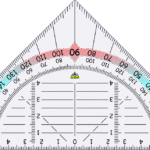
- Rulers, protractors, and pencils
- Charts showing different types of triangles
- Cut-out cardboard shapes of various triangles
Rationale for the Lesson
Understanding triangles is important because they are fundamental shapes in geometry. This knowledge helps pupils appreciate how triangles are used in construction, engineering, and everyday objects, building a foundation for further studies in science and mathematics.
Prerequisite/Previous Knowledge
Pupils should have prior knowledge of basic geometric shapes such as squares, rectangles, and circles, and be able to identify their properties.
Lesson Content/Board Summary
TRIANGLES
Definition of a Triangle
A triangle is a polygon with three straight sides and three angles. It is the simplest polygon. The sum of the interior angles of any triangle is always 180 degrees.
Types of Triangles (Based on Length of Sides)
The following are types of triangles based on the length of their sides:
- Equilateral Triangle: A triangle in which all three sides are equal in length. Consequently, all three angles are also equal, each measuring 60 degrees.
- Isosceles Triangle: A triangle in which two sides are equal in length. The angles opposite these two equal sides are also equal.
- Scalene Triangle: A triangle in which all three sides are of different lengths. As a result, all three angles are also of different measures.
Types of Triangles (Based on Measures of Angles)
The following are types of triangles based on the measure of their angles:
- Right-Angled Triangle: A triangle that has one angle measuring exactly 90 degrees (a right angle). The side opposite the right angle is called the hypotenuse.
- Acute-Angled Triangle: A triangle in which all three angles are acute, meaning each angle measures less than 90 degrees.
- Obtuse-Angled Triangle: A triangle that has one angle measuring greater than 90 degrees but less than 180 degrees (an obtuse angle). The other two angles are acute.
Teaching Methods/Instructional Techniques
Discussion, Lecture, Demonstration, Question and Answer, Visual Aids
Instructional Procedures
Step 1: Introduction
Time: 5 minutes
Teaching Skill: Set Induction
Teacher’s Activity: The teacher greets the pupils, reviews the previous lesson briefly, and then introduces the topic “Triangles” by asking pupils to name shapes they see around them.
Pupils’ Activity: Pupils respond to greetings, recall the previous lesson, and name various shapes like doors, windows, and tables.
Learning Point: Pupils are prepared for the new lesson and connect it to prior knowledge.
Step 2: Definition of a Triangle
Time: 7 minutes
Teaching Skill: Explanation/Definition
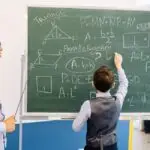
Teacher’s Activity: The teacher defines a triangle as a three-sided polygon and explains that the sum of its interior angles is 180 degrees, illustrating with a drawn example on the board.
Pupils’ Activity: Pupils listen attentively, take notes, and ask clarifying questions about the definition.
Learning Point: Pupils understand the basic definition and properties of a triangle.
Step 3: Types of Triangles (Based on Sides)
Time: 8 minutes
Teaching Skill: Demonstration/Classification
Teacher’s Activity: The teacher explains and demonstrates the types of triangles based on sides (equilateral, isosceles, scalene) using charts and cut-out shapes, highlighting the characteristics of each.
Pupils’ Activity: Pupils observe the shapes, identify the differences, and copy the characteristics into their notebooks.
Learning Point: Pupils can differentiate between equilateral, isosceles, and scalene triangles.
Step 4: Types of Triangles (Based on Angles)
Time: 8 minutes
Teaching Skill: Explanation/Illustration
Teacher’s Activity: The teacher explains and illustrates the types of triangles based on angles (right-angled, acute-angled, obtuse-angled) with examples on the board, emphasizing the angle measures.
Pupils’ Activity: Pupils listen, observe the angle distinctions, and note down the definitions and examples.
Learning Point: Pupils can identify right-angled, acute-angled, and obtuse-angled triangles.
Step 5: Practical Application/Drawing
Time: 7 minutes
Teaching Skill: Practical Demonstration
Teacher’s Activity: The teacher instructs pupils to draw one example of each type of triangle learned, guiding them on the correct use of rulers and pencils.
Pupils’ Activity: Pupils attempt to draw the different triangles in their notebooks, seeking help where necessary.
Learning Point: Pupils develop practical skills in drawing and identifying triangles.
Step 6: Discussion on Real-Life Examples
Time: 5 minutes
Teaching Skill: Inquiry/Discussion
Teacher’s Activity: The teacher asks pupils to mention objects or structures in their environment where they can see triangles being used, facilitating a short discussion.
Pupils’ Activity: Pupils share examples like roof trusses, bridge supports, road signs, and slices of pizza.
Learning Point: Pupils connect the concept of triangles to real-world applications.
Step 7: Evaluation/Review
Time: 5 minutes
Teaching Skill: Questioning/Assessment
Teacher’s Activity: The teacher evaluates the learning by asking the following questions:
- What is a triangle?
- List three types of triangles based on their sides.
- Mention two types of triangles based on their angles.
- Draw an example of a right-angled triangle.
Pupils’ Activity: Pupils answer orally and in writing.
Learning Point: Pupils demonstrate understanding of the lesson.
Step 8: Conclusion
Time: 3 minutes
Teaching Skill: Summarization
Teacher’s Activity: The teacher summarizes the key points of the lesson on the definition and types of triangles and assigns homework, asking pupils to find and draw five real-life objects that are triangular in shape.
Pupils’ Activity: Pupils listen to the summary, copy the homework, and prepare for the next class.
Learning Point: Pupils consolidate their learning and prepare for independent practice.
Lesson Keywords
- Triangle – A polygon with three sides and three angles.
- Equilateral – A triangle with all three sides equal and all angles 60 degrees.
- Isosceles – A triangle with two equal sides and two equal base angles.
- Scalene – A triangle with all sides of different lengths and all angles of different measures.
- Right-angled – A triangle containing one angle of 90 degrees.
- Acute-angled – A triangle where all three angles are less than 90 degrees.
- Obtuse-angled – A triangle containing one angle greater than 90 degrees.
Differentiation
For pupils who grasp concepts quickly, the teacher can challenge them to identify triangles within complex geometric patterns. For those who need more support, the teacher can provide pre-drawn templates of triangles for classification and focus on identifying only the most common types.
Note for teachers using this lesson plan
Encourage pupils to use rulers and pencils for accurate drawings. Emphasize the real-world relevance of triangles by showing pictures or actual objects. Ensure all pupils get an opportunity to participate in identifying and classifying triangles.

Community Join the conversation Open discussion +