

Class: Senior Secondary School 1 (SS1, SS 1, SSS1, SSS 1)
Term: 1st Term
Week: 7
Age: 15 years
Duration: 45 minutes
Subject: Technical Drawing
Curriculum Theme: Technical Drawing
Previous Lesson: Angles: Types, Construction and Bisection.
Topic: ANGLES AND TRIANGLES
Subject Matter: Types of triangles (isosceles, equilateral, scalene, and right-angled), construction of triangles given two sides and one angle, construction given two angles and one side, construction given three sides, correct use of compass and straight edge.
Specific Objectives
By the end of the lesson, pupils should be able to:
Cognitive Domain:
- Define a triangle and list its basic properties.
- Identify and describe different types of triangles based on their sides and angles.
- State the steps involved in constructing a triangle given various conditions.
Affective Domain:
- Appreciate the importance of accuracy in technical drawing.
- Show interest in learning different methods of triangle construction.
- Develop a habit of neatness and precision in their work.
Psychomotor Domain:
- Construct an equilateral triangle using a compass and straight edge.
- Construct a triangle given two sides and one included angle.
- Construct a triangle given two angles and one side.
- Construct a triangle given three sides.
Social Domain:
- Collaborate effectively with peers during practical exercises.
- Share tools and resources respectfully when working in groups.
Reference Materials
The following resources were used in planning this lesson:
- 9 Years Basic Education Curriculum for Technical Drawing.
- State Unified Scheme of Work for Senior Secondary Technical Drawing.
- Technical Drawing for Senior Secondary Schools by A.B. Oluyemi.
- https://www.studywithjumi.com/lesson-note-for-technical-drawing-sss1-first-term-week-7
Instructional Materials
The teacher will teach this lesson with the aid of:
- Models of different types of triangles.
- Charts and posters showing triangle properties and construction steps.
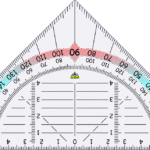
- Compasses, rulers, set squares, protractors.
- Drawing boards and pencils.
Rationale for the Lesson
This lesson helps pupils understand the fundamental geometric shapes and their construction, which is important for advanced technical drawing concepts. It enables pupils to develop precision and accuracy in using drawing instruments, skills that are valuable in various technical fields and daily life problem-solving.
Prerequisite/Previous Knowledge
Pupils are expected to have basic knowledge of geometric shapes, angles, and the use of basic drawing instruments like rulers and pencils from their Junior Secondary School Technical Drawing lessons.
Lesson Content/Board Summary
ANGLES AND TRIANGLES
Definition of a Triangle
A triangle is a plane figure with three straight sides and three angles. The sum of the interior angles of any triangle is always 180 degrees.
Types of Triangles
Triangles can be classified based on their sides or angles. The following are types of triangles:
- Equilateral Triangle: A triangle with all three sides equal in length and all three angles equal (each 60 degrees).
- Isosceles Triangle: A triangle with two sides equal in length and the angles opposite these sides also equal.
- Scalene Triangle: A triangle with all three sides of different lengths and all three angles of different measures.
- Right-angled Triangle: A triangle that has one angle measuring exactly 90 degrees. The side opposite the right angle is called the hypotenuse.
Construction of Triangles
Construction 1: Given Three Sides (SSS)
To construct a triangle when the lengths of its three sides (a, b, c) are known:
- Draw a line segment equal to one of the sides (e.g., side ‘c’).
- With one endpoint as centre, open the compass to the length of the second side (e.g., side ‘a’) and draw an arc.
- With the other endpoint of the first line segment as centre, open the compass to the length of the third side (e.g., side ‘b’) and draw another arc to intersect the first arc.
- Join the intersection point to the two endpoints of the first line segment to complete the triangle.
Construction 2: Given Two Sides and One Included Angle (SAS)
To construct a triangle when two sides and the angle between them are known:
- Draw a line segment equal to one of the given sides.
- At one endpoint of this line segment, construct the given angle using a protractor or set square.
- Along the arm of the angle, measure and mark the length of the second given side.
- Join the end of the second side to the other end of the first line segment to form the triangle.
Construction 3: Given Two Angles and One Side (ASA)
To construct a triangle when two angles and the side between them are known:
- Draw a line segment equal to the given side.
- At one endpoint of this line segment, construct the first given angle.
- At the other endpoint of the line segment, construct the second given angle.
- Extend the arms of the two angles until they intersect. The intersection point forms the third vertex of the triangle.
Teaching Methods/Instructional Techniques
Discussion, Lecture, Demonstration, Question and Answer, Visual Aids
Instructional Procedures
Step 1: Introduction
Time: 5 minutes
Teaching Skill: Set Induction
Teacher’s Activity: The teacher greets the pupils, checks attendance, and asks pupils to mention some common shapes they know. The teacher then guides them to recall what they know about angles and triangles from previous classes.
Pupils’ Activity: Pupils respond to questions and actively participate in the discussion.
Learning Point: Pupils recall prior knowledge of shapes and angles, preparing them for the lesson on triangles.
Step 2: Presentation of Types of Triangles
Time: 10 minutes
Teaching Skill: Explanation/Illustration
Teacher’s Activity: The teacher defines a triangle and uses charts, posters, and models to explain and illustrate the different types of triangles: equilateral, isosceles, scalene, and right-angled. The teacher asks pupils to identify characteristics of each type.
Pupils’ Activity: Pupils observe the models and charts, listen attentively, identify the types of triangles, and ask questions for clarification.
Learning Point: Pupils understand the definition and classification of triangles based on their sides and angles.
Step 3: Demonstration of Triangle Construction (SSS, SAS, ASA)
Time: 20 minutes
Teaching Skill: Demonstration/Practical Application
Teacher’s Activity: The teacher demonstrates on the board or a large drawing surface, step-by-step, how to construct triangles under the following conditions, emphasizing the correct use of compass and straight edge:
- Given three sides (SSS).
- Given two sides and one included angle (SAS).
- Given two angles and one side (ASA).
The teacher ensures all pupils can see the demonstration clearly and explains each step.
Pupils’ Activity: Pupils observe the demonstration carefully, take notes, and ask questions where necessary. Some pupils may attempt to follow along with their instruments if time permits.
Learning Point: Pupils learn the practical steps for constructing different types of triangles using appropriate tools.
Step 4: Supervised Practice
Time: 5 minutes
Teaching Skill: Guided Practice
Teacher’s Activity: The teacher provides a simple construction problem (e.g., construct an equilateral triangle of side 5cm) and supervises pupils as they attempt to construct it individually or in pairs. The teacher offers guidance and corrects errors.
Pupils’ Activity: Pupils practice constructing a triangle under the teacher’s supervision, applying the steps learned.
Learning Point: Pupils reinforce their understanding and practical skills in triangle construction.
Step 5: Evaluation/Review
Time: 5 minutes
Teaching Skill: Questioning/Assessment
Teacher’s Activity: The teacher evaluates the learning by asking the following questions:
- Define a triangle.
- List three types of triangles based on their sides.
- State the conditions under which a triangle can be constructed.
- Briefly explain the steps to construct a triangle given its three sides.
Pupils’ Activity: Pupils answer orally and in writing.
Learning Point: Pupils demonstrate understanding of the lesson.
Step 6: Conclusion
Time: 5 minutes
Teaching Skill: Summarization/Consolidation
Teacher’s Activity: The teacher summarizes the key points of the lesson, reiterating the types of triangles and the different methods of construction. The teacher assigns homework for pupils to practice constructing various triangles.
Pupils’ Activity: Pupils listen to the summary and copy down the homework assignment.
Learning Point: Pupils consolidate their learning and prepare for further practice.
Lesson Keywords
- Triangle – A plane figure with three straight sides and three angles.
- Equilateral – A triangle with all sides and angles equal.
- Isosceles – A triangle with two equal sides and two equal angles.
- Scalene – A triangle with all sides and angles unequal.
- Right-angled – A triangle with one angle measuring 90 degrees.
- Construction – The process of drawing geometric figures accurately using instruments.
Differentiation
For pupils who grasp the concepts quickly, the teacher can provide more complex construction problems or challenge them to construct specific angles within a triangle. For pupils who need more support, the teacher can provide one-on-one guidance during practical sessions and simplified step-by-step guides.
Note for teachers using this lesson plan
Ensure that all pupils have the necessary drawing instruments. Emphasize neatness and accuracy throughout the lesson. Encourage pupils to practice regularly to master the construction techniques.
Community Join the conversation Open discussion +