

Class: Junior Secondary School 2 (JSS 2 / JS2)
Term: Third Term
Week: 9
Age: 13 years
Duration: 45 minutes
Subject: Basic Science and Technology
Curriculum Theme: Basic Science
Previous Lesson: Triangles: Definition and Types.
Topic: PETROCHEMICALS
Subject Matter: Meaning of crude oil, petrochemicals, Refining of crude oil
Specific Objectives
By the end of the lesson, pupils should be able to:
Cognitive Domain:
- Define crude oil.
- Define petrochemicals.
- Explain the process of refining crude oil.
- List at least four products obtained from crude oil refining.
Affective Domain:
- Appreciate the economic importance of crude oil to Nigeria.
- Value the various uses of petrochemical products in daily life.
Psychomotor Domain:
- Identify common petrochemical products found in their environment.
- Outline the basic stages involved in crude oil refining.
Social Domain:
- Discuss the impact of crude oil activities on the environment and society.
Reference Materials
The following resources were used in planning this lesson:
- 9 Years Basic Education Curriculum
- State Unified Scheme of Work
- Basic Science and Technology for Junior Secondary Schools, Book 2.
Instructional Materials
The teacher will teach this lesson with the aid of:
- Charts showing a fractional distillation column and its products.
- Pictures of crude oil and various petrochemical products (e.g., plastics, kerosene, petrol).
- Samples of plastic materials.
Rationale for the Lesson
This lesson helps pupils understand crude oil, which is a major resource in Nigeria. It enables them to know how crude oil is processed and the many products derived from it that are used daily. Understanding this topic also helps pupils appreciate the impact of these resources on the economy and environment.
Prerequisite/Previous Knowledge
Pupils are expected to have prior knowledge of mixtures and simple separation techniques from their earlier science lessons.
Lesson Content/Board Summary
PETROCHEMICALS
Meaning of Crude Oil
Crude oil is a naturally occurring, yellowish-black liquid found beneath the Earth’s surface. It is a complex mixture of hydrocarbons with varying molecular weights, along with other organic compounds. It is also known as petroleum. Crude oil is a fossil fuel formed from the remains of ancient marine organisms over millions of years.
Key characteristics of crude oil:
- It is a thick, black, or dark brown liquid.
- It has a distinct, strong smell.
- It is insoluble in water.
- It is lighter than water, so it floats on water.
Meaning of Petrochemicals
Petrochemicals are chemical products derived from petroleum (crude oil) or natural gas. They are essential raw materials used in the manufacture of a wide range of everyday products.
Examples of petrochemicals and their uses:
- Plastics: Used for bottles, bags, toys, car parts.
- Synthetic Fibers: Used for clothes, carpets (e.g., nylon, polyester).
- Fertilizers: Used to improve crop yield.
- Detergents: Used for washing and cleaning.
- Paints: Used for coating surfaces.
- Medicines: Some pharmaceutical products are derived from petrochemicals.
Refining of Crude Oil
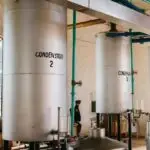
Crude oil is a mixture of many different hydrocarbons that boil at different temperatures. To separate these components, crude oil is processed in a refinery through a process called fractional distillation.
Fractional Distillation of Crude Oil:
This process separates crude oil into different fractions (products) based on their boiling points. The steps are:
- Heating: Crude oil is heated in a furnace to about 350-400°C, turning most of it into vapor.
- Fractionating Column: The hot mixture of liquid and vapor is then passed into a tall fractionating column, which is hotter at the bottom and cooler at the top.
- Vaporization and Condensation:
- Vapors rise up the column.
- As they rise, they cool.
- Different fractions condense at different temperatures (and therefore different levels) in the column.
- Fractions with higher boiling points condense lower down the column.
- Fractions with lower boiling points rise higher before condensing.
- Collection: The separated liquid fractions are collected at various levels as finished products or further processed.
Products Obtained from Crude Oil Refining (from top to bottom of the column):
- Refinery Gases (LPG): Used for cooking and heating (lowest boiling point).
- Gasoline (Petrol): Fuel for cars.
- Naphtha: Used to make chemicals (petrochemicals).
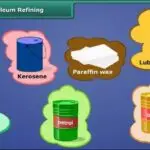
- Kerosene: Jet fuel, lighting, cooking.
- Diesel Oil (Gas Oil): Fuel for diesel engines, heating oil.
- Lubricating Oils: Engine lubricants.
- Fuel Oil: Fuel for ships and power stations.
- Bitumen/Asphalt: Used for road surfacing and roofing (highest boiling point, collected at the bottom).
Teaching Methods/Instructional Techniques
Discussion, Lecture, Demonstration, Question and Answer, Visual Aids
Instructional Procedures
Step 1: Introduction
Time: 5 minutes
Teaching Skill: Set Induction
Teacher’s Activity: The teacher asks pupils if they know where petrol, kerosene, and cooking gas come from. The teacher also asks pupils to name some things made of plastic.
Pupils’ Activity: Pupils respond by mentioning crude oil and various plastic items.
Learning Point: Pupils are introduced to the topic and relate it to their daily experiences.
Step 2: Meaning of Crude Oil
Time: 7 minutes
Teaching Skill: Explanation/Definition
Teacher’s Activity: The teacher explains what crude oil is, its origin, and its physical characteristics, using a chart or picture. The teacher emphasizes that crude oil is a mixture.
Pupils’ Activity: Pupils listen attentively, ask questions, and take notes on the definition and characteristics of crude oil.
Learning Point: Pupils understand what crude oil is and its basic properties.
Step 3: Meaning of Petrochemicals
Time: 7 minutes
Teaching Skill: Explanation/Listing
Teacher’s Activity: The teacher defines petrochemicals and gives examples of common products made from them, showing samples where available.
Pupils’ Activity: Pupils listen, identify the samples, and list examples of petrochemicals and their uses in their notes.
Learning Point: Pupils learn about petrochemicals and their importance in manufacturing everyday items.
Step 4: Refining of Crude Oil
Time: 10 minutes
Teaching Skill: Explanation/Demonstration
Teacher’s Activity: The teacher explains the process of crude oil refining using fractional distillation. The teacher uses a diagram of a fractional distillation column to illustrate how different products are separated based on their boiling points.
Pupils’ Activity: Pupils observe the diagram, listen to the explanation, and ask questions about the process.
Learning Point: Pupils understand that crude oil is separated into useful products through fractional distillation.
Step 5: Products of Crude Oil Refining
Time: 8 minutes
Teaching Skill: Listing/Discussion
Teacher’s Activity: The teacher lists and briefly explains the various products obtained from crude oil refining, from refinery gases to bitumen, linking them to their uses.
Pupils’ Activity: Pupils identify the products and their uses, discussing how they encounter these products in their daily lives.
Learning Point: Pupils identify and understand the uses of various products derived from crude oil.
Step 6: Evaluation/Review
Time: 5 minutes
Teaching Skill: Questioning/Assessment
Teacher’s Activity: The teacher evaluates the learning by asking the following questions:
- What is crude oil?
- Mention two characteristics of crude oil.
- Define petrochemicals and give two examples.
- Briefly explain how crude oil is refined.
- List three products obtained from the refining of crude oil.
Pupils’ Activity: Pupils answer orally and in writing.
Learning Point: Pupils demonstrate understanding of the lesson.
Step 7: Conclusion
Time: 3 minutes
Teaching Skill: Summarization
Teacher’s Activity: The teacher summarizes the key points of the lesson, reinforcing the importance of crude oil and its products. The teacher also assigns homework related to the topic.
Pupils’ Activity: Pupils listen and copy the homework.
Learning Point: Pupils consolidate their understanding of petrochemicals and their significance.
Lesson Keywords
- Crude Oil – A naturally occurring, unrefined petroleum product composed of hydrocarbon deposits and other organic materials.
- Petrochemicals – Chemical products derived from petroleum or natural gas.
- Refining – The process of purifying a raw material or a crude substance.
- Fractional Distillation – A process used to separate components of a liquid mixture based on differences in their boiling points.
- Hydrocarbons – Organic compounds consisting entirely of hydrogen and carbon.
Differentiation
For pupils who grasp concepts quickly, the teacher can encourage them to research the environmental impacts of crude oil extraction and refining. For pupils who need more support, the teacher can provide simplified diagrams and allow more time for questions and answers, focusing on basic definitions and one or two examples for each concept.
Note for teachers using this lesson plan
Ensure that the charts and diagrams used are clear and large enough for all pupils to see. Emphasize the relevance of the topic to Nigeria’s economy and daily life. Encourage pupils to relate the products of crude oil to items they use or see every day. Be prepared to discuss basic environmental concerns if pupils raise them.

Community Join the conversation Open discussion +