

Class: Senior Secondary School 2 (SS2 / SSS 2)
Term: Second Term
Week: 4
Age: 16 years
Duration: 45 minutes
Subject: Biology
Curriculum Theme: Regulation and Control
Previous Lesson: Pests and Diseases of Crops: Life Cycle and Control Methods.
Topic: REPRODUCTIVE SYSTEM IN FISH AND REPTILES
Subject Matter: Structures of male and female reproductive organ, parts and functions of male and female reproductive organ of fish and reptiles, structure of male and female gametes, differences between male and female reproductive organ of fish and reptiles.
Specific Objectives
By the end of the lesson, pupils should be able to:
Cognitive Domain:
- Identify the male and female reproductive organs in fish and reptiles.
- State the functions of the various parts of the reproductive organs in fish and reptiles.
- Describe the structures of male and female gametes in fish and reptiles.
- Differentiate between the reproductive systems of fish and reptiles.
Affective Domain:
- Appreciate the importance of reproduction for species survival.
- Develop an interest in the comparative anatomy of animal reproductive systems.
Psychomotor Domain:
- Draw and label the male and female reproductive organs of fish and reptiles.
- Draw and label the male and female gametes.
Social Domain:
- Collaborate effectively in groups to observe and identify reproductive structures from diagrams or specimens.
Reference Materials
The following resources were used in planning this lesson:
- Senior Secondary Schools Education Curriculum
- State Unified Scheme of Work
- Essential Biology for Senior Secondary Schools by M.C. Michael
- https://www.biologyonline.com/
- https://www.britannica.com/
Instructional Materials
The teacher will teach this lesson with the aid of:
- Biology textbook
- Posters showing diagrams of fish and reptile reproductive systems
- Dissected specimens of fish and a reptile (if available) or models
- Whiteboard/chalkboard and markers/chalk
Rationale for the Lesson
This lesson helps pupils understand how fish and reptiles reproduce, which is essential for the continuity of their species. It enables pupils to compare the reproductive strategies and structures across different animal groups, enhancing their knowledge of biological diversity.
Prerequisite/Previous Knowledge
Pupils have basic knowledge of animal classification and general body systems from their previous biology lessons.
Lesson Content/Board Summary
Reproductive System in Fish and Reptiles
Introduction to Reproductive Systems
The reproductive system is a system of organs within an organism that work together for the purpose of reproduction. Reproduction is the biological process by which new individual organisms are produced from their parents.
Reproductive System in Fish
Fish typically have separate sexes (dioecious), meaning there are distinct male and female individuals.
The following are the reproductive organs in fish:
- Male Reproductive Organs:
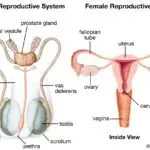
- Testes: These are paired organs located in the abdominal cavity, producing sperm (male gametes).
- Vas Deferens: Ducts that transport sperm from the testes to the urinogenital opening.
- Urinogenital Opening: The opening through which sperm are released, often shared with the urinary system.
- Female Reproductive Organs:
- Ovaries: Paired organs located in the abdominal cavity, producing eggs (female gametes).
- Oviducts: Ducts that transport eggs from the ovaries to the urinogenital opening.
- Urinogenital Opening: The opening through which eggs are released.
Structure of Gametes in Fish
- Sperm: Typically microscopic, with a head (containing genetic material), a midpiece (for energy), and a tail (for motility).
- Egg: Generally larger than sperm, containing yolk for nourishment of the embryo. Fertilization is usually external in most fish.
Reproductive System in Reptiles
Reptiles also have separate sexes. Fertilization in reptiles is internal.
The following are the reproductive organs in reptiles:
- Male Reproductive Organs:
- Testes: Paired organs located internally, producing sperm.
- Vas Deferens: Ducts that carry sperm from the testes to the cloaca.
- Hemipenes (in lizards and snakes) or a single penis (in turtles and crocodiles): Copulatory organs used for internal fertilization.
- Cloaca: A common opening for the digestive, urinary, and reproductive systems.
- Female Reproductive Organs:
- Ovaries: Paired organs producing eggs.
- Oviducts: Tubes where eggs are fertilized and shells are formed before being laid.
- Cloaca: A common opening through which eggs are laid.
Structure of Gametes in Reptiles
- Sperm: Similar to fish sperm, with a head, midpiece, and tail.
- Egg: Fertilized eggs are typically cleidoic (shelled) and contain a large amount of yolk for embryonic development, albumen, and protective membranes. They are laid on land.
Differences between Reproductive Systems of Fish and Reptiles
- Fertilization: Fish mostly exhibit external fertilization, while reptiles always have internal fertilization.
- Copulatory Organ: Most fish lack copulatory organs; reptiles possess hemipenes or a penis for internal fertilization.
- Egg Development: Fish eggs are typically laid in water and develop externally without a hard shell. Reptile eggs are cleidoic (shelled), laid on land, and contain significant yolk for terrestrial development.
- Cloaca: Present in reptiles as a common opening for all systems; in many fish, there are separate urinogenital and anal openings.
Teaching Methods/Instructional Techniques
Discussion, Lecture, Demonstration, Question and Answer, Visual Aids
Instructional Procedures
Step 1: Introduction
Time: 5 minutes
Teaching Skill: Set Induction
Teacher’s Activity: The teacher greets the pupils, reviews the previous lesson briefly, and then introduces the topic by asking pupils about how different animals reproduce.
Pupils’ Activity: Pupils respond to the teacher’s questions and listen attentively to the introduction of the new topic.
Learning Point: Pupils recall previous knowledge and are prepared for the new lesson.
Step 2: Presentation of Fish Reproductive System
Time: 10 minutes
Teaching Skill: Explanation/Demonstration
Teacher’s Activity: The teacher displays diagrams or dissected specimens of a fish, pointing out and explaining the male reproductive organs (testes, vas deferens, urinogenital opening) and their functions. The teacher also describes the structure of fish sperm.
Pupils’ Activity: Pupils observe the diagrams/specimens, listen to the explanations, and ask questions for clarification. They may also sketch the organs.
Learning Point: Pupils identify and understand the male reproductive organs and gametes in fish.
Step 3: Presentation of Fish Female Reproductive System
Time: 8 minutes
Teaching Skill: Explanation/Illustration
Teacher’s Activity: The teacher continues by explaining the female reproductive organs in fish (ovaries, oviducts, urinogenital opening) and their functions. The teacher also describes the structure of fish eggs.
Pupils’ Activity: Pupils observe, listen, and take notes on the female reproductive organs and gametes in fish.
Learning Point: Pupils identify and understand the female reproductive organs and gametes in fish.
Step 4: Presentation of Reptile Male Reproductive System
Time: 8 minutes
Teaching Skill: Explanation/Visualisation
Teacher’s Activity: The teacher presents diagrams or specimens of a reptile, explaining the male reproductive organs (testes, vas deferens, hemipenes/penis, cloaca) and their functions. The teacher also describes the structure of reptile sperm.
Pupils’ Activity: Pupils observe the diagrams/specimens, listen to the explanations, and participate in identifying the organs.
Learning Point: Pupils understand the male reproductive organs and gametes in reptiles.
Step 5: Presentation of Reptile Female Reproductive System
Time: 8 minutes
Teaching Skill: Explanation/Description
Teacher’s Activity: The teacher explains the female reproductive organs in reptiles (ovaries, oviducts, cloaca) and their functions. The teacher particularly emphasizes the structure of the reptile egg.
Pupils’ Activity: Pupils listen, take notes, and ask questions regarding the female reproductive organs and especially the shelled egg.
Learning Point: Pupils understand the female reproductive organs and gametes in reptiles.
Step 6: Comparison of Reproductive Systems
Time: 3 minutes
Teaching Skill: Comparative Analysis
Teacher’s Activity: The teacher leads a brief discussion comparing the key differences and similarities between the reproductive systems of fish and reptiles, focusing on fertilization, copulatory organs, and egg types.
Pupils’ Activity: Pupils contribute to the discussion by highlighting observed differences and similarities.
Learning Point: Pupils can compare and contrast the reproductive systems of fish and reptiles.
Step 7: Evaluation/Review
Time: 5 minutes
Teaching Skill: Questioning/Assessment
Teacher’s Activity: The teacher evaluates the learning by asking the following questions:
- List two male reproductive organs found in fish.
- Mention the primary function of the ovaries in both fish and reptiles.
- Describe two key differences between the reproductive system of a fish and a reptile.
- What is the significance of the cloaca in reptile reproduction?
Pupils’ Activity: Pupils answer orally and in writing.
Learning Point: Pupils demonstrate understanding of the lesson.
Step 8: Conclusion
Time: 2 minutes
Teaching Skill: Summarization
Teacher’s Activity: The teacher summarizes the main points of the lesson and assigns homework, which includes drawing and labeling the reproductive organs of a typical fish and a typical reptile.
Pupils’ Activity: Pupils listen to the summary and copy down the homework assignment.
Learning Point: Pupils consolidate their learning and prepare for further study.
Lesson Keywords
- Reproductive system – Organs involved in producing offspring.
- Gonads – Organs that produce gametes (e.g., testes, ovaries).
- Testes – Male gonads that produce sperm.
- Ovaries – Female gonads that produce eggs.
- Vas deferens – Ducts that carry sperm.
- Oviducts – Ducts that carry eggs.
- Sperm – Male gamete.
- Egg – Female gamete.
- Cloaca – Common opening for digestive, urinary, and reproductive systems in reptiles.
- Hemipenes – Paired copulatory organs in male lizards and snakes.
- Fertilization – Fusion of male and female gametes.
Differentiation
For struggling learners, the teacher will provide simplified diagrams and focus on identifying the main organs and their basic functions. Advanced learners will be encouraged to research different types of fish and reptile reproductive strategies (e.g., viviparity, ovoviviparity) and discuss evolutionary adaptations.
Note for teachers using this lesson plan
Teachers should ensure that diagrams are clear and well-labeled. If actual dissected specimens are available, supervise pupils closely during observation. Emphasize the connection between reproductive structures and the environment (aquatic vs. terrestrial) where fertilization and development occur. Encourage pupils to draw and label the organs as part of their note-taking.


Community Join the conversation Open discussion +