

Class: Senior Secondary School 2 (SS2 / SSS2)
Term: Second Term
Week: 5
Age: 16 years
Duration: 45 minutes
Subject: Biology
Curriculum Theme: Biology of Reproduction
Previous Lesson: Reproductive System in Fish and Reptiles.
Topic: REPRODUCTIVE SYSTEM IN BIRD AND MAMMALS
Subject Matter: Structures of male and female reproductive system, parts and function of the reproductive system, structures and differences of male and female gametes, differences between male and female reproductive organ
Specific Objectives
By the end of the lesson, pupils should be able to:
Cognitive Domain:
- Define the term reproductive system.
- Identify the structures of the male and female reproductive systems in mammals and birds.
- State the functions of each part of the reproductive systems.
- Describe the structures of male and female gametes.
Affective Domain:
- Appreciate the complexity and importance of reproductive systems in living organisms.
- Show interest in learning about the biological processes of reproduction.
- Recognize the role of reproduction in the continuity of species.
Psychomotor Domain:
- Draw and label the male and female reproductive organs of a mammal.
- Draw and label a mammalian sperm cell.
- Distinguish between male and female reproductive organs and gametes using diagrams or specimens.
Social Domain:
- Discuss respectfully the differences in reproductive systems among animals.
- Collaborate with peers in observing and discussing biological specimens.
Reference Materials
The following resources were used in planning this lesson:
- Senior Secondary Schools Education Curriculum
- State Unified Scheme of Work
- Modern Biology for Senior Secondary Schools by P.H.C. Okeke et al.
Instructional Materials
The teacher will teach this lesson with the aid of:
- Biology textbook
- Charts/posters showing male and female reproductive systems of mammals and birds
- Microscope
- Prepared slides of mammalian sperm and ovum
- Fresh sperm specimen from a rat (if available and feasible)
- Chalkboard/Whiteboard and markers/chalk
Rationale for the Lesson
This lesson helps pupils understand how living organisms reproduce, ensuring the continuation of their species. It enables pupils to identify and explain the different parts and functions of reproductive systems in birds and mammals, which is important for understanding life processes.
Prerequisite/Previous Knowledge
Pupils have basic knowledge of cell structure, simple life processes, and general animal characteristics from previous lessons.
Lesson Content/Board Summary
REPRODUCTIVE SYSTEM IN BIRDS AND MAMMALS
Introduction to Reproduction
Reproduction is the biological process by which new individual organisms are produced from their parents. It is a fundamental feature of all known life; each individual organism exists as the result of reproduction.
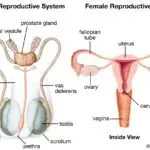
Male Reproductive System in Mammals
The male reproductive system produces sperm and delivers them to the female reproductive tract.
- Testes: Produce sperm and male hormones (testosterone). Located in the scrotum outside the body cavity for optimal temperature for sperm production.
- Epididymis: A coiled tube where sperm mature and are stored.
- Vas Deferens (Sperm Duct): Carries sperm from the epididymis to the urethra.
- Seminal Vesicles: Produce fluid that nourishes sperm and makes up a significant portion of semen.
- Prostate Gland: Produces a milky fluid that activates sperm and protects them from the acidic environment of the vagina.
- Urethra: A tube that carries both urine and semen out of the body through the penis.
- Penis: The external organ used for copulation and urination.
Female Reproductive System in Mammals
The female reproductive system produces eggs, receives sperm, and provides a suitable environment for fertilization and fetal development.
- Ovaries: Produce eggs (ova) and female hormones (estrogen and progesterone).
- Fallopian Tubes (Oviducts): Tubes that transport eggs from the ovaries to the uterus. Fertilization usually occurs here.
- Uterus: A muscular, pear-shaped organ where a fertilized egg implants and develops into a fetus.
- Cervix: The lower, narrow part of the uterus that opens into the vagina.
- Vagina: A muscular tube that connects the uterus to the outside of the body. It receives the penis during copulation and serves as the birth canal.
Male Reproductive System in Birds
The male bird reproductive system is internal and includes:
- Testes: Paired, oval-shaped organs located internally near the kidneys. They produce sperm.
- Vas Deferens: Tubes that carry sperm from the testes to the cloaca.
- Cloaca: A multi-purpose opening for the digestive, urinary, and reproductive tracts. In most birds, sperm transfer occurs by pressing cloacas together.
Female Reproductive System in Birds
Most female birds have only one functional ovary (the left one) and oviduct.
- Ovary: Contains follicles where ova (eggs) develop.
- Oviduct: A long, coiled tube divided into several regions:
- Infundibulum: Catches the ovulated egg.
- Magnum: Secretes albumen (egg white).
- Isthmus: Forms the shell membranes.
- Uterus (Shell Gland): Forms the hard outer shell.
- Vagina: Connects the uterus to the cloaca and stores sperm.
- Cloaca: The common opening for the digestive, urinary, and reproductive systems.
Structure of Gametes
Gametes are the reproductive cells (sperm in males, ova/eggs in females).
Mammalian Sperm Cell
A sperm cell is typically microscopic and motile.
- Head: Contains the nucleus with haploid chromosomes and an acrosome (cap-like structure) containing enzymes for penetrating the egg.
- Midpiece: Contains mitochondria which provide energy for movement.
- Tail (Flagellum): A long, whip-like structure that propels the sperm.
Mammalian/Bird Ovum (Egg Cell)
An ovum is generally larger than a sperm cell and non-motile.
- Nucleus: Contains haploid chromosomes.
- Cytoplasm: Contains nutrients (yolk in birds) to support the early development of the embryo.
- Cell Membrane: Surrounds the cytoplasm.
- Protective Layers: Zona pellucida (mammals) or vitelline membrane and albumen/shell (birds).
Differences Between Male and Female Gametes
- Size: Sperm are much smaller than ova.
- Motility: Sperm are motile (can move), while ova are non-motile.
- Number: Males produce millions of sperm, while females produce a limited number of ova.
- Yolk Content: Ova, especially in birds, contain significant yolk for embryonic nourishment; sperm have very little nutrient storage.
Differences Between Male and Female Reproductive Organs (Mammals)
- Location of Gonads: Male testes are typically external (in scrotum), while female ovaries are internal.
- Duct Systems: Males have vas deferens and urethra for sperm transport; females have fallopian tubes and uterus for egg transport and development.
- External Genitalia: Males have a penis; females have a vulva (labia, clitoris).
- Common Passageway: Male urethra serves both urinary and reproductive functions. Female systems are largely separate for urinary and reproductive functions, though the vagina and urethra are close.
Teaching Methods/Instructional Techniques
Discussion, Lecture, Demonstration, Question and Answer, Visual Aids
Instructional Procedures
Step 1: Introduction
Time: 5 minutes
Teaching Skill: Set Induction
Teacher’s Activity: The teacher greets the pupils and asks them to recall what they understand by reproduction in living organisms. The teacher then introduces the topic: Reproductive System in Bird and Mammals.
Pupils’ Activity: Pupils respond to the questions and listen attentively to the introduction.
Learning Point: Pupils are reminded of the concept of reproduction and introduced to the lesson’s focus.
Step 2: Explanation of Male Mammalian Reproductive System
Time: 10 minutes
Teaching Skill: Explanation/Demonstration
Teacher’s Activity: The teacher uses charts and diagrams to explain the structures and functions of the male reproductive system in mammals, pointing out the testes, epididymis, vas deferens, seminal vesicles, prostate gland, urethra, and penis. The teacher then mounts a fresh sperm specimen from a rat under a microscope and guides pupils to observe it.
Pupils’ Activity: Pupils observe the charts, listen to the explanations, and observe the sperm specimen under the microscope. They ask questions for clarification.
Learning Point: Pupils identify and understand the parts and functions of the mammalian male reproductive system and observe a sperm cell.
Step 3: Explanation of Female Mammalian Reproductive System
Time: 7 minutes
Teaching Skill: Explanation/Visualisation
Teacher’s Activity: The teacher uses charts and diagrams to explain the structures and functions of the female reproductive system in mammals, highlighting the ovaries, fallopian tubes, uterus, cervix, and vagina. The teacher may also show a prepared slide of an ovum.
Pupils’ Activity: Pupils observe the charts, listen to the explanations, and observe the ovum slide. They take notes.
Learning Point: Pupils identify and understand the parts and functions of the mammalian female reproductive system and observe an ovum.
Step 4: Explanation of Bird Reproductive Systems
Time: 7 minutes
Teaching Skill: Comparative Analysis
Teacher’s Activity: The teacher uses diagrams to explain the structures of both male and female reproductive systems in birds, emphasizing key differences from mammals, such as internal testes and the single functional ovary/oviduct in females, and the role of the cloaca.
Pupils’ Activity: Pupils observe the diagrams, compare them with mammalian systems, and note down the structures like testes, vas deferens, ovary, oviduct (infundibulum, magnum, isthmus, uterus, vagina), and cloaca.
Learning Point: Pupils understand the structures and functions of bird reproductive systems and note their unique features.
Step 5: Structure and Differences of Gametes
Time: 5 minutes
Teaching Skill: Description/Comparison
Teacher’s Activity: The teacher further describes the detailed structures of sperm and ovum, and then explains the key differences between male and female gametes (size, motility, number, yolk content) and between the overall male and female reproductive organs.
Pupils’ Activity: Pupils listen, ask questions, and make notes on the structures and differences of gametes and reproductive organs.
Learning Point: Pupils can describe gamete structures and differentiate between male and female gametes and reproductive organs.
Step 6: Drawing and Labeling
Time: 6 minutes
Teaching Skill: Practical Application
Teacher’s Activity: The teacher instructs pupils to draw and label a mammalian sperm cell and the male or female mammalian reproductive system based on their observations and notes.
Pupils’ Activity: Pupils draw and label the requested diagrams in their notebooks.
Learning Point: Pupils develop their observational and drawing skills, reinforcing their understanding of the structures.
Step 7: Evaluation/Review
Time: 5 minutes
Teaching Skill: Questioning/Assessment
Teacher’s Activity: The teacher evaluates the learning by asking the following questions:
- Define reproduction.
- List three parts of the mammalian male reproductive system and state one function for each.
- Mention two differences between a mammalian sperm cell and an ovum.
- Name two parts of the female reproductive system in birds and state their functions.
Pupils’ Activity: Pupils answer orally and in writing.
Learning Point: Pupils demonstrate understanding of the lesson.
Step 8: Conclusion
Time: 2 minutes
Teacher’s Activity: The teacher summarizes the main points of the lesson, reiterating the importance of the reproductive system in the continuity of life. The teacher assigns homework: “Draw and label the male and female reproductive systems of a bird.”
Pupils’ Activity: Pupils listen to the summary and copy the homework.
Learning Point: Pupils consolidate their understanding and are given an opportunity for further practice.
Lesson Keywords
- Reproduction – The process by which new individual organisms are produced.
- Gametes – Reproductive cells (sperm and ovum).
- Sperm – Male gamete.
- Ovum – Female gamete (egg).
- Testes – Male gonads that produce sperm and hormones.
- Ovaries – Female gonads that produce ova and hormones.
- Uterus – Organ in female mammals where the embryo develops.
- Oviduct – Tube through which eggs travel from the ovary to the uterus (mammals) or cloaca (birds).
- Cloaca – Common opening for digestive, urinary, and reproductive tracts in birds.
Differentiation
For pupils who grasp concepts quickly, the teacher can provide additional questions on reproductive hormones or comparative anatomy across different animal groups. For pupils needing more support, the teacher will provide simplified diagrams and one-on-one guidance during the drawing and labeling activities, focusing on core structures and functions.
Note for teachers using this lesson plan
Ensure that all diagrams are clear and accurately labeled. When demonstrating with a microscope, ensure all pupils have an opportunity to observe the specimens. Emphasize the functional significance of each part of the reproductive system. Encourage pupils to ask questions, especially on sensitive topics, and address them professionally.

Community Join the conversation Open discussion +