

Class: Senior Secondary School 1 (SS1, SS 1, SSS1, SSS 1)
Term: 2nd Term
Week: 3
Age: 15 years
Duration: 45 minutes
Subject: Building Construction
Curriculum Theme: Building Construction
Previous Lesson: Setting Out: Tools, Equipment and Procedures.
Topic: Excavation and Earth Work: Soil Types and Excavation Meaning
Subject Matter: types of soil such as clay and sandy soil, properties and classification of soil, characteristics of soils, definition of excavation, tools used for excavation
Specific Objectives
By the end of the lesson, pupils should be able to:
Cognitive Domain:
- Define excavation.
- Identify different types of soil.
- State the properties and characteristics of various soil types.
Affective Domain:
- Appreciate the importance of understanding soil types for construction.
- Show interest in observing different soil types during practical activities or site visits.
Psychomotor Domain:
- Observe and differentiate between various soil types on a construction site or through samples.
- Identify common tools used for excavation.
Social Domain:
- Collaborate with peers during observation and discussion of soil types.
Reference Materials
The following resources were used in planning this lesson:
- 9 Years Basic Education Curriculum for Building Construction.
- State Unified Scheme of Work for Senior Secondary Schools.
- Building Construction for Senior Secondary Schools by J.S. Aduwo.
Instructional Materials
The teacher will teach this lesson with the aid of:
- Shovel, pickaxe, mattock
- Pictures or videos of a digger (excavator) and bulldozer
- Soil samples (clay, sand, loam)
- Pictures of construction sites showing excavation.
Rationale for the Lesson
Understanding soil types and excavation is important in building construction. It helps pupils to know how to prepare a building site correctly and ensures that structures are built on stable ground. This knowledge helps to prevent future building failures.
Prerequisite/Previous Knowledge
Pupils should have a basic understanding of building materials and the general process of construction from their previous lessons.
Lesson Content/Board Summary
Excavation and Earth Work: Soil Types and Excavation Meaning
1. Definition of Soil
Soil is the loose surface material of the earth in which plants grow. It is a mixture of organic matter, minerals, gases, liquids, and organisms that together support life.
2. Types of Soil
There are different types of soil, each with unique properties:
- Clay Soil: This soil is heavy and sticky when wet, and hard when dry. It has very fine particles and poor drainage.
- Sandy Soil: This soil is light, gritty, and drains water quickly. It has large particles and does not retain much moisture or nutrients.
- Loamy Soil: This is a mixture of sand, silt, and clay. It is considered ideal for agriculture and some construction purposes due to its good drainage and nutrient retention.
- Silt Soil: This soil has medium-sized particles, smoother than sand but not as sticky as clay. It retains moisture better than sand but drains better than clay.
3. Properties and Characteristics of Soil
The following are important properties and characteristics of soil:
- Particle Size: Refers to the size of individual soil grains (e.g., sand has large particles, clay has small particles).
- Texture: Describes the feel of the soil, determined by the proportion of sand, silt, and clay.
- Colour: Varies based on mineral content and organic matter (e.g., dark for organic-rich, red for iron-rich).
- Water Retention: The ability of soil to hold water. Clay soils retain more water than sandy soils.
- Drainage: The rate at which water passes through the soil. Sandy soils drain faster than clay soils.
- Cohesion: The ability of soil particles to stick together. Clay soils have high cohesion.
- Bearing Capacity: The ability of soil to support loads without failure, important for foundations.
4. Definition of Excavation
Excavation is the process of digging or removing earth, rock, or other materials from a site using tools, equipment, or explosives. It is a fundamental step in construction, typically done to prepare for foundations, basements, or trenches for utilities.
5. Tools Used for Excavation
The following are common tools and equipment used for excavation:
- Hand Tools:
- Shovel: Used for digging, lifting, and moving loose materials.
- Pickaxe: Used for breaking hard soil or rocks.
- Mattock: Used for digging and grubbing out roots.
- Spade: Similar to a shovel, often used for cutting and lifting soil.
- Mechanical Equipment:
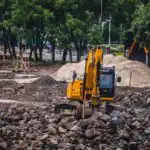
- Digger (Excavator): A heavy machine with a bucket for digging and moving large amounts of earth.
- Bulldozer: A powerful machine used for pushing large quantities of soil, sand, rubble, or other material.
- Backhoe: A tractor-like vehicle with a shovel on the front and a backhoe on the back, used for digging trenches.
- Trencher: A machine used for digging narrow trenches, especially for pipes and cables.
Teaching Methods/Instructional Techniques
Discussion, Lecture, Demonstration, Question and Answer, Visual Aids
Instructional Procedures
Step 1: Introduction
Time: 5 minutes
Teaching Skill: Set Induction
Teacher’s Activity: The teacher asks pupils about different types of ground or soil they have seen or walked on, relating it to building sites.
Pupils’ Activity: Pupils mention various surfaces like sandy ground, muddy areas, or hard earth.
Learning Point: Pupils connect their prior experiences to the topic of soil and construction.
Step 2: Identification of Soil Types
Time: 10 minutes
Teaching Skill: Explanation/Demonstration
Teacher’s Activity: The teacher displays samples of different soil types (e.g., clay, sand, loam if available) or uses pictures/charts to show and explain each type.
Pupils’ Activity: Pupils observe the samples/pictures, feel the texture (if samples are available), and listen to the explanations.
Learning Point: Pupils identify and differentiate between various soil types.
Step 3: Properties and Characteristics of Soil
Time: 10 minutes
Teaching Skill: Explanation/Questioning
Teacher’s Activity: The teacher explains the key properties and characteristics of each soil type, such as particle size, texture, water retention, and drainage, using the board summary.
Pupils’ Activity: Pupils take notes, ask questions for clarification, and discuss how these properties might affect building.
Learning Point: Pupils understand the important features of different soils and their relevance.
Step 4: Definition of Excavation
Time: 5 minutes
Teaching Skill: Definition/Illustration
Teacher’s Activity: The teacher defines excavation clearly and explains its purpose in construction, showing pictures or short video clips of excavated building sites.
Pupils’ Activity: Pupils listen, take notes, and contribute examples of excavation they might have seen in their environment.
Learning Point: Pupils comprehend the meaning and primary purpose of excavation in construction.
Step 5: Tools Used for Excavation
Time: 5 minutes
Teaching Skill: Identification/Demonstration
Teacher’s Activity: The teacher displays actual hand tools (if possible) or pictures of various hand tools and mechanical equipment used for excavation, explaining their functions.
Pupils’ Activity: Pupils identify the tools, discuss their uses, and differentiate between hand tools and mechanical equipment.
Learning Point: Pupils recognize and state the uses of common excavation tools and equipment.
Step 6: Practical Observation/Discussion
Time: 5 minutes
Teaching Skill: Observation/Discussion
Teacher’s Activity: The teacher leads a discussion on how different soil types affect the choice of excavation methods and tools. If a site visit is feasible, the teacher guides pupils to observe soil types and excavation activities.
Pupils’ Activity: Pupils ask questions, share observations, and discuss the practical implications of soil types on excavation.
Learning Point: Pupils relate theoretical knowledge of soil and excavation to practical application.
Step 7: Evaluation/Review
Time: 5 minutes
Teaching Skill: Questioning/Assessment
Teacher’s Activity: The teacher evaluates the learning by asking the following questions:
- Define excavation.
- Mention three types of soil and one characteristic of each.
- List four properties of soil.
- Name three hand tools and two mechanical equipment used for excavation.
Pupils’ Activity: Pupils answer orally and in writing.
Learning Point: Pupils demonstrate understanding of the lesson.
Step 8: Conclusion
Time: Ongoing
Teaching Skill: Summarization
Teacher’s Activity: The teacher summarizes the key learning points of the lesson, emphasizing the importance of understanding soil types and proper excavation techniques in building construction. The teacher assigns homework: Research the importance of soil testing before starting a building project.
Pupils’ Activity: Pupils listen attentively, ask any final questions, and copy down the homework assignment.
Learning Point: Reinforces the lesson and encourages further independent learning.
Lesson Keywords
- Soil – The loose surface material of the Earth in which plants grow.
- Clay Soil – A heavy, sticky soil with very fine particles and poor drainage.
- Sandy Soil – A light, gritty soil with large particles and good drainage.
- Loamy Soil – A balanced mixture of sand, silt, and clay, often considered ideal.
- Excavation – The process of digging or removing earth, rock, or other materials from a site.
- Shovel – A hand tool used for digging, lifting, and moving loose materials.
- Digger – A heavy machine (excavator) used for digging and moving large amounts of earth.
- Bulldozer – A powerful machine used for pushing large quantities of soil or other materials.
Differentiation
For visual learners, diagrams, pictures, and videos of soil types and excavation tools will be used. Kinesthetic learners will benefit from handling soil samples (if available) or observing excavation activities. Auditory learners will be engaged through teacher explanations and group discussions. Advanced learners will be encouraged to research soil bearing capacity and foundation types, while struggling learners will receive simplified definitions and additional support during identification tasks.
Note for teachers using this lesson plan
Emphasize safety precautions during any discussion or observation related to excavation sites. If an actual site visit is not feasible, utilize high-quality videos and detailed pictures to simulate the experience. Encourage pupils to bring small, labelled soil samples from their local environment for a practical session.


Community Join the conversation Open discussion +