

Class: Senior Secondary School 1 (SS1, SS 1, SSS1, SSS 1)
Term: 3rd Term
Week: 5
Age: 15 years
Duration: 45 minutes
Subject: Building Construction
Curriculum Theme: Building Construction
Previous Lesson: Walling Materials: Types and Properties.
Topic: Manufacturing of Walling Materials: Block and Brick Processes
Subject Matter: manufacturing process of sandcrete blocks, manufacturing process of clay bricks, stages of block and brick production, sizes of bricks and blocks, site visit to production area
Specific Objectives
By the end of the lesson, pupils should be able to:
Cognitive Domain:
- Define sandcrete block and clay brick.
- List the stages involved in the manufacturing process of sandcrete blocks.
- List the stages involved in the manufacturing process of clay bricks.
- State common sizes of sandcrete blocks and clay bricks.
Affective Domain:
- Appreciate the importance of proper manufacturing techniques for durable building materials.
- Participate actively in discussions about block and brick production.
Psychomotor Domain:
- Identify different sizes of sandcrete blocks and clay bricks.
- Observe the practical aspects of block and brick production during a site visit (if applicable).
Social Domain:
- Collaborate with peers during group activities or discussions related to building materials.
Reference Materials
The following resources were used in planning this lesson:
- 9 Years Basic Education Curriculum for Senior Secondary Schools.
- State Unified Scheme of Work for Building Construction SSS 1.
- Building Construction for Senior Secondary Schools by E.A. Odunlami.
- https://www.education.gov.ng/
- https://www.nerdc.gov.ng/
Instructional Materials
The teacher will teach this lesson with the aid of:
- Hand mould
- Moulding machine (picture/diagram)
- Pallets
- Mortar (samples or ingredients)
- Head pan
- Shovel
- Samples of sandcrete blocks and clay bricks
- Charts showing manufacturing stages
Rationale for the Lesson
This lesson helps pupils understand how essential building materials like blocks and bricks are made. Knowing these processes enables pupils to appreciate the quality and durability of structures around them and prepares them for potential careers in the construction industry.
Prerequisite/Previous Knowledge
Pupils should have basic knowledge of common building materials and their uses in construction.
Lesson Content/Board Summary
Manufacturing of Walling Materials: Block and Brick Processes
Manufacturing Process of Sandcrete Blocks
Sandcrete blocks are solid or hollow units made from a mixture of sand, cement, and water, compacted and cured.
The following are the stages in the manufacturing of sandcrete blocks:
- Batching: Measuring the correct proportions of sand, cement, and water.
- Mixing: Thoroughly blending the materials to achieve a uniform mix.
- Moulding: Compacting the mixture into block moulds using hand moulds or machine.
- Curing: Allowing the freshly moulded blocks to harden by keeping them moist, usually for 7 to 28 days.
- Drying/Stacking: Stacking the cured blocks for drying and storage.
Manufacturing Process of Clay Bricks
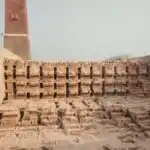
Clay bricks are rectangular blocks made from clay or shale, formed, dried, and then fired at high temperatures.
The following are the stages in the manufacturing of clay bricks:
- Excavation of Clay: Digging out suitable clay from the ground.
- Preparation of Clay: Cleaning, crushing, and mixing the clay with water to achieve plasticity (called pugging).
- Moulding: Shaping the plastic clay into brick forms, either by hand or machine (e.g., wire-cut or pressed bricks).
- Drying: Removing moisture from the moulded bricks in drying sheds or kilns to prevent cracking during firing.
- Firing: Baking the dried bricks at high temperatures (around 900-1200°C) in kilns to achieve strength and durability.
- Cooling and Stacking: Gradually cooling the fired bricks before stacking for storage.
Sizes of Blocks and Bricks
The following are common sizes of blocks and bricks:
- Sandcrete Blocks:
- 225mm x 225mm x 450mm (9 inches block)
- 150mm x 225mm x 450mm (6 inches block)
- 100mm x 225mm x 450mm (4 inches block)
- Clay Bricks (Standard):
- 215mm x 102.5mm x 65mm (Nigerian standard)
Site Visit to Production Area
A site visit to a block or brick production area provides practical exposure to the manufacturing processes. It helps pupils observe the stages, equipment, and quality control measures firsthand.
Teaching Methods/Instructional Techniques
Discussion, Lecture, Demonstration, Question and Answer, Visual Aids
Instructional Procedures
Step 1: Introduction
Time: 5 minutes
Teaching Skill: Set Induction
Teacher’s Activity: The teacher introduces the topic by asking pupils about the materials used to build the walls of their school or homes. The teacher then explains that today’s lesson will cover how these walling materials are made.
Pupils’ Activity: Pupils respond to the teacher’s questions and listen attentively.
Learning Point: Pupils are introduced to the lesson’s topic and its relevance.
Step 2: Presentation of Sandcrete Block Manufacturing Process
Time: 10 minutes
Teaching Skill: Explanation/Demonstration
Teacher’s Activity: The teacher explains the definition of sandcrete blocks and describes each stage of their manufacturing process (batching, mixing, moulding, curing, drying/stacking) using charts or diagrams and mentioning the instructional materials like hand mould, mortar, head pan, and shovel.
Pupils’ Activity: Pupils listen, take notes, and ask questions for clarification.
Learning Point: Pupils understand the steps involved in making sandcrete blocks.
Step 3: Presentation of Clay Brick Manufacturing Process
Time: 10 minutes
Teaching Skill: Explanation/Visualisation
Teacher’s Activity: The teacher explains the definition of clay bricks and outlines the stages of their production (excavation, preparation, moulding, drying, firing, cooling/stacking), emphasizing the role of kilns for firing.
Pupils’ Activity: Pupils pay attention, compare the process with sandcrete block making, and ask questions.
Learning Point: Pupils learn the stages of clay brick manufacturing.
Step 4: Sizes of Blocks and Bricks
Time: 5 minutes
Teaching Skill: Identification/Illustration
Teacher’s Activity: The teacher presents samples or pictures of sandcrete blocks and clay bricks, stating their common standard sizes. The teacher encourages pupils to identify the different sizes.
Pupils’ Activity: Pupils observe the samples, identify the sizes, and note them down.
Learning Point: Pupils can identify and state the common sizes of blocks and bricks.
Step 5: Discussion on Site Visit (if applicable)
Time: 5 minutes
Teaching Skill: Discussion/Observation
Teacher’s Activity: The teacher discusses the importance and potential benefits of a site visit to a block or brick production factory. If a visit was conducted, the teacher facilitates a discussion on pupils’ observations.
Pupils’ Activity: Pupils share their thoughts on the importance of site visits or discuss their observations from a past visit.
Learning Point: Pupils understand the practical relevance of observing production processes.
Step 6: Class Activity/Recap
Time: 5 minutes
Teaching Skill: Recall/Participation
Teacher’s Activity: The teacher asks pupils to briefly recap the main stages of block and brick production discussed so far.
Pupils’ Activity: Pupils orally recall and summarize the key stages of manufacturing for both sandcrete blocks and clay bricks.
Learning Point: Pupils reinforce their understanding of the lesson content.
Step 7: Evaluation/Review
Time: 5 minutes
Teaching Skill: Questioning/Assessment
Teacher’s Activity: The teacher evaluates the learning by asking the following questions:
- Define sandcrete block.
- List three stages in the manufacturing of sandcrete blocks.
- Mention two stages in the manufacturing of clay bricks.
- State two common sizes of sandcrete blocks.
Pupils’ Activity: Pupils answer orally and in writing.
Learning Point: Pupils demonstrate understanding of the lesson.
Step 8: Conclusion
Time: 5 minutes
Teaching Skill: Summarization/Assignment
Teacher’s Activity: The teacher summarizes the key points of the lesson, reiterating the importance of knowing how walling materials are manufactured. The teacher then gives pupils homework to draw and label the stages of sandcrete block production.
Pupils’ Activity: Pupils listen to the summary and copy down the homework.
Learning Point: Pupils consolidate their learning and are given tasks for further practice.
Lesson Keywords
- Sandcrete Block – A building unit made from sand, cement, and water.
- Clay Brick – A building unit made from clay, dried, and fired in a kiln.
- Moulding – The process of shaping raw materials into a desired form.
- Curing – The process of maintaining moisture and temperature for cement-based products to gain strength.
- Firing – The process of baking clay products at high temperatures to harden them.
- Batching – Measuring ingredients in correct proportions.
Differentiation
For pupils who grasp concepts quickly, the teacher can assign additional research on different types of blocks (e.g., interlocking blocks) or bricks (e.g., engineering bricks). For pupils needing more support, the teacher can provide simplified diagrams and offer one-on-one explanations during practical demonstrations.
Note for teachers using this lesson plan
Teachers should ideally bring actual samples of sandcrete blocks and clay bricks to the class for pupils to observe. If a site visit is not feasible, detailed videos or high-quality images of the manufacturing processes should be used to provide visual learning. Encourage pupils to relate the lesson to buildings in their immediate environment.

Community Join the conversation Open discussion +