

Class: Junior Secondary School 3 (JSS 3)
Term: 2nd Term
Week: 9
Age: 14 years
Duration: 45 minutes
Subject: Cultural And Creative Arts
Curriculum Theme: Cultural And Creative Arts
Previous Lesson: Making of Crotchets
Topic: Batik Work
Subject Matter: Meaning of batik, Materials and tools used in batik work, Making a batik project: Techniques.
SPECIFIC OBJECTIVES
By the end of the lesson, pupils should be able to:
- Cognitive Domain:
(a) Explain the meaning of batik work.
(b) Identify materials and tools used in batik production.
(c) Describe basic techniques involved in making batik. - Affective Domain:
(a) Appreciate batik as a form of cultural and creative expression.
(b) Show interest in textile crafts and indigenous art forms. - Psychomotor Domain:
(a) Handle batik tools and materials correctly.
(b) Produce a simple batik design using appropriate techniques. - Social Domain:
(a) Work cooperatively with classmates during batik activities.
(b) Respect others’ creative ideas and finished batik works.
REFERENCE MATERIALS
The following resources was used in planning this lesson:
- 9 Years Basic Education Curriculum
- Lagos State Unified Scheme of Work for Junior Secondary Schools
- Encyclopaedia Britannica – Batik textile art (https://www.britannica.com/art/batik)
- Victoria and Albert Museum – What is batik? (https://www.vam.ac.uk/articles/what-is-batik)
- Relevant Textbooks
INSTRUCTIONAL MATERIALS
The teacher will teach this lesson with the aid of:
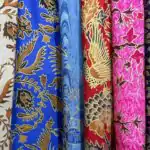
- Samples of batik fabrics
- Plain white cotton fabric
- Candle wax or paraffin wax
- Dyes and colouring agents
- Brushes and small containers
- Charcoal pencil
- Stove or heater (teacher use only)
- Charts showing batik processes
RATIONALE FOR THE LESSON
The lesson develops pupils’ creativity and practical skills while promoting appreciation of textile art and indigenous craft practices.
PREREQUISITE/PREVIOUS KNOWLEDGE
Pupils have prior knowledge of basic textile designs and simple art patterns from previous Cultural and Creative Arts lessons.
LESSON CONTENT/BOARD SUMMARY
BATIK WORK
Meaning of Batik
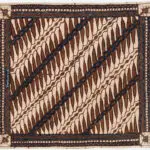
Batik is a traditional textile design technique in which melted wax is applied to fabric to create patterns before dyeing. The wax prevents dye from penetrating certain areas, forming decorative designs after removal.
Materials and Tools Used in Batik Work
Batik production requires specific materials and tools to achieve desired designs and colours.
The following are materials and tools used in batik work:
- Plain cotton fabric
- Candle wax or paraffin wax
- Fabric dyes or colourants
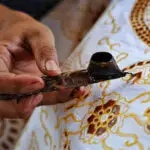
- Brushes or tjanting tools
- Charcoal pencil
- Stove or heat source
- Bowls or containers
Making a Batik Project: Techniques
Batik techniques involve careful application of wax and dye to produce decorative patterns on fabric.
The following are basic batik techniques:
- Wax-resist technique – applying wax to areas not intended to absorb dye
- Crackle effect – creating cracks in wax to form patterns
- Brushing technique – painting dye onto fabric surfaces
- Layering technique – repeated waxing and dyeing for complex designs
TEACHING METHODS/INSTRUCTIONAL TECHNIQUES
Discussion, Explanation, Demonstration, Visual Aids, Practical Activity, Group Work
INSTRUCTIONAL PROCEDURES
To deliver this lesson, the teacher will adopt the following steps:
Step 1: Introduction
Time: 5 minutes
Teaching Skill: Set Induction
Teacher’s Activity: Ask pupils questions about fabrics with patterns and display a batik sample to stimulate interest.
Pupils’ Activity: Observe the fabric and respond to questions.
Learning Point: Introduction to batik as a textile art form.
Step 2: Meaning of Batik Work
Time: 8 minutes
Teaching Skill: Explanation
Teacher’s Activity: Explain the meaning of batik and relate it to cultural textile practices.
Pupils’ Activity: Listen attentively and take brief notes.
Learning Point: Understanding what batik work is.
Step 3: Materials and Tools Used in Batik Work
Time: 8 minutes
Teaching Skill: Demonstration
Teacher’s Activity: Display and explain the use of each batik material and tool.
Pupils’ Activity: Observe materials and ask questions.
Learning Point: Identification of batik materials and tools.
Step 4: Batik Making Techniques
Time: 9 minutes
Teaching Skill: Demonstration and Explanation
Teacher’s Activity: Explain batik techniques and demonstrate wax application on fabric.
Pupils’ Activity: Observe the process carefully.
Learning Point: Knowledge of basic batik techniques.
Step 5: Note-Taking
Time: 5 minutes
Teaching Skill: Guided Writing
Teacher’s Activity: Guide pupils to copy the board summary into their notebooks.
Pupils’ Activity: Copy lesson notes.
Learning Point: Reinforcement of lesson content.
Step 6: Evaluation/Review
Time: 5 minutes
Teaching Skill: Questioning
Teacher’s Activity: The teacher evaluates the learning by asking the following questions:
- What is batik work?
- List three materials used in batik production.
- Mention two batik techniques.
- Explain the purpose of wax in batik work.
Pupils’ Activity: Answer questions orally.
Learning Point: Assessment of pupils’ understanding.
Step 7: Conclusion
Time: 5 minutes
Teaching Skill: Summarization
Teacher’s Activity: Summarize the lesson and encourage pupils to practice batik designs at home using safe materials.
Pupils’ Activity: Listen and respond to final remarks.
Learning Point: Consolidation of learning.
LESSON KEYWORDS
- Batik – textile design using wax and dye
- Wax-resist – technique of preventing dye penetration
- Dye – colouring substance for fabric
- Textile – fabric material
- Pattern – decorative design on fabric
DIFFERENTIATION
Use visual samples for visual learners, demonstrations for kinesthetic learners, and oral explanations for auditory learners.
NOTE FOR TEACHERS USING THIS LESSON PLAN
Ensure safety when handling hot wax. Supervise practical sessions closely and use illustrations where materials are limited.
Community Join the conversation Open discussion +