

Class: Primary Two
Term: Third Term
Subject: National Values Education
Curriculum Theme: Civic Education
Previous Lesson: The Disadvantages Of Choosing A Leader
Topic: Formation of Political Parties
Content/Learning Area: Defining a political party, mentioning how political parties are formed, Discussing the steps involved in forming a political party
Time Allocation: 40 minutes
Performance Objectives
By the end of the lesson, pupils should be able to:
- Cognitive Domain:
– Define a political party.
– Mention how political parties are formed.
– Discuss the steps involved in forming a political party.
- Psychomotor Domain:
– Actively participate in class discussions.- Take notes on the lesson.
- Affective domain:
– Show interest in learning about political parties.
– Appreciate the role of political parties in society.
- Social Domain:
– Work collaboratively with peers.
– Respect diverse opinions during discussions.
Reference Materials
- 9 – Years Basic Education Curriculum
- Abuja Educational Resource Center Scheme of Work
- NAPPS National Unified Scheme of Work
- Online Details
- Relevant Textbooks
instructional Materials
To deliver this lesson, the teacher will use a whiteboard or chart paper, markers, and relevant pictures or illustrations.
Rationale for the Lesson
Understanding how political parties are formed is crucial for developing informed and engaged citizens. This lesson provides a foundation for future learning about government and civic participation.
Prerequisite/Previous Knowledge
The teacher will start by asking pupils what they know about government and how decisions are made, sparking a brief discussion to gauge their prior knowledge and engage them in the topic.
Lesson Content
What is a Political Party?
A political party is a group of people who share similar beliefs and goals. they work together to influence the government and make decisions that affect the country.
How Political Parties Are Formed
The formation of political parties involves several key steps to bring together like-minded individuals and establish a recognized political entity.
These include:
- Group of Like-minded People: People with similar ideas and goals come together to form a party.
- Shared Interests: Members have common interests and work towards achieving those interests.
- Leadership Selection: The group chooses leaders to represent them and make decisions.
- Registration: The party registers with the relevant authorities to be officially recognized.
- Promotion and Campaign: The party promotes its ideas and campaigns for support to win elections.
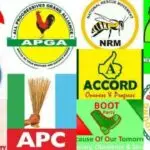
Examples of Political Parties
Political parties exist in various countries, each with its unique identity and objectives.
Examples are:
- The People’s democratic Party (PDP) in Nigeria: Known for its umbrella symbol.
- the All Progressives Congress (APC) in Nigeria: Known for its broom symbol.
- The Democratic Party in the United States: Known for its donkey symbol.
- The Republican Party in the United States: Known for its elephant symbol.
- Labor Party in the United Kingdom: Known for advocating for workers’ rights and social justice.
- African National Congress (ANC) in South Africa: Known for its ancient role in ending apartheid.
Teaching Methods
To deliver this lesson, the teacher will adopt the following methods: Discussion, Explanation, Question and Answer.
Instructional Procedures
To deliver this lesson, the teacher will adopt the following steps:
Step 1: Introduction
Time: 5 minutes
Teaching Skill: Set Induction
Teacher’s Activity: Briefly review the previous lesson and introduce the topic of political parties.
Pupils’ Activity: Listen attentively and respond to the teacher’s questions.
Step 2: Explanation of Key Concepts
Time: 10 minutes
Teaching Skill: Explanation
Teacher’s Activity: Define a political party and explain its purpose.
Pupils’ Activity: Listen attentively and take notes.
Step 3: Steps in Forming a Political Party
Time: 10 minutes
Teaching Skill: Guided practise
Teacher’s Activity: Explain the steps involved in forming a political party using examples.
Pupils’ Activity: Participate in a class discussion and answer questions.
step 4: Self-reliant Practice
Time: 5 minutes
Teaching Skill: Independent Practice
Teacher’s Activity: Ask pupils to list the steps involved in forming a political party.
Pupils’ Activity: Work individually or in pairs to complete the task.
Step 5: Note-Taking
Time: 5 minutes
Teaching Skill: note-Taking
Teacher’s Activity: Guide pupils in summarizing the key points of the lesson.
Pupils’ Activity: take notes on the key concepts and steps.
Step 6: Evaluation/Review
Time: 5 minutes
teaching Skill: questioning
Teacher’s Activity: Ask evaluation questions to assess pupils’ understanding.
Pupils’ Activity: Answer the evaluation questions.
Step 7: Conclusion
Time: 5 minutes
Teaching Skill: Closure
Teacher’s Activity: Summarize the key points and assign homework.
Pupils’ activity: Listen attentively and note down homework.
Lesson Keywords
- political Party – A group of people with similar beliefs who work together to influence the government.
- Leadership – The individuals who guide and represent a political party.
- Registration – The process of officially recognizing a political party with the relevant authorities.
- Campaign – Activities undertaken to promote a political party and gain support.
- Interests – Shared goals and concerns that members of a political party work towards.
Lesson Evaluation
To evaluate the learning, the teacher asks pupils to:
- What is a political party?
- What are three steps involved in forming a political party?
- Why are political parties vital?
- Name a political party in your country and describe its symbol.
- What might a political party campaign for?
Assignment/Homework
- Research and write about a political party in nigeria, including its history and goals.
- Draw the symbol of a political party and explain what it represents.
- List three reasons why political parties are critically important in a democracy.
Differentiation
- For slower learners: Provide one-on-one assistance and simplified explanations.
- For advanced learners: Encourage them to research and present information on additional political parties.
- For visual/auditory/kinesthetic learners: Use visual aids, discussions, and hands-on activities to cater to different learning styles.
Note for Teachers
Ensure to use real-life examples and visual aids to enhance pupils’ understanding. Encourage active participation and create a supportive learning environment.



Community Join the conversation Open discussion +