

Class: Primary Five
Term: First Term
Subject: National Values Education
Curriculum Theme: Civic Education
previous Lesson: Loyalty, Meaning And Evidence Of Loyalty In The Family
Topic: Loyalty too the Community
Content/Learning Area: Evidence of loyalty to the community, Importance of loyalty to the community, Ways to show loyalty to the community
Time Allocation: 40 minutes
Performance Objectives
By the end of the lesson, pupils should be able to:
- Cognitive Domain:
- List five pieces of evidence of loyalty to the community.
- Explain the meaning of loyalty to the community.
- affective Domain:
- Show willingness to participate in community activities.
- Express understanding of the benefits of community loyalty.
- Psychomotor Domain:
- Demonstrate gratitude for the importance of loyalty to the community through active participation in class discussions.
- Draw a picture illustrating an act of loyalty to the community.
- Social Domain:
- Engage in group discussions to identify ways to show loyalty to their community.
- Cooperate with peers during activities.
Reference Materials
- 9 – Years Basic Education Curriculum
- Abuja Educational Resource Center Scheme of Work
- NAPPS national Unified Scheme of Work
- Online Details
- Relevant Textbooks
Instructional Materials
To deliver this lesson, the teacher will use a whiteboard or chart paper, markers, and pictures illustrating community activities.
Rationale for the Lesson
Understanding loyalty to the community fosters responsible citizenship and contributes to a harmonious society. It teaches pupils the importance of contributing to their surroundings.
Prerequisite/Previous Knowledge
Pupils are familiar with the concept of helping others and being kind to their neighbors.
lesson Content
Loyalty to the Community
Loyalty to the community means being dedicated to its well-being and growth. It involves showing respect,participating in community activities,and helping to improve the community.
Evidence of Loyalty to the Community
Ways to show loyalty include:
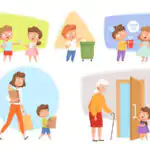
- Participating in Community Clean-Up: Helping keep the community clean.
- Respecting Community Rules: Following rules to maintain order and peace.
- Supporting Community Projects: Getting involved in and supporting projects that improve the community (e.g., building a playground).
- Helping Neighbors: Offering help to neighbors in need.
- promoting Community Harmony: Encouraging peace and unity among community members.
- Volunteering Time: Offering free time to assist in community events or initiatives.
- Reporting Issues: Informing relevant authorities about problems affecting the community, such as security concerns or infrastructure damage.
Teaching Methods
To deliver this lesson, the teacher will adopt the following methods: Discussion, Group work, Visual aids.
Instructional Procedures
To deliver this lesson, the teacher will adopt the following steps:
Step 1: Introduction
Time: 5 minutes
Teaching Skill: Set Induction
Teacher’s Activity: Asks pupils what they understand by the term “community”.
Pupils’ Activity: Respond to the teacher’s questions and share their understanding of the term “community”.
Step 2: Description of Key Concepts
Time: 10 minutes
Teaching Skill: Description
Teacher’s Activity: Explains the meaning of loyalty to the community,emphasizing its importance.
Pupils’ Activity: Listen attentively and ask clarifying questions.
Step 3: Exhibition/Guided Practice
Time: 10 minutes
Teaching Skill: Demonstration
Teacher’s Activity: Provides examples of loyalty to the community (e.g., participating in clean-up drives, respecting community rules).Pupils’ Activity: Participate in a class discussion, providing their own examples.
Step 4: Self-reliant Practice
Time: 5 minutes
Teaching Skill: Guided Practice
Teacher’s Activity: Guides pupils in group activities to brainstorm ways to show loyalty to their community.
Pupils’ Activity: Work in groups to brainstorm and share ideas.
Step 5: Note-Taking
Time: 5 minutes
Teaching Skill: Note-Taking
Teacher’s Activity: Summarizes key points on the board.
Pupils’ Activity: Take notes in their notebooks.
Step 6: Evaluation/Review
Time: 5 minutes
Teaching Skill: Questioning
Teacher’s Activity: Asks evaluation questions to assess understanding.
pupils’ activity: Answer the evaluation questions.
Objective-aligned checks:
- List five pieces of evidence of loyalty to the community.
- Explain the meaning of loyalty to the community.
- Draw a picture illustrating an act of loyalty to the community.
step 7: Conclusion
Time: 2 minutes
Teaching Skill: Summarizing
Teacher’s Activity: Summarizes the key points and encourages pupils to practice loyalty in their daily lives.
Pupils’ Activity: Listen attentively and ask any remaining questions.
Lesson Keywords
- Loyalty – Being faithful and committed to someone or something.
- Community – A group of people living in the same place or having a particular characteristic in common.
- Respect – Showing consideration and appreciation for others and their property.
- Participation – Taking part in activities or events.
- Harmony – Peaceful and friendly relations.
Lesson Evaluation
To evaluate the learning, the teacher asks pupils to:
- What dose loyalty to the community mean?
- List five examples of loyalty to the community.
- How does participating in a community clean-up demonstrate loyalty?
- Describe a way you can show loyalty to your community.
- Draw a picture of someone showing loyalty to their community.
Assignment/Homework
- Write a short paragraph about why loyalty to the community is important.
- List three ways you can show loyalty to your community at home.
- Interview a community leader about their experiences and the importance of community involvement.
Differentiation
- For slower learners: Provide one-on-one assistance and simplified explanations.
- For advanced learners: Encourage them to research additional ways to show community loyalty.
- For visual/auditory/kinesthetic learners: Use visual aids, discussions, and hands-on activities to cater to different learning styles.
Note for Teachers
Encourage pupils to share personal experiences related to community loyalty to make the lesson more engaging and relatable. emphasize the importance of practical application of the concepts discussed in the lesson.


Community Join the conversation Open discussion +