

Class: Pre-School Level 4
Term: Second Term
Week: 10
Age: 5 years
Duration: 30 minutes
Subject: Physical and Health Education
Curriculum Theme: Physical and Health Education
Previous Lesson: Simple movement activities like walking, jogging, and hopping.
Topic: TRACK EVENTS: RUNNING A 25-METRE RACE IN PAIRS
Subject Matter: TRACK EVENTS – Short distance race (25m race): Running in pairs.
Specific Objectives
By the end of the lesson, pupils should be able to:
Cognitive Domain
- Identify a short-distance race as a track event.
- State one reason why track events are important.
Affective Domain
- Show enthusiasm for participating in a running race.
- Listen and follow instructions during the race.
Psychomotor Domain
- Demonstrate proper running technique for a short distance.
- Participate in a 25-metre race, running in pairs.
Social Domain
- Take turns and run cooperatively with a partner.
- Celebrate participation and effort, not just winning.
Reference Materials
- NAPPS National Unified Teaching Scheme for Pre-School Level 4
- Early Childhood Care and Education curriculum resources
- Suitable early-years Physical and Health Education workbook
Instructional Materials
- Open playground or clear outdoor space
- Cones or markers to mark start and finish lines
- Whistle (for teacher to signal start/stop)
- Optional: Stop-watch (for teacher’s fun, not for competitive timing of pupils)
Rationale for the Lesson
This lesson helps 5-year-olds develop their gross motor skills, coordination, and stamina through running. Participating in a race in pairs also fosters social skills like cooperation, taking turns, and sportsmanship, all while promoting a healthy and active lifestyle from a young age.
Prerequisite/Previous Knowledge
Pupils can walk, run, and follow simple instructions. They have previously engaged in various movement activities and understand the concept of moving from one point to another.
Lesson Content/Board Summary
TRACK EVENTS: Running a 25-Metre Race in Pairs
Track events are fun activities where we use our bodies to run, jump, or throw. Today, we will learn about a running track event called a short-distance race.
What is a Short-Distance Race?
- A short-distance race means running very fast for a short way.
- It helps us use our energy and makes our bodies strong.
The 25-Metre Race
- A 25-metre race is like running about 25 big steps from one place to another.
- We will mark a start line and a finish line.
Running in Pairs
- Running in pairs means two friends run together at the same time.
- You will stand next to your partner and run to the finish line together.
Importance of Track Events (Like Running)
- They help us stay healthy and strong.
- They make us active and happy.
- They teach us to play together and follow rules.
Key Words
- Track: A path where we run races.
- Race: A competition to see who can run or move fastest.
- Pairs: Two people together.
- Fast: Moving quickly.
- Finish Line: The end point of a race.
What the Teacher Should Show or Draw
- Demonstrate a good running posture (straight back, looking forward, pumping arms).
- Show how to stand at the start line.
- Show how to run towards the finish line.
- Demonstrate how two pupils can stand side-by-side to run in pairs.
- Draw a simple start and finish line on the ground with chalk or use cones.
Movement Rhyme: Run, Run, Run So Fast!
Tune: “Twinkle, Twinkle Little Star”
Lyrics:
Run, run, run so fast,
To the finish, don’t be last.
Side by side with a friend,
Run together to the end.
Run, run, run so fast,
Having fun, what a blast!
Actions:
- “Run, run, run so fast” – Jog lightly in place, pump arms.
- “To the finish, don’t be last” – Point forward.
- “Side by side with a friend” – Hold hands with an imaginary friend or stand next to a peer.
- “Run together to the end” – Jog lightly again.
- “Having fun, what a blast!” – Clap hands and smile.
How to use the rhyme: Sing this rhyme before the race to get pupils excited and ready to run. It reinforces the idea of running with a friend.
Watch and Move Along
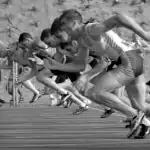
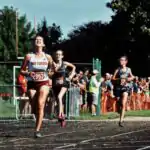
Let’s watch some children running and having fun, then we can try it ourselves!
Teaching Methods/Instructional Techniques
Play-based Learning, Demonstration, Guided Practice, Songs and Rhymes, Question and Answer, Imitation, Practical Activity.
Instructional Procedures
Step 1: Introduction (Warm-up)
Time: 5 minutes
Teaching Skill: Engagement/Warm-up
Teacher’s Activity: The teacher greets the pupils and leads them in a simple warm-up exercise. “Good morning, active boys and girls! Today we’re going to have a super fun running race! But first, let’s get our bodies ready. Let’s stretch our arms up high, touch our toes, and do some gentle jogging in place.”
Pupils’ Activity: Pupils greet the teacher and participate in the warm-up exercises, stretching and jogging lightly.
Learning Point: Pupils prepare their bodies for physical activity and understand the importance of warming up.
Step 2: Introduction to Track Events and Short Races
Time: 4 minutes
Teaching Skill: Explanation/Concept Introduction
Teacher’s Activity: The teacher explains what track events are, focusing on running. “Track events are like sports where we run, jump, or throw. Today, we’re going to do a running track event! It’s called a short-distance race. Does anyone know what ‘race’ means?” The teacher listens to responses and clarifies. “It means we run from one place to another as fast as we can!”
Pupils’ Activity: Pupils listen attentively and respond to the teacher’s questions about what a race is.
Learning Point: Pupils understand the basic concept of a track event and a short-distance race.
Step 3: Demonstration of Running a 25-Metre Distance
Time: 5 minutes
Teaching Skill: Demonstration/Modelling
Teacher’s Activity: The teacher marks a start and finish line (about 25 big steps apart) using cones or chalk. The teacher demonstrates how to stand at the start line, listen for a signal, and run to the finish line with good form. “Watch me! I will stand here at the start line. When I say ‘Go!’, I will run fast to the finish line. See how my arms move and I look forward?”
Pupils’ Activity: Pupils observe the teacher’s demonstration, paying attention to the start, running, and finish.
Learning Point: Pupils observe the correct way to run a short distance and identify the start and finish lines.
Step 4: Individual Practice Running the 25-Metre Distance
Time: 4 minutes
Teaching Skill: Guided Practice
Teacher’s Activity: The teacher invites pupils to practice running the 25-metre distance individually or in small groups, ensuring safe spacing. “Now it’s your turn! One by one, or in small groups, let’s practice running from the start to the finish. Remember to run fast and safe!” The teacher provides encouragement and gentle correction.
Pupils’ Activity: Pupils take turns practicing running the 25-metre distance, trying to run fast and safely.
Learning Point: Pupils gain confidence and practice their running skills for a short distance.
Step 5: Explaining and Demonstrating Running in Pairs
Time: 4 minutes
Teaching Skill: Explanation/Demonstration
Teacher’s Activity: The teacher explains the concept of “running in pairs” and demonstrates with two pupils or another teacher. “Today, we’re going to run in pairs! That means two friends will run side-by-side. Look, I will choose two friends to show us. They will stand together at the start line and run to the finish line together. It’s about having fun with a friend!”
Pupils’ Activity: Pupils watch the demonstration of running in pairs and identify what “running in pairs” means.
Learning Point: Pupils understand how to run cooperatively with a partner.
Step 6: Running the 25-Metre Race in Pairs
Time: 4 minutes
Teaching Skill: Practical Activity/Facilitation
Teacher’s Activity: The teacher pairs up the pupils and organizes them to run the 25-metre race in pairs. “Now, everyone find a partner! Stand side-by-side at the start line. When I blow the whistle, run to the finish line with your friend! Remember to have fun!” The teacher supervises closely, ensuring safety and encouraging all participants.
Pupils’ Activity: Pupils pair up, stand at the start line, and participate in the 25-metre race in pairs, running to the finish line.
Learning Point: Pupils actively participate in a track event, practicing running and cooperation.
Step 7: Evaluation/Review
Time: 2 minutes
Teaching Skill: Questioning/Assessment
Teacher’s Activity: The teacher checks pupils’ understanding through short questions and practical tasks.
- “What kind of event did we do today? Was it running or jumping?”
- “How many friends ran together in our race?” (Point to two fingers)
- “Show me how you stood at the start line.”
- “Why is it good to run and play?”
Pupils’ Activity: Pupils respond orally and demonstrate the required skill where appropriate.
Learning Point: Pupils demonstrate understanding of the lesson.
Step 8: Conclusion (Cool-down)
Time: 2 minutes
Teaching Skill: Reinforcement/Cool-down
Teacher’s Activity: The teacher leads pupils in a cool-down activity, such as slow walking and gentle stretches. “Great job everyone! You all ran so well. Let’s walk slowly now to cool down our bodies. Remember, running makes us strong and healthy, and it’s fun to do with friends!”
Pupils’ Activity: Pupils participate in the cool-down exercises and listen to the teacher’s concluding remarks.
Learning Point: Pupils cool down their bodies and reinforce the benefits of physical activity.
Lesson Keywords
- Track: A special path or area for sports like running.
- Race: A game where people run fast to see who gets to the end first.
- Pairs: Two people or things together.
- Fast: Moving very quickly.
- Finish Line: The place where a race ends.
Differentiation
- Support: For pupils who are less confident or slower, the teacher can pair them with a slightly faster but supportive partner, reduce the distance slightly, or provide more direct encouragement and hand-holding if needed. Focus on participation and effort rather than speed.
- Extension: For pupils who are very active and quick, the teacher can challenge them to run a slightly longer distance (e.g., 30m) or encourage them to demonstrate good running form to their peers. They could also be challenged to lead a warm-up exercise.
Note for teachers using this lesson plan
Before the lesson, ensure the playground or outdoor space is clear of any obstacles and is safe for running. Mark the start and finish lines clearly with cones, chalk, or tape. Emphasize safety throughout the activity, reminding children to look where they are going and not to push or trip others. The main goal is participation, enjoyment, and developing gross motor skills and social interaction, not competitive winning. Encourage all pupils, regardless of speed, and celebrate their effort. The 25-metre distance is an approximation; focus on the concept of a short race rather than precise measurement. Repeat the rhyme as often as needed to reinforce the lesson’s theme and energize the children.
Community Join the conversation Open discussion +