

Class: Pre-School Level 4
Term: Third Term
Week: 9
Age: 5 years
Duration: 30 minutes
Subject: Physical and Health Education
Curriculum Theme: Not separately stated in the scheme.
Previous Lesson: Understanding different types of indoor games.
Topic: CHESS: MEANING AND BASIC PLAY
Subject Matter: CHESS – Concept of chess. Weekly focus: Chess: Meaning and Basic Play.
Specific Objectives
By the end of the lesson, pupils should be able to:
Cognitive Domain
- Identify a chess board when shown.
- State that chess is an indoor game.
- Tell that two players are needed for a chess game.
Affective Domain
- Show interest in learning about chess.
- Appreciate chess as a game that helps with thinking.
Psychomotor Domain
- Point to the squares and pieces on a chess board.
- Demonstrate taking turns during a simple game activity.
Social Domain
- Participate in discussions about playing games fairly.
- Take turns when interacting with the chess board.
Reference Materials
- NAPPS National Unified Teaching Scheme for Pre-School Level 4.
- Early Childhood Care and Education resources on indoor games.
- Relevant early-years physical and health education textbooks.
Instructional Materials
- A real chess board and pieces.
- Charts showing a chess board and different chess pieces.
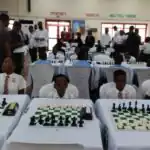
- Pictures of children playing chess.
Rationale for the Lesson
Learning about chess at this age introduces pupils to a valuable indoor game that promotes critical thinking, patience, and strategic skills. It helps children understand the concept of rules, taking turns, and fair play, all while engaging in a calm and focused activity that complements more active physical education lessons.
Prerequisite/Previous Knowledge
Pupils can identify different types of games, understand the concept of playing indoors, and know how to take turns during simple activities.
Lesson Content/Board Summary
CHESS: MEANING AND BASIC PLAY
Chess is a fun and challenging indoor game played by two players. It is played on a special board with black and white squares, using different kinds of pieces.
Why is chess an indoor game?
- It is played inside a room or building.
- It does not need a large field or space to play.
- It is a quiet game that makes you think.
Basic Play (for young children):
- There is a special board with squares.
- There are different pieces that look unique.
- Only two people play at one time.
- Players take turns to move their pieces.
- It helps you to think and be patient.
Key Words
- Chess – A game played by two people on a board with special pieces.
- Board – The flat surface with squares where chess is played.
- Pieces – The different playing objects used in chess.
- Indoor game – A game played inside a building.
What the Teacher Should Show or Draw
- Display a real chess board and pieces.
- Point to the black and white squares on the board.
- Show the different shapes of the chess pieces (e.g., King, Queen, Rook, Pawn, without naming all).
- Show pictures of children sitting and playing chess calmly.
Chess Fun Rhyme
Tune: “Twinkle, Twinkle Little Star”
Chess, oh chess, a game so grand,
Played by two, hand in hand.
On a board of black and white,
Thinking hard with all our might.
Indoor fun for you and me,
Smart and patient we will be!
Actions:
- “Chess, oh chess, a game so grand,” – Hold hands up like a board.
- “Played by two, hand in hand.” – Hold up two fingers, then clasp hands.
- “On a board of black and white,” – Point to an imaginary board.
- “Thinking hard with all our might.” – Tap head gently.
- “Indoor fun for you and me,” – Point to self and then to others.
- “Smart and patient we will be!” – Nod head and smile.
How to use the rhyme: Sing the rhyme together after introducing the basic concept of chess to reinforce the key ideas of two players, the board, and thinking.
Watch and Learn About Chess
The teacher will show a short, age-appropriate video clip introducing the chess board and pieces.
Teaching Methods/Instructional Techniques
Play-based Learning, Demonstration, Picture Talk, Question and Answer, Guided Practice, Songs and Rhymes, Manipulation of Objects, Repetition.Instructional Procedures
Step 1: Introduction
Time: 3 minutes
Teaching Skill: Engagement/Recall
Teacher’s Activity: The teacher greets the pupils and asks them to name some indoor games they know. The teacher then introduces a new indoor game called “Chess” by showing a covered chess board.
Pupils’ Activity: Pupils respond by naming indoor games like Ludo, Snakes and Ladders. They show curiosity about the covered object.
Learning Point: Pupils recall previous knowledge of indoor games and are introduced to the topic.
Step 2: Meaning of Chess
Time: 5 minutes
Teaching Skill: Explanation/Demonstration
Teacher’s Activity: The teacher uncovers the chess board, displays it, and explains in simple terms that chess is an indoor game played by two people on this special board with different pieces. The teacher asks, “Why do you think it’s called an indoor game?”
Pupils’ Activity: Pupils observe the chess board, listen to the explanation, and offer simple reasons why it’s an indoor game (e.g., “It’s played inside,” “You don’t run around”).
Learning Point: Pupils understand that chess is an indoor game played by two people.
Step 3: Identifying the Chess Board and Pieces
Time: 4 minutes
Teaching Skill: Identification/Observation
Teacher’s Activity: The teacher points to the black and white squares on the board and then shows the different chess pieces, emphasizing that they all look different. The teacher asks pupils to point to the board and then to some pieces.
Pupils’ Activity: Pupils observe the board and pieces, then point to the chess board and some individual pieces as requested by the teacher.
Learning Point: Pupils can identify a chess board and recognise that it has different pieces.
Step 4: Basic Play – Two Players and Taking Turns
Time: 5 minutes
Teaching Skill: Concept Building/Guided Practice
Teacher’s Activity: The teacher explains that only two people play chess at a time. The teacher demonstrates with two pupils how players take turns to move their pieces (without actually moving them according to rules, just showing the concept of “my turn, your turn”).
Pupils’ Activity: Pupils observe the demonstration and then practice taking turns with a partner using an imaginary board or a real board, simply pointing to where they would “move” a piece.
Learning Point: Pupils understand that chess is played by two people who take turns.
Step 5: Benefits of Playing Chess
Time: 3 minutes
Teaching Skill: Discussion/Reinforcement
Teacher’s Activity: The teacher asks pupils, “Why do you think playing chess is good for us?” The teacher explains that chess helps us think, be patient, and solve problems, making our brains stronger.
Pupils’ Activity: Pupils offer ideas (e.g., “It’s fun,” “It makes you smart”). They listen to the teacher’s explanation of the benefits.
Learning Point: Pupils appreciate that chess helps them think and be patient.
Step 6: Rhyme and Video Reinforcement
Time: 6 minutes
Teaching Skill: Auditory/Visual Learning
Teacher’s Activity: The teacher leads the pupils in singing the “Chess Fun Rhyme” with actions. Afterwards, the teacher shows the short video about the chess board and pieces to reinforce the visual aspects of the lesson.
Pupils’ Activity: Pupils sing the rhyme with actions and watch the video attentively, pointing out things they recognise.
Learning Point: Pupils reinforce their understanding through song and visual aids.
Step 7: Evaluation/Review
Time: 4 minutes
Teaching Skill: Questioning/Assessment
Teacher’s Activity: The teacher checks pupils’ understanding through short questions and practical tasks.
- “Point to the chess board.”
- “Tell me one thing about chess.”
- “Is chess an indoor or outdoor game?”
- “How many players play chess?”
Pupils’ Activity: Pupils respond orally and demonstrate the required skill where appropriate (e.g., pointing to the board).
Learning Point: Pupils demonstrate understanding of the lesson.
Step 8: Conclusion
Time: 1 minute
Teaching Skill: Summarisation
Teacher’s Activity: The teacher praises the pupils for their participation and reminds them that chess is a wonderful game that makes them smart. The teacher encourages them to ask an adult to show them more about chess at home.
Pupils’ Activity: Pupils listen and respond with “Thank you, teacher!”
Learning Point: Pupils conclude the lesson with a positive impression of chess.
Lesson Keywords
- Chess – A game played by two people on a board with special pieces.
- Board – The playing surface with squares for chess.
- Pieces – The different playing objects used in chess.
- Indoor game – A game played inside a building.
- Players – The people who play the game.
Differentiation
- Support: For pupils who struggle to identify the board or pieces, the teacher can use larger charts or real objects for closer inspection, provide hand-over-hand guidance for pointing, and repeat explanations slowly. Peer support can also be encouraged.
- Extension: For quicker pupils, the teacher can ask them to identify the different colours of the squares on the board, or ask them to explain in their own words why thinking is important when playing chess. They can also be encouraged to count the number of squares along one side of the board.
Note for teachers using this lesson plan
Before the lesson, ensure you have a clean chess board and pieces ready for demonstration. If a real set is unavailable, clear charts or large pictures are essential. The main goal for this age group is to introduce the *concept* of chess: what it looks like, that it’s an indoor game, played by two people, and involves thinking. Avoid getting into the specific moves of pieces, as this is too complex for 5-year-olds in an introductory lesson. Focus on identification, simple rules like taking turns, and the benefits. Encourage active participation by allowing pupils to touch the board and pieces (under supervision) and to demonstrate taking turns. Observe if pupils can correctly point to the board and pieces and articulate that it’s an indoor game played by two. Repeat the rhyme multiple times to aid memory and engagement.
Community Join the conversation Open discussion +