

Class: Senior Secondary School 2 (SS2 / SSS2)
Term: 3rd Term
Week: 2
Age: 16 years
Duration: 45 minutes
Subject: Basic Electronics
Curriculum Theme: Electrical and Electronic Devices
Previous Lesson: Measuring Instruments: Concept and Classification (Analogue and Digital).
Topic: MEASURING INSTRUMENTS
Subject Matter: Meaning of MEASURING INSTRUMENTS, types and uses of measuring instruments (multimeter, voltmeter, ammeter, oscilloscope, ohmmeter, wattmeter)
Specific Objectives
By the end of the lesson, pupils should be able to:
Cognitive Domain:
- Define measuring instruments.
- Identify different types of measuring instruments.
- State the uses of various measuring instruments.
Affective Domain:
- Appreciate the importance of measuring instruments in electronics.
- Develop an interest in using electronic measuring tools.
Psychomotor Domain:
- Handle basic measuring instruments correctly.
- Demonstrate the measurement of simple electrical quantities using appropriate instruments.
Social Domain:
- Collaborate with peers when identifying and using measuring instruments.
Reference Materials
The following resources were used in planning this lesson:
- Senior Secondary Schools Education Curriculum
- State Unified Scheme of Work
- Basic Electronics for Senior Secondary Schools by O. A. Adebayo
Instructional Materials
The teacher will teach this lesson with the aid of:
- Charts showing various measuring instruments
- Circuit boards with components
- Actual measuring instruments (e.g., multimeter, voltmeter, ammeter, ohmmeter, oscilloscope, wattmeter – if available)
Rationale for the Lesson
This lesson helps pupils understand the tools used to test and troubleshoot electronic circuits. It enables them to identify and use common measuring instruments, which is important for practical work and understanding how electronic devices function.
Prerequisite/Previous Knowledge
Pupils should have basic knowledge of electricity, electronic components, and fundamental electrical quantities like voltage, current, and resistance.
Lesson Content/Board Summary
MEASURING INSTRUMENTS
Meaning of Measuring Instruments
Measuring instruments are tools or devices used to determine the value or quantity of a physical property, such as voltage, current, resistance, or power, in an electrical or electronic circuit. They provide quantitative data about the performance of a circuit.
Types and Uses of Measuring Instruments
The following are common types of measuring instruments and their uses:
-
Multimeter
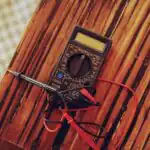
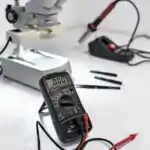
A multimeter is a portable electronic measuring instrument that combines several measurement functions in one unit. It is used to measure voltage (volts), current (amperes), and resistance (ohms) in a circuit.
-
Voltmeter
A voltmeter is an instrument used to measure the electric potential difference (voltage) between two points in an electrical circuit. It is connected in parallel across the component whose voltage is to be measured.
-
Ammeter
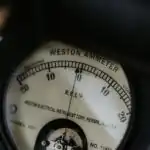
An ammeter is an instrument used to measure the electric current flowing through a circuit. It is connected in series with the component or circuit path where the current is to be measured.
-
Ohmmeter
An ohmmeter is an electronic instrument used to measure electrical resistance in ohms. It is typically used to test continuity or the resistance of components when the circuit is de-energized.
-
Oscilloscope
An oscilloscope is an electronic test instrument that allows observation of varying signal voltages, usually as a two-dimensional plot of one or more signals as a function of time. It is used to display and analyze waveforms.
-
Wattmeter
A wattmeter is an electrical instrument used to measure electric power in watts. It measures the rate at which electrical energy is consumed or produced in a circuit.
Teaching Methods/Instructional Techniques
Discussion, Lecture, Demonstration, Question and Answer, Visual Aids
Instructional Procedures
Step 1: Introduction
Time: 5 minutes
Teaching Skill: Set Induction
Teacher’s Activity: The teacher greets the pupils and asks them to mention some tools they know are used for taking measurements in daily life.
Pupils’ Activity: Pupils respond by mentioning tools like rulers, tape measures, scales, etc.
Learning Point: Pupils recall prior knowledge related to measurement.
Step 2: Explanation of Measuring Instruments
Time: 10 minutes
Teaching Skill: Explanation/Definition
Teacher’s Activity: The teacher explains what measuring instruments are in the context of electronics and their general importance.
Pupils’ Activity: Pupils listen attentively and take notes.
Learning Point: Pupils understand the meaning and purpose of measuring instruments.
Step 3: Introduction of Types of Measuring Instruments
Time: 10 minutes
Teaching Skill: Identification/Classification
Teacher’s Activity: The teacher displays charts or actual measuring instruments (multimeter, voltmeter, ammeter, oscilloscope, ohmmeter, wattmeter) and introduces each one by name.
Pupils’ Activity: Pupils observe the instruments and identify them by their names.
Learning Point: Pupils can identify common types of measuring instruments.
Step 4: Demonstration of Uses
Time: 10 minutes
Teaching Skill: Demonstration/Practical Application
Teacher’s Activity: The teacher demonstrates how each instrument is used to measure specific electrical quantities on a simple circuit board, explaining the readings.
Pupils’ Activity: Pupils watch the demonstration carefully and ask questions for clarification.
Learning Point: Pupils observe the practical application of each instrument.
Step 5: Practical Activity
Time: 5 minutes
Teaching Skill: Guided Practice
Teacher’s Activity: The teacher guides pupils to practice using a multimeter to measure voltage, current, and resistance on simple circuits.
Pupils’ Activity: Pupils, in groups or individually, attempt to use the instruments under supervision.
Learning Point: Pupils gain hands-on experience with measuring instruments.
Step 6: Discussion and Clarification
Time: 5 minutes
Teaching Skill: Questioning/Feedback
Teacher’s Activity: The teacher addresses any questions or difficulties pupils encountered during the practical activity and clarifies misconceptions.
Pupils’ Activity: Pupils ask questions and participate in discussions.
Learning Point: Pupils’ understanding is reinforced and clarified.
Step 7: Evaluation/Review
Time: 5 minutes
Teaching Skill: Questioning/Assessment
Teacher’s Activity: The teacher evaluates the learning by asking the following questions:
- Define measuring instruments.
- Mention three types of measuring instruments.
- State the main use of a voltmeter.
- How is an ammeter connected in a circuit to measure current?
Pupils’ Activity: Pupils answer orally and in writing.
Learning Point: Pupils demonstrate understanding of the lesson.
Step 8: Conclusion
Time: 5 minutes
Teaching Skill: Summarization
Teacher’s Activity: The teacher summarizes the key points of the lesson, emphasizing the importance of accurate measurement in electronics and assigns homework to research other types of measuring instruments.
Pupils’ Activity: Pupils listen to the summary and copy the homework.
Learning Point: Pupils consolidate their learning and are prepared for further study.
Lesson Keywords
- Multimeter – An instrument that measures voltage, current, and resistance.
- Voltmeter – An instrument used to measure voltage.
- Ammeter – An instrument used to measure current.
- Ohmmeter – An instrument used to measure resistance.
- Oscilloscope – An instrument used to display and analyze waveforms.
- Wattmeter – An instrument used to measure electric power.
Differentiation
For pupils who grasp the concepts quickly, the teacher can challenge them to explain the internal workings of some instruments. For those needing more support, the teacher can provide one-on-one guidance during the practical activity and simplified diagrams.
Note for teachers using this lesson plan
Ensure that actual measuring instruments are available for pupils to see and ideally use. Safety precautions regarding handling electrical circuits and instruments should be clearly communicated and strictly followed. Encourage pupils to ask questions and explore the functions of each instrument.
Community Join the conversation Open discussion +