

Class: Senior Secondary School 2 (SS2 / SSS 2)
Term: 2nd Term
Week: 3
Age: 16 years
Duration: 45 minutes
Subject: Basic Electronics
Curriculum Theme: Nil
Previous Lesson: Integrated Circuits and Micro-Processors: Application of IC and Microprocessors.
Topic: INTEGRATED CIRCUIT (IC) AND MICRO-PROCESSORS.
Subject Matter: Meaning of INTEGRATED CIRCUIT (IC) AND MICRO-PROCESSORS, concepts of micro-processors, RAM, ROM, EPROM, applications of micro-processors.
Specific Objectives
By the end of the lesson, pupils should be able to:
Cognitive Domain:
- Define Integrated Circuit (IC).
- Explain the basic concept of a microprocessor.
- State the full meaning and function of RAM, ROM, and EPROM.
- List various applications of microprocessors.
Affective Domain:
- Appreciate the importance of microprocessors in modern electronic devices.
- Show interest in learning more about digital electronics.
Psychomotor Domain:
- Identify examples of devices that utilize microprocessors.
- Differentiate between various memory types (RAM, ROM, EPROM) based on their characteristics.
Social Domain:
- Discuss with peers the impact of microprocessor technology on daily life.
Reference Materials
The following resources were used in planning this lesson:
- Senior Secondary Schools Education Curriculum
- State Unified Scheme of Work
- Basic Electronics for Senior Secondary Schools Textbook
Instructional Materials
The teacher will teach this lesson with the aid of:
- Chart on micro-processors
- Whiteboard and markers
- Examples of devices containing microprocessors (e.g., old phone, calculator)
Rationale for the Lesson
This lesson enables pupils to understand the fundamental components of modern electronic systems, specifically integrated circuits and microprocessors. Understanding these concepts helps pupils grasp how many devices they use daily function, from computers to mobile phones.
Prerequisite/Previous Knowledge
Pupils should have a basic understanding of electronic components like resistors, capacitors, and diodes, as well as an elementary concept of digital electronics from previous lessons.
Lesson Content/Board Summary
INTEGRATED CIRCUIT (IC) AND MICRO-PROCESSORS
Meaning of Integrated Circuit (IC)
An Integrated Circuit (IC), also known as a microchip or chip, is a miniature electronic circuit fabricated on a single piece of semiconductor material, usually silicon. It combines many transistors, diodes, resistors, and capacitors into a tiny package, performing specific electronic functions.
Meaning of Microprocessor
A microprocessor is an Integrated Circuit (IC) that contains the entire Central Processing Unit (CPU) of a computer on a single chip. It is the “brain” of a computer or any digital device, responsible for executing instructions, performing arithmetic and logical operations, and managing the overall operation of the system.
Concepts of Microprocessors
Microprocessors are designed to process data based on instructions stored in memory. They communicate with other components like memory and input/output devices to perform tasks. Key components within a microprocessor include the Arithmetic Logic Unit (ALU), Control Unit (CU), and Registers.
Random Access Memory (RAM)
RAM stands for Random Access Memory. It is a type of computer memory that can be read from and written to by the microprocessor. RAM is volatile, meaning it loses its stored information when power is removed. It is used for temporarily storing data and programs that are actively being used by the microprocessor, allowing for fast access.
Read-Only Memory (ROM)
ROM stands for Read-Only Memory. It is a type of non-volatile memory, meaning the data stored in it remains even when the power is turned off. The information stored in ROM is typically permanent and cannot be easily altered by the user. It often contains essential startup instructions (firmware) for the computer or device.
Erasable Programmable Read-Only Memory (EPROM)
EPROM stands for Erasable Programmable Read-Only Memory. It is a type of non-volatile memory that can be erased by exposing it to strong ultraviolet (UV) light. Once erased, it can be reprogrammed with new data. EPROMs are typically identified by a quartz window on their package, which allows UV light to reach the silicon chip inside for erasing.
Applications of Microprocessors
Microprocessors are widely used in a vast array of electronic devices due to their versatility and small size. The following are some applications of microprocessors:
- Computers: Desktops, laptops, servers, tablets.
- Mobile Phones: Smartphones and feature phones.
- Control Systems: Industrial automation, robotics, traffic light control.
- Embedded Devices: Digital cameras, washing machines, microwaves, smart TVs.
- Automotive Electronics: Engine control units, anti-lock braking systems (ABS), infotainment systems.
- Medical Equipment: Pacemakers, diagnostic machines, monitoring devices.
- Consumer Electronics: Gaming consoles, DVD/Blu-ray players, digital watches.
- Networking Equipment: Routers, modems, switches.
Teaching Methods/Instructional Techniques
Discussion, Lecture, Demonstration, Question and Answer, Visual Aids
Instructional Procedures
Step 1: Introduction
Time: 5 minutes
Teaching Skill: Set Induction
Teacher’s Activity: The teacher greets the pupils and asks them to recall basic electronic components and their functions. The teacher then introduces the topic of Integrated Circuits and Microprocessors, relating it to devices they use daily.
Pupils’ Activity: Pupils respond to the questions and listen attentively to the introduction.
Learning Point: Pupils connect previous knowledge to the new topic and understand the relevance of the lesson.
Step 2: Integrated Circuit (IC)
Time: 7 minutes
Teaching Skill: Explanation/Definition
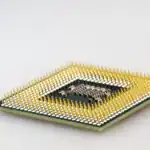
Teacher’s Activity: The teacher defines an Integrated Circuit (IC) and explains its significance as a miniature electronic circuit combining many components. The teacher may show a picture or an actual IC.
Pupils’ Activity: Pupils listen, observe, and ask questions for clarity. They copy the definition into their notes.
Learning Point: Pupils understand the meaning of an Integrated Circuit.
Step 3: Microprocessor
Time: 8 minutes
Teaching Skill: Explanation/Illustrative
Teacher’s Activity: The teacher explains what a microprocessor is, highlighting its role as the “brain” of digital devices and its basic functions (executing instructions, performing calculations).
Pupils’ Activity: Pupils listen and contribute examples of devices they know that have a “brain” or processing unit. They write down the definition.
Learning Point: Pupils grasp the core concept and function of a microprocessor.
Step 4: Random Access Memory (RAM)
Time: 5 minutes
Teaching Skill: Explanation/Comparison
Teacher’s Activity: The teacher explains the meaning of RAM, its volatility, and its primary use in temporarily storing active data for the microprocessor.
Pupils’ Activity: Pupils listen and note down the definition and characteristics of RAM.
Learning Point: Pupils learn about RAM as a volatile, read/write memory.
Step 5: Read-Only Memory (ROM)
Time: 5 minutes
Teaching Skill: Explanation/Comparison
Teacher’s Activity: The teacher explains the meaning of ROM, emphasizing its non-volatile nature and its role in storing permanent startup instructions.
Pupils’ Activity: Pupils listen and differentiate ROM from RAM based on the explanation. They copy the definition.
Learning Point: Pupils understand ROM as a non-volatile, read-only memory.
Step 6: Erasable Programmable Read-Only Memory (EPROM)
Time: 5 minutes
Teaching Skill: Explanation/Description
Teacher’s Activity: The teacher explains EPROM, its erasable and reprogrammable features, and how it differs from standard ROM.
Pupils’ Activity: Pupils listen and record the definition and key features of EPROM.
Learning Point: Pupils learn about EPROM as a type of reprogrammable ROM.
Step 7: Evaluation/Review
Time: 5 minutes
Teaching Skill: Questioning/Assessment
Teacher’s Activity: The teacher evaluates the learning by asking the following questions:
- Define an Integrated Circuit (IC).
- What is a Microprocessor?
- State the full meaning of RAM, ROM, and EPROM.
- List three applications of microprocessors.
Pupils’ Activity: Pupils answer orally and in writing.
Learning Point: Pupils demonstrate understanding of the lesson.
Step 8: Conclusion
Time: 5 minutes
Teaching Skill: Summarization/Assignment
Teacher’s Activity: The teacher summarizes the key points of the lesson, reinforcing the definitions and applications discussed. The teacher then gives pupils an assignment to find out more about other types of memory like EEPROM and Flash memory.
Pupils’ Activity: Pupils listen to the summary and copy down the assignment.
Learning Point: Pupils consolidate their understanding and are encouraged to research further.
Lesson Keywords
- Integrated Circuit (IC) – A miniature electronic circuit on a single semiconductor material.
- Microprocessor – An IC containing the entire CPU of a computer.
- RAM – Random Access Memory; volatile memory for active data.
- ROM – Read-Only Memory; non-volatile memory for permanent data.
- EPROM – Erasable Programmable Read-Only Memory; erasable with UV light.
- Volatile Memory – Memory that loses its data when power is removed.
- Non-volatile Memory – Memory that retains its data even without power.
Differentiation
The teacher will provide additional visual aids and simplified explanations for struggling learners. Advanced learners will be encouraged to research the internal architecture of microprocessors and different types of memory not covered in detail.
Note for teachers using this lesson plan
Ensure pupils grasp the fundamental difference between volatile and non-volatile memory. Encourage pupils to bring examples of old electronic devices (e.g., calculators, old phones) where they can potentially identify ICs or discuss their functions. Emphasize the widespread use of microprocessors in everyday technology.


Community Join the conversation Open discussion +