

Class: Senior Secondary School 1 (SS1, SS 1, SSS1, SSS 1)
Term: 2nd Term
Week: 5
Age: 15 years
Duration: 45 minutes
Subject: Auto Mechanic Work
Curriculum Theme: Auto Mechanic Work
Previous Lesson: Types of Drive and Vehicle Driving Arrangement.
Topic: TRANSMISSION SYSTEM – Suspension System Types and Functions
Subject Matter: suspension system meaning, laminated spring, coil spring, torsion bar, functions of suspension system
Specific Objectives
By the end of the lesson, pupils should be able to:
Cognitive Domain:
- Define the term ‘suspension system’.
- Identify and list different types of suspension systems.
- State at least three functions of a vehicle’s suspension system.
Affective Domain:
- Appreciate the importance of a properly functioning suspension system for vehicle safety and comfort.
- Show interest in learning about various automotive components.
Psychomotor Domain:
- Differentiate between laminated springs, coil springs, and torsion bars.
- Sketch simple diagrams of the different suspension components.
Social Domain:
- Participate actively in class discussions regarding vehicle suspension systems.
- Collaborate with peers to identify components from diagrams or actual parts.
Reference Materials
The following resources were used in planning this lesson:
- 9 Years Basic Education Curriculum for Senior Secondary Schools (Auto Mechanic Work).
- State Unified Scheme of Work for Auto Mechanic Work SSS 1.
- Heitner, A. (2006). Automobile Mechanics. Macmillan Publishers.
- Internet resources on automotive suspension systems.
Instructional Materials
The teacher will teach this lesson with the aid of:
- Charts illustrating different suspension system types (laminated spring, coil spring, torsion bar).
- Posters showing the layout of a complete suspension system.
- Actual or miniature models of suspension components (if available).
- Whiteboard and markers.
Rationale for the Lesson
This lesson helps pupils understand how a vehicle’s suspension system works to provide a smooth ride and maintain tire contact with the road. Knowing about suspension types and their functions is important for diagnosing vehicle problems and ensuring safety and comfort during driving.
Prerequisite/Previous Knowledge
Pupils should have basic knowledge of vehicle components and the general purpose of a transmission system from previous lessons.
Lesson Content/Board Summary
TRANSMISSION SYSTEM – Suspension System Types and Functions
Meaning of Suspension System
The suspension system of a vehicle is a group of components that connect the wheels to the chassis. It allows relative motion between the wheels and the body, absorbing shocks and vibrations from the road to provide a comfortable ride and maintain tire contact for vehicle control.
Types of Suspension Systems
There are several types of suspension systems, categorized by the springing medium used. The common types include:
Laminated Spring (Leaf Spring)
A laminated spring, also known as a leaf spring, consists of several layers of steel plates of varying lengths, stacked on top of each other. The longest plate is at the top, and the shortest is at the bottom. These plates are held together by a central bolt and clamps. Laminated springs are commonly used in heavy-duty vehicles like trucks and buses due to their strength and load-carrying capacity.
Coil Spring
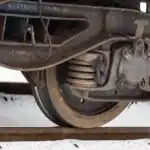
A coil spring is a helical spring made from a heavy gauge steel wire that is wound into a coil shape. It works by compressing and expanding to absorb shocks. Coil springs are widely used in modern passenger cars and light trucks, often in conjunction with shock absorbers, because they offer a good balance of comfort and handling.
Torsion Bar
A torsion bar is a long, straight bar of spring steel that twists along its axis to provide spring action. One end of the bar is anchored to the vehicle chassis, and the other end is connected to a suspension arm. When the wheel moves up or down, the bar twists, resisting the movement and providing suspension. Torsion bars are compact and durable, found in some cars and light trucks.
Functions of the Suspension System
The suspension system performs several important functions in a vehicle:
- It helps to absorb shocks and vibrations from the road, providing a comfortable ride for occupants.
- It maintains tire contact with the road surface, improving traction and vehicle control.
- It supports the weight of the vehicle and its load.
- It helps to maintain proper steering geometry and wheel alignment.
- It protects the vehicle’s chassis, engine, and other components from damage due to road irregularities.
- It allows the wheels to move independently over bumps without significantly affecting the vehicle body.
Teaching Methods/Instructional Techniques
Discussion, Lecture, Demonstration, Question and Answer, Visual Aids
Instructional Procedures
Step 1: Introduction
Time: 5 minutes
Teaching Skill: Set Induction
Teacher’s Activity: The teacher greets the pupils and asks them what makes a car ride smoothly over bumps and rough roads. The teacher then introduces the topic: “Transmission System – Suspension System Types and Functions.”
Pupils’ Activity: Pupils respond to the questions and listen attentively to the introduction.
Learning Point: Pupils are introduced to the concept of vehicle suspension and its importance.
Step 2: Explanation of Suspension System
Time: 5 minutes
Teaching Skill: Explanation/Definition
Teacher’s Activity: The teacher explains what a suspension system is, using simple language and relating it to everyday experiences of driving on different roads. The teacher emphasizes its role in comfort and control.
Pupils’ Activity: Pupils listen and ask questions for clarification.
Learning Point: Pupils understand the meaning and general purpose of a suspension system.
Step 3: Explanation of Laminated Spring
Time: 5 minutes
Teaching Skill: Illustration/Description
Teacher’s Activity: The teacher explains the structure and working principle of a laminated spring, using charts or actual models. The teacher mentions its common application in heavy vehicles.
Pupils’ Activity: Pupils observe the charts/models and take notes.
Learning Point: Pupils learn about the laminated spring as a type of suspension component.
Step 4: Explanation of Coil Spring
Time: 5 minutes
Teaching Skill: Illustration/Description
Teacher’s Activity: The teacher describes the coil spring, showing how it looks and explaining its function of compressing and expanding. The teacher highlights its use in modern passenger cars.
Pupils’ Activity: Pupils compare the coil spring to the laminated spring and note their differences.
Learning Point: Pupils understand the coil spring as another type of suspension component.
Step 5: Explanation of Torsion Bar
Time: 5 minutes
Teaching Skill: Illustration/Description
Teacher’s Activity: The teacher explains the concept of a torsion bar, describing how it twists to provide spring action. The teacher points out its compact nature and application.
Pupils’ Activity: Pupils listen and try to visualize the twisting action of the bar.
Learning Point: Pupils learn about the torsion bar as a unique suspension component.
Step 6: Explanation of Functions of Suspension System
Time: 10 minutes
Teaching Skill: Listing/Elaboration
Teacher’s Activity: The teacher lists and explains the various functions of the suspension system, writing key points on the board. The teacher encourages pupils to think about what would happen if a car had no suspension.
Pupils’ Activity: Pupils contribute ideas, write down the functions, and ask questions.
Learning Point: Pupils understand the critical roles the suspension system plays in a vehicle.
Step 7: Evaluation/Review
Time: 5 minutes
Teaching Skill: Questioning/Assessment
Teacher’s Activity: The teacher evaluates the learning by asking the following questions:
- Define the term ‘suspension system’.
- List three different types of suspension systems discussed.
- State two important functions of a vehicle’s suspension system.
- Differentiate between a laminated spring and a coil spring.
Pupils’ Activity: Pupils answer orally and in writing.
Learning Point: Pupils demonstrate understanding of the lesson.
Step 8: Conclusion
Time: 5 minutes
Teaching Skill: Summarization/Assignment
Teacher’s Activity: The teacher summarizes the main points of the lesson, reiterating the importance of the suspension system. The teacher gives pupils an assignment to draw and label one type of suspension spring.
Pupils’ Activity: Pupils listen to the summary and copy down the assignment.
Learning Point: Pupils consolidate their learning and receive further practice.
Lesson Keywords
- Suspension System – The system of springs, shock absorbers, and linkages that connects a vehicle to its wheels and allows relative motion between the two.
- Laminated Spring – Also known as a leaf spring, it consists of several layers of steel plates used in suspension.
- Coil Spring – A helical spring made of steel wire, commonly used in vehicle suspension to absorb shocks.
- Torsion Bar – A straight bar of spring steel that twists to provide springing action in a suspension system.
- Shock Absorber – A device that dampens the oscillations of the springs in a vehicle’s suspension system.
Differentiation
For pupils who grasp concepts quickly, the teacher can challenge them to identify vehicles that use specific suspension types. For pupils who need more support, the teacher can provide additional diagrams or simplified explanations and allow them to work in pairs.
Note for teachers using this lesson plan
Ensure that the instructional materials, especially charts and models, are clearly visible to all pupils. Encourage active participation and questions to clarify understanding. Emphasize the practical implications of a good suspension system for safety and comfort.



Community Join the conversation Open discussion +