

Class: Senior Secondary School 1 (SS1, SS 1, SSS1, SSS 1)
Term: First Term
Week: 8
Age: 15 years
Duration: 45 minutes
Subject: Basic Electricity
Curriculum Theme: Basic Electricity
Previous Lesson: Resistor Color Coding and Uses.
Topic: CAPACITORS
Subject Matter: Definition of capacitor, types of capacitors, circuit symbols of capacitors, applications and uses of capacitors
Specific Objectives
By the end of the lesson, pupils should be able to:
Cognitive Domain:
- Define a capacitor.
- List at least three types of capacitors.
- Draw the circuit symbols for different capacitors.
- State at least three applications of capacitors.
Affective Domain:
- Appreciate the importance of capacitors in electronic circuits.
- Show interest in identifying different types of capacitors.
Psychomotor Domain:
- Identify various capacitor types from physical examples.
- Sketch the circuit symbols of polarised and non-polarised capacitors.
Social Domain:
- Participate actively in class discussions regarding capacitor applications.
Reference Materials
The following resources were used in planning this lesson:
- 9 Years Basic Education Curriculum for Basic Science and Technology.
- State Unified Scheme of Work for Senior Secondary School 1 (SS1, SS 1, SSS1, SSS 1) Basic Electricity.
- Basic Electricity for Senior Secondary Schools by A.O. Okoro.
Instructional Materials
The teacher will teach this lesson with the aid of:
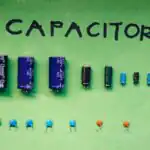
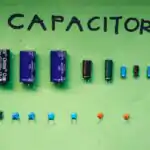
- Assorted capacitors (e.g., electrolytic, ceramic, film).
- Circuit symbol charts showing capacitor symbols.
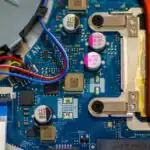
- Sample circuit boards containing capacitors.
Rationale for the Lesson
This lesson helps pupils understand an important component in electrical and electronic circuits. Learning about capacitors enables pupils to grasp how many common devices around them function, from simple radios to complex computers, and prepares them for further studies in electronics.
Prerequisite/Previous Knowledge
Pupils have prior knowledge of basic electrical components like resistors and conductors, and a general understanding of electric current and circuits.
Lesson Content/Board Summary
CAPACITORS
Definition of Capacitor
A capacitor is an electrical component used to store electrical energy in an electric field. It consists of two conducting plates separated by an insulating material called a dielectric.
Types of Capacitors
Capacitors are classified based on their dielectric material, construction, and whether their capacitance can be varied. The following are common types of capacitors:
- Electrolytic Capacitors: Have a polarised nature (positive and negative terminals) and offer high capacitance values. Used for power supply filtering.
- Ceramic Capacitors: Small, non-polarised, and suitable for high-frequency applications.
- Film Capacitors: Use plastic film as a dielectric, offering good stability and low loss.
- Variable Capacitors: Capacitance can be changed mechanically or electronically, often used in tuning circuits (e.g., radios).
Circuit Symbols of Capacitors
The following are the standard circuit symbols for capacitors:
- Non-polarised Capacitor: Two parallel lines.
- Polarised Capacitor (Electrolytic): One straight line and one curved line, with a plus sign indicating the positive terminal.
- Variable Capacitor: Non-polarised symbol with an arrow passing through it.
Applications and Uses of Capacitors
Capacitors have numerous applications in electronic circuits. The following are some common uses:
- Energy Storage: Used in camera flashes, defibrillators, and uninterruptible power supplies (UPS).
- Filtering/Smoothing: Used in power supplies to smooth out pulsating DC voltage.
- Timing Circuits: Used in combination with resistors to create delays or oscillations.
- Tuning Circuits: Used in radios and televisions to select specific frequencies.
- Coupling and Decoupling: Used to block DC signals while allowing AC signals to pass, or to bypass unwanted signals to ground.
Teaching Methods/Instructional Techniques
Discussion, Lecture, Demonstration, Question and Answer, Visual Aids
Instructional Procedures
Step 1: Introduction
Time: 5 minutes
Teaching Skill: Set Induction
Teacher’s Activity: The teacher greets the pupils and reviews the previous lesson briefly. The teacher then introduces the new topic by asking pupils if they have seen any electronic devices and if they know what components are inside them. The teacher then displays various types of capacitors and asks pupils to observe them.
Pupils’ Activity: Pupils respond to greetings, recall previous knowledge, observe the displayed components, and attempt to identify them.
Learning Point: Pupils are prepared for the new lesson and their interest is aroused.
Step 2: Definition of Capacitor
Time: 5 minutes
Teaching Skill: Explanation/Definition
Teacher’s Activity: The teacher defines a capacitor as an electrical component that stores electrical energy in an electric field and explains its basic structure (two plates separated by a dielectric). The teacher writes the definition on the board.
Pupils’ Activity: Pupils listen attentively, take notes, and ask questions for clarification.
Learning Point: Pupils understand the fundamental definition and function of a capacitor.
Step 3: Types of Capacitors
Time: 7 minutes
Teaching Skill: Classification/Demonstration
Teacher’s Activity: The teacher discusses and demonstrates various types of capacitors using the assorted physical capacitors. The teacher highlights key characteristics of each type, such as polarisation and typical applications, and lists them on the board.
Pupils’ Activity: Pupils observe the physical capacitors, listen to the explanations, identify different types, and copy notes from the board.
Learning Point: Pupils can identify and differentiate between various types of capacitors.
Step 4: Circuit Symbols of Capacitors
Time: 7 minutes
Teaching Skill: Illustration/Drawing
Teacher’s Activity: The teacher displays circuit symbol charts for capacitors (non-polarised, polarised, variable). The teacher draws these symbols on the board, explaining the distinction between polarised and non-polarised types.
Pupils’ Activity: Pupils observe the charts, draw the symbols in their notebooks, and ask questions about their representation.
Learning Point: Pupils learn to recognise and draw standard circuit symbols for capacitors.
Step 5: Applications and Uses of Capacitors
Time: 7 minutes
Teaching Skill: Elaboration/Application
Teacher’s Activity: The teacher explains various applications and uses of capacitors in everyday electronic devices, giving examples like camera flashes, power supply filtering, and radio tuning. The teacher lists these applications on the board.
Pupils’ Activity: Pupils listen, contribute examples if possible, and note down the applications.
Learning Point: Pupils understand the practical importance and uses of capacitors in technology.
Step 6: Class Activity/Discussion
Time: 7 minutes
Teaching Skill: Group Discussion/Observation
Teacher’s Activity: The teacher displays sample circuit boards and guides pupils to identify capacitors on them. The teacher encourages pupils to discuss among themselves the possible functions of these capacitors in the circuits. The teacher provides clarification as needed.
Pupils’ Activity: Pupils examine the circuit boards, identify capacitors, discuss their observations, and share their thoughts on the functions.
Learning Point: Pupils apply their knowledge to real-world examples and enhance their observation skills.
Step 7: Evaluation/Review
Time: 5 minutes
Teaching Skill: Questioning/Assessment
Teacher’s Activity: The teacher evaluates the learning by asking the following questions:
- Define a capacitor in your own words.
- Mention three types of capacitors you have learned today.
- Draw the circuit symbol for a polarised capacitor.
- State two common applications of capacitors.
Pupils’ Activity: Pupils answer orally and in writing.
Learning Point: Pupils demonstrate understanding of the lesson.
Step 8: Conclusion
Time: 2 minutes
Teaching Skill: Summarisation/Assignment
Teacher’s Activity: The teacher summarises the key points of the lesson and gives pupils homework: research other types of capacitors not discussed in class and their uses.
Pupils’ Activity: Pupils listen to the summary and copy down the homework.
Learning Point: The lesson is reinforced, and pupils are encouraged to conduct further research.
Lesson Keywords
- Capacitor – An electrical component that stores electrical energy in an electric field.
- Dielectric – The insulating material separating the plates of a capacitor.
- Polarised Capacitor – A capacitor with specific positive and negative terminals that must be connected correctly.
- Non-polarised Capacitor – A capacitor that can be connected in a circuit in either direction.
- Capacitance – The ability of a capacitor to store an electric charge, measured in Farads (F).
Differentiation
The lesson caters to diverse learners by employing visual aids (physical capacitors, charts), auditory explanations, and kinesthetic activities (drawing symbols, identifying components on boards). More advanced pupils can be challenged with additional research questions, while those needing support receive focused attention during activity sessions.
Note for teachers using this lesson plan
Teachers should ensure that all instructional materials, especially the assorted capacitors and circuit symbol charts, are readily available before the lesson. Emphasise safety precautions when handling electronic components and circuit boards. Encourage practical demonstrations where possible to enhance understanding.

Community Join the conversation Open discussion +