

Class: Senior Secondary School 1 (SS1, SS 1, SSS1, SSS 1)
Term: 2nd Term
Week: 6
Age: 15 years
Duration: 45 minutes
Subject: Basic Electronics
Curriculum Theme: Basic Electronics
Previous Lesson: Circuit Components: Resistor Colour Coding and Rating.
Topic: CIRCUIT COMPONENTS: Capacitors and Inductors.
Subject Matter: Meaning of capacitors, types of capacitors, capacitor symbols, meaning of inductors, types of inductors, inductor symbols.
Specific Objectives
By the end of the lesson, pupils should be able to:
Cognitive Domain:
- Define a capacitor and an inductor.
- State at least three types of capacitors.
- State at least three types of inductors.
Affective Domain:
- Appreciate the functions of capacitors and inductors in electronic circuits.
- Show interest in identifying different circuit components.
Psychomotor Domain:
- Draw the symbols for various types of capacitors.
- Draw the symbols for various types of inductors.
Social Domain:
- Collaborate with peers to discuss the uses of capacitors and inductors.
Reference Materials
The following resources were used in planning this lesson:
- 9 Years Basic Education Curriculum for Basic Electronics.
- State Unified Scheme of Work for Basic Electronics SSS 1.
- Federal Ministry of Education. (2012). Basic Electronics for Senior Secondary Schools 1. NERDC.
- Relevant online educational resources.
Instructional Materials
The teacher will teach this lesson with the aid of:
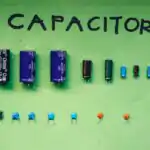
- Assorted capacitors (e.g., electrolytic, ceramic, film).
- Assorted inductors (e.g., air core, iron core, ferrite core).
- Charts showing symbols of capacitors and inductors.
- Whiteboard and markers.
Rationale for the Lesson
This lesson helps pupils understand two fundamental components in electronics: capacitors and inductors. Knowing their meanings, types, and symbols enables pupils to identify them in circuits and understand their basic roles in various electronic devices they encounter daily.
Prerequisite/Previous Knowledge
Pupils are expected to have basic knowledge of electric current, voltage, resistance, and other basic circuit components like resistors.
Lesson Content/Board Summary
CIRCUIT COMPONENTS: CAPACITORS AND INDUCTORS
1. Capacitors
A capacitor is an electronic component that stores electrical energy in an electric field. It consists of two conductive plates separated by a dielectric (insulating material).
The following are types of capacitors:
- Electrolytic capacitors
- Ceramic capacitors
- Film capacitors
- Mica capacitors
- Variable capacitors
The following are common capacitor symbols:
- Fixed Capacitor: Two parallel lines.
- Electrolytic Capacitor: One straight line and one curved line, with the curved line usually marked with a minus sign or an arrow.
- Variable Capacitor: Two parallel lines with an arrow passing through them.
2. Inductors
An inductor is an electronic component that stores energy in a magnetic field when electric current flows through it. It typically consists of a coil of wire.
The following are types of inductors:
- Air core inductors
- Iron core inductors
- Ferrite core inductors
- Variable inductors
The following are common inductor symbols:
- Air Core Inductor: A series of loops (coils).
- Iron Core Inductor: A series of loops with two parallel straight lines above them.
- Ferrite Core Inductor: A series of loops with two parallel dashed lines above them.
Teaching Methods/Instructional Techniques
Discussion, Lecture, Demonstration, Question and Answer, Visual Aids
Instructional Procedures
Step 1: Introduction
Time: 5 minutes
Teaching Skill: Set Induction
Teacher’s Activity: The teacher greets the pupils, reviews the previous lesson on basic circuit components, and introduces the topic of capacitors and inductors as important components in electronic circuits.
Pupils’ Activity: Pupils respond to greetings, recall previous knowledge, and listen attentively to the new topic.
Learning Point: Pupils are prepared for the day’s lesson and connect it to prior knowledge.
Step 2: Meaning of Capacitors
Time: 7 minutes
Teaching Skill: Explanation/Definition
Teacher’s Activity: The teacher explains what a capacitor is, its function of storing electrical energy, and its basic structure (two plates separated by a dielectric). The teacher shows physical examples of capacitors.
Pupils’ Activity: Pupils listen, observe the physical examples, and ask questions for clarification.
Learning Point: Pupils understand the definition and basic function of a capacitor.
Step 3: Types and Symbols of Capacitors
Time: 7 minutes
Teaching Skill: Demonstration/Illustration
Teacher’s Activity: The teacher discusses various types of capacitors (e.g., electrolytic, ceramic, film) and demonstrates their circuit symbols using a chart or by drawing on the board. Pupils are guided to draw the symbols.
Pupils’ Activity: Pupils identify different types of capacitors and practice drawing their symbols in their notebooks.
Learning Point: Pupils identify different capacitor types and can draw their symbols.
Step 4: Meaning of Inductors
Time: 7 minutes
Teaching Skill: Explanation/Definition
Teacher’s Activity: The teacher explains what an inductor is, its function of storing energy in a magnetic field, and its basic structure (a coil of wire). The teacher shows physical examples of inductors.
Pupils’ Activity: Pupils listen, observe the physical examples, and ask questions for clarification.
Learning Point: Pupils understand the definition and basic function of an inductor.
Step 5: Types and Symbols of Inductors
Time: 7 minutes
Teaching Skill: Demonstration/Illustration
Teacher’s Activity: The teacher discusses various types of inductors (e.g., air core, iron core, ferrite core) and demonstrates their circuit symbols using a chart or by drawing on the board. Pupils are guided to draw the symbols.
Pupils’ Activity: Pupils identify different types of inductors and practice drawing their symbols in their notebooks.
Learning Point: Pupils identify different inductor types and can draw their symbols.
Step 6: Class Activity/Discussion
Time: 5 minutes
Teaching Skill: Facilitation/Questioning
Teacher’s Activity: The teacher leads a brief discussion, asking pupils to compare and contrast capacitors and inductors, and to identify where they might have seen these components in everyday devices.
Pupils’ Activity: Pupils participate in the discussion, sharing their observations and understanding.
Learning Point: Pupils deepen their understanding and apply knowledge to real-world contexts.
Step 7: Evaluation/Review
Time: 5 minutes
Teaching Skill: Questioning/Assessment
Teacher’s Activity: The teacher evaluates the learning by asking the following questions:
- Define a capacitor.
- List three types of capacitors.
- Draw the symbol for an electrolytic capacitor.
- Define an inductor.
- Mention two types of inductors.
- Draw the symbol for an air core inductor.
Pupils’ Activity: Pupils answer orally and in writing.
Learning Point: Pupils demonstrate understanding of the lesson.
Step 8: Conclusion
Time: 2 minutes
Teaching Skill: Summarization/Assignment
Teacher’s Activity: The teacher summarizes the key points of the lesson, emphasizing the importance of capacitors and inductors in electronics. An assignment is given to research common applications of capacitors and inductors.
Pupils’ Activity: Pupils take notes on the summary and the assignment.
Learning Point: Pupils consolidate their learning and are given tasks for further study.
Lesson Keywords
- Capacitor – An electronic component that stores electrical energy in an electric field.
- Inductor – An electronic component that stores energy in a magnetic field.
- Dielectric – An insulating material used to separate the plates of a capacitor.
- Farad (F) – The unit of capacitance.
- Henry (H) – The unit of inductance.
Differentiation
For pupils who grasp concepts quickly, they will be encouraged to research advanced applications of capacitors and inductors. For pupils needing more support, the teacher will provide additional visual aids and simplified explanations, ensuring individual attention during practical drawing sessions.
Note for teachers using this lesson plan
Teachers should adapt this lesson plan to suit the specific needs and context of their pupils. Practical demonstrations with actual components are highly encouraged to enhance understanding. Ensure pupils have enough time to practice drawing the symbols correctly.

Community Join the conversation Open discussion +