

Class: Senior Secondary School 1 (SS1, SS 1, SSS1, SSS 1)
Term: Second Term
Week: 7
Age: 15 years
Duration: 45 minutes
Subject: Basic Electricity
Curriculum Theme: Basic Electricity
Previous Lesson: Alternating Current Terminologies.
Topic: KIRCHHOFF’S CURRENT LAW
Subject Matter: statement of Kirchhoff’s current law, application of Kirchhoff’s current law, solving simple network equations using current law, experimental verification of current law
Specific Objectives
By the end of the lesson, pupils should be able to:
Cognitive Domain:
- Define Kirchhoff’s Current Law (KCL).
- State Kirchhoff’s Current Law (KCL).
- Explain the application of KCL in circuit analysis.
Affective Domain:
- Appreciate the importance of experimental verification in electricity.
- Develop an interest in analyzing electrical circuits.
Psychomotor Domain:
- Apply KCL to solve simple network equations.
- Observe an experiment to verify KCL.
Social Domain:
- Work collaboratively in groups to solve KCL problems.
Reference Materials
The following resources were used in planning this lesson:
- 9 Years Basic Education Curriculum for Senior Secondary Schools.
- State Unified Scheme of Work for Basic Electricity SSS 1.
- Anyanwu, J. O. (2018). New System Physics for Senior Secondary Schools. Learn Africa Plc.
Instructional Materials
The teacher will teach this lesson with the aid of:
- Breadboard
- Resistors
- Connecting wires
- DC Power supply
- Ammeter
- Circuit diagrams illustrating nodes and current flow
Rationale for the Lesson
This lesson helps pupils understand how current behaves at junctions in an electrical circuit. This knowledge is important for analyzing and troubleshooting electrical networks, which is a fundamental skill in electrical engineering and electronics.
Prerequisite/Previous Knowledge
Pupils are expected to have prior knowledge of electric current, voltage, resistance, and basic circuit components such as resistors and power sources.
Lesson Content/Board Summary
KIRCHHOFF’S CURRENT LAW (KCL)
1. Statement of Kirchhoff’s Current Law (KCL)
Kirchhoff’s Current Law states that the algebraic sum of currents entering a node (or junction) in an electrical circuit is equal to the algebraic sum of currents leaving that node. Alternatively, the algebraic sum of all currents at any node in a circuit is zero.
Mathematically, KCL can be expressed as:
ΣIin = ΣIout
or
ΣI = 0 (where currents entering are positive and currents leaving are negative, or vice versa).
2. Explanation of KCL
KCL is based on the principle of conservation of charge. Electric charge cannot accumulate at a node; any charge that flows into a node must flow out of it. This means that current (rate of flow of charge) must be conserved at every junction.
3. Application of KCL
KCL is applied to analyze complex electrical circuits, particularly to find unknown currents in different branches of a circuit. It is used in conjunction with Kirchhoff’s Voltage Law (KVL) to solve network equations.
The steps for applying KCL are:
- Identify all the nodes (junctions) in the circuit.
- Assign a reference direction (in or out) for each current flowing into or out of a node.
- Apply the KCL equation (ΣI = 0 or ΣIin = ΣIout) to each independent node.
4. Solving Simple Network Equations Using KCL
Example: In a circuit, if 3A and 5A currents enter a node, and an unknown current (I) leaves the node, find I.
According to KCL:
Currents entering = Currents leaving
3A + 5A = I
8A = I
Therefore, the unknown current (I) leaving the node is 8A.
5. Experimental Verification of KCL
KCL can be verified experimentally by constructing a simple circuit with multiple branches meeting at a node. Ammeters are used to measure currents entering and leaving the node. The sum of measured currents entering the node should be approximately equal to the sum of measured currents leaving the node.
Teaching Methods/Instructional Techniques
Discussion, Lecture, Demonstration, Question and Answer, Visual Aids
Instructional Procedures
Step 1: Introduction
Time: 5 minutes
Teaching Skill: Set Induction/Questioning
Teacher’s Activity: The teacher greets the pupils and reviews the previous lesson on basic circuit components. The teacher then asks pupils to imagine water flowing through pipes and what happens when pipes join. This leads to the concept of current at a junction.
Pupils’ Activity: Pupils respond to questions and share their ideas about current flow at junctions.
Learning Point: Pupils recall previous knowledge and are introduced to the concept of current behavior at a junction.
Step 2: Statement of Kirchhoff’s Current Law
Time: 10 minutes
Teaching Skill: Explanation/Lecture
Teacher’s Activity: The teacher formally states Kirchhoff’s Current Law (KCL) and writes it on the board. The teacher explains the terms “node” and “junction” and emphasizes the concept of algebraic sum. Pupils are encouraged to write down the statement.
Pupils’ Activity: Pupils listen attentively, define KCL, and write down the statement in their notebooks.
Learning Point: Pupils learn the formal statement and definition of Kirchhoff’s Current Law.
Step 3: Explanation of KCL (Conservation of Charge)
Time: 7 minutes
Teaching Skill: Explanation/Analogy
Teacher’s Activity: The teacher further explains that KCL is a direct consequence of the conservation of electric charge. The teacher uses the water pipe analogy to illustrate that charge cannot build up at a junction, so what enters must leave.
Pupils’ Activity: Pupils listen, ask questions for clarity, and understand the underlying principle of KCL.
Learning Point: Pupils understand that KCL is based on the principle of conservation of charge.
Step 4: Application of KCL and Problem Solving (Teacher Demonstration)
Time: 8 minutes
Teaching Skill: Demonstration/Problem Solving
Teacher’s Activity: The teacher draws a simple circuit diagram with a node and known currents entering and leaving. The teacher demonstrates how to apply KCL to find an unknown current, showing step-by-step calculations on the board.
Pupils’ Activity: Pupils observe the teacher’s demonstration, copy the example, and ask questions about the steps.
Learning Point: Pupils learn how to apply KCL to solve simple circuit problems.
Step 5: Guided Practice
Time: 5 minutes
Teaching Skill: Guided Practice/Collaboration
Teacher’s Activity: The teacher provides another simple problem involving KCL and guides pupils to solve it in groups or individually. The teacher moves around to provide assistance and check their work.
Pupils’ Activity: Pupils work on the given problem, applying KCL to find unknown currents.
Learning Point: Pupils practice applying KCL to solve circuit problems and reinforce their understanding.
Step 6: Experimental Verification (Demonstration)
Time: 5 minutes
Teaching Skill: Demonstration/Observation
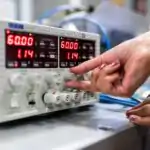
Teacher’s Activity: The teacher sets up a simple circuit on a breadboard with multiple branches meeting at a node, using resistors, wires, a power supply, and ammeters. The teacher demonstrates measuring currents entering and leaving the node and shows how the sums are approximately equal.
Pupils’ Activity: Pupils observe the experimental setup and the current readings, noting how KCL is verified.
Learning Point: Pupils observe the practical verification of Kirchhoff’s Current Law.
Step 7: Evaluation/Review
Time: 5 minutes
Teaching Skill: Questioning/Assessment
Teacher’s Activity: The teacher evaluates the learning by asking the following questions:
- Define Kirchhoff’s Current Law.
- State the principle upon which KCL is based.
- Mention two steps involved in applying KCL to a circuit.
- If 4A and 6A currents enter a node, and 7A leaves, what is the value of the remaining current leaving the node?
Pupils’ Activity: Pupils answer orally and in writing.
Learning Point: Pupils demonstrate understanding of the lesson.
Step 8: Conclusion
Time: 3 minutes
Teaching Skill: Summarizing
Teacher’s Activity: The teacher summarizes the key points of the lesson, reiterating the statement and importance of Kirchhoff’s Current Law. The teacher assigns homework, which could involve solving additional KCL problems.
Pupils’ Activity: Pupils listen to the summary and copy down the homework.
Learning Point: Pupils review the main concepts of the lesson and prepare for further practice.
Lesson Keywords
- Kirchhoff’s Current Law (KCL) – A law stating that the algebraic sum of currents entering a node is equal to the sum of currents leaving it.
- Node – A junction or point in a circuit where two or more circuit elements or branches meet.
- Junction – Another term for a node in an electrical circuit.
- Current – The rate of flow of electric charge.
- Circuit – A closed path through which an electric current can flow.
Differentiation
For pupils who grasp the concept quickly, the teacher can provide more complex circuit diagrams for KCL application. For pupils who need more support, the teacher can provide simpler diagrams and work through problems step-by-step, offering individual guidance.
Note for teachers using this lesson plan
Teachers should ensure all instructional materials, especially the breadboard, resistors, power supply, and ammeters, are readily available and in good working condition for the demonstration. Emphasize safety precautions when working with electrical circuits. Encourage active participation and critical thinking during problem-solving sessions.

Community Join the conversation Open discussion +