

Class: Senior Secondary School 1 (SS1, SS 1, SSS1, SSS 1)
Term: 1st Term
Week: 6
Age: 15 years
Duration: 45 minutes
Subject: Basic Electricity
Curriculum Theme: Basic Electricity
Previous Lesson: Electric Power: Energy, Work and Joule’s Law.
Topic: RESISTORS
Subject Matter: electrical circuit components and their symbols, identification of resistor, definition of resistor, circuit symbols of fixed resistor, circuit symbols of variable resistor
Specific Objectives
By the end of the lesson, pupils should be able to:
Cognitive Domain:
- Define a resistor.
- Identify different types of resistors.
- State the circuit symbols for fixed and variable resistors.
Affective Domain:
- Appreciate the importance of standard circuit symbols in electrical diagrams.
- Develop an interest in identifying and using various electrical components.
Psychomotor Domain:
- Draw the circuit symbols for fixed and variable resistors accurately.
- Match physical resistors to their corresponding circuit symbols.
Social Domain:
- Collaborate with peers to identify circuit components and symbols.
Reference Materials
The following resources were used in planning this lesson:
- 9 Years Basic Education Curriculum for Basic Science and Technology.
- State Unified Scheme of Work for Basic Electricity SSS 1.
- Anyanwu, J.A. (2015). New School Physics for Senior Secondary Schools. Africana First Publishers Plc.
- https://www.allaboutcircuits.com/textbook/direct-current/chpt-1/circuit-symbols-schematics/
- https://www.electronics-tutorials.ws/resistor/res_1.html
Instructional Materials
The teacher will teach this lesson with the aid of:
- Circuit symbol charts
- Sample fixed resistors
- Sample variable resistors (rheostat/potentiometer)
- Breadboard
- Component kits
- Whiteboard and markers
Rationale for the Lesson
This lesson helps pupils understand basic electrical components, specifically resistors, which are fundamental in almost all electronic circuits. Understanding resistors and their symbols enables pupils to interpret and design simple electrical diagrams, which is important for further studies in electronics and daily applications.
Prerequisite/Previous Knowledge
Pupils have prior knowledge of basic electrical terms such as current, voltage, and simple circuits from their Junior Secondary School Basic Technology lessons.
Lesson Content/Board Summary
RESISTORS
Electrical Circuit Components and Their Symbols
Electrical circuit components are devices used to build electronic circuits. Each component has a standard symbol that represents it in a circuit diagram.
Common electrical circuit components include:
- Resistor
- Capacitor
- Inductor
- Diode
- Transistor
- Battery/Power Supply
- Switch
- Lamp
Identification of Resistor
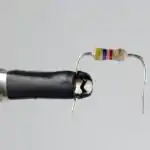
A resistor is a passive two-terminal electrical component that implements electrical resistance as a circuit element. Resistors are typically small, cylindrical components with coloured bands indicating their resistance value. They are found in almost all electronic circuits.
Definition of Resistor
A resistor is an electrical component designed to oppose the flow of electric current in a circuit. It converts electrical energy into heat energy.
Circuit Symbols of Fixed Resistor
A fixed resistor has a resistance value that does not change. Its symbol is universally recognized in circuit diagrams.
The symbol for a fixed resistor is:
(Teacher will draw the standard zig-zag or rectangular block symbol on the board)
Circuit Symbols of Variable Resistor (Rheostat/Potentiometer)
A variable resistor is a resistor whose electrical resistance can be adjusted or varied manually. Examples include rheostats and potentiometers.
The symbol for a variable resistor is:
(Teacher will draw the standard zig-zag or rectangular block symbol with an arrow passing through or pointing to it)
Teaching Methods/Instructional Techniques
Discussion, Lecture, Demonstration, Question and Answer, Visual Aids
Instructional Procedures
Step 1: Introduction
Time: 5 minutes
Teaching Skill: Set Induction
Teacher’s Activity: The teacher greets the pupils and asks them to recall some basic electrical components they know. The teacher then introduces the topic “Resistors” by displaying various components and asking pupils if they can identify any.
Pupils’ Activity: Pupils respond to the teacher’s questions and observe the displayed components.
Learning Point: Pupils recall prior knowledge and are introduced to the lesson’s topic.
Step 2: Explanation of Electrical Circuit Components and Their Symbols
Time: 10 minutes
Teaching Skill: Explanation/Demonstration
Teacher’s Activity: The teacher uses circuit symbol charts and actual components to explain what electrical circuit components are. The teacher points out various components and their corresponding standard symbols, guiding pupils to understand their representation in diagrams.
Pupils’ Activity: Pupils observe the components and charts, actively participate in identifying them, and ask questions for clarification.
Learning Point: Pupils understand that components have standard symbols for circuit representation.
Step 3: Identification and Definition of a Resistor
Time: 8 minutes
Teaching Skill: Identification/Definition
Teacher’s Activity: The teacher specifically picks out different types of resistors from the component kit, shows them to the pupils, and explains their physical appearance. The teacher then guides the pupils to define what a resistor is and its function in a circuit.
Pupils’ Activity: Pupils observe the resistors, describe what they see, and contribute to defining a resistor based on the teacher’s guidance.
Learning Point: Pupils can identify a resistor and define its function.
Step 4: Circuit Symbol of Fixed Resistor
Time: 7 minutes
Teaching Skill: Drawing/Demonstration
Teacher’s Activity: The teacher draws the standard circuit symbol for a fixed resistor clearly on the board, explaining its features. The teacher ensures pupils understand how to draw it correctly.
Pupils’ Activity: Pupils observe the teacher drawing the symbol and practice drawing it in their notebooks.
Learning Point: Pupils learn and can draw the symbol for a fixed resistor.
Step 5: Circuit Symbol of Variable Resistor
Time: 7 minutes
Teaching Skill: Drawing/Demonstration
Teacher’s Activity: The teacher draws the standard circuit symbol for a variable resistor (e.g., rheostat) on the board, highlighting the difference from a fixed resistor symbol. The teacher explains that its resistance can be changed.
Pupils’ Activity: Pupils observe and practice drawing the symbol for a variable resistor in their notebooks.
Learning Point: Pupils learn and can draw the symbol for a variable resistor.
Step 6: Evaluation/Review
Time: 5 minutes
Teaching Skill: Questioning/Assessment
Teacher’s Activity: The teacher evaluates the learning by asking the following questions:
- Define a resistor.
- Mention two characteristics of a resistor.
- Draw the circuit symbol for a fixed resistor.
- Draw the circuit symbol for a variable resistor.
Pupils’ Activity: Pupils answer orally and in writing.
Learning Point: Pupils demonstrate understanding of the lesson.
Step 7: Conclusion
Time: 3 minutes
Teaching Skill: Summarization
Teacher’s Activity: The teacher summarizes the key points of the lesson, reiterating the definition of a resistor and the importance of knowing its symbols. The teacher assigns homework: “Find out about the different types of variable resistors and their uses.”
Pupils’ Activity: Pupils listen attentively to the summary and copy down the homework.
Learning Point: Pupils reinforce their understanding and are given a task to extend their knowledge.
Lesson Keywords
- Resistor – An electrical component that opposes the flow of electric current.
- Fixed Resistor – A resistor with a constant resistance value.
- Variable Resistor – A resistor whose resistance value can be changed.
- Circuit Symbol – A graphical representation of an electrical component in a circuit diagram.
- Ohm – The unit of electrical resistance.
Differentiation
For pupils who grasp concepts quickly, the teacher can challenge them to identify resistors by their colour codes or research practical applications of fixed and variable resistors. For pupils needing more support, the teacher will provide additional visual aids and guided practice in drawing symbols and identifying components.
Note for teachers using this lesson plan
Ensure a variety of physical resistors (fixed and variable) are available for pupils to handle and observe. Emphasize the importance of standard symbols for clear communication in electrical engineering. Encourage pupils to draw the symbols neatly and accurately in their notebooks.
Community Join the conversation Open discussion +