

Class: Senior Secondary School 2 (SS2 / SSS2)
Term: 3rd Term
Week: 4
Age: 16 years
Duration: 45 minutes
Subject: Physics
Curriculum Theme: Electric Field
Previous Lesson: Electric Field: Coulomb’s Law and Electric Field Intensity.
Topic: ELECTRIC FIELD
Subject Matter: Capacitors and capacitances (definition), arrangement of capacitors (series, parallel), energy stored in a capacitor (concept), application of capacitors (smoothing, timing, and more)
Specific Objectives
By the end of the lesson, pupils should be able to:
Cognitive Domain:
- Define a capacitor and capacitance.
- State the formulas for equivalent capacitance in series and parallel arrangements.
- Explain the concept of energy stored in a capacitor.
- List various applications of capacitors.
Affective Domain:
- Appreciate the importance of capacitors in electronic circuits.
- Develop an interest in further study of electrical components.
Psychomotor Domain:
- Calculate the equivalent capacitance for simple series and parallel combinations.
- Solve problems related to energy stored in a capacitor.
Social Domain:
- Collaborate with peers to solve problems involving capacitor arrangements.
Reference Materials
The following resources were used in planning this lesson:
- Senior Secondary Schools Education Curriculum
- State Unified Scheme of Work
- New School Physics by P.N. Okeke
- Comprehensive Certificate Physics by I.G. Esaenyi
Instructional Materials
The teacher will teach this lesson with the aid of:
- Textbook
- Charts showing series and parallel arrangements of capacitors
- An equipped laboratory (for potential demonstration of capacitor charging/discharging)
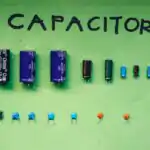
- Actual capacitors of different values
Rationale for the Lesson
This lesson helps pupils understand how capacitors store electrical energy and their widespread use in modern electronic devices. Understanding capacitors is important for pupils pursuing careers in engineering, electronics, and related scientific fields.
Prerequisite/Previous Knowledge
Pupils have a basic understanding of electric charges, electric potential, and simple electrical circuits.
Lesson Content/Board Summary
Capacitors and Capacitance
1. Definition of Capacitor and Capacitance
A capacitor is an electrical device used to store electric charge and electrical energy in an electric field. It typically consists of two conducting plates separated by a dielectric (insulating) material.
Capacitance (C) is the ability of a capacitor to store electric charge. It is defined as the ratio of the charge (Q) stored on the plates to the potential difference (V) across them.
Formula: C = Q/V
The unit of capacitance is the Farad (F). One Farad is a very large unit, so common units are microfarad (µF = 10-6 F) and picofarad (pF = 10-12 F).
2. Arrangement of Capacitors
a) Capacitors in Series
When capacitors are connected in series, the same charge flows through each capacitor, but the total potential difference is divided among them. The equivalent capacitance (Ceq) for capacitors in series is given by:
1/Ceq = 1/C1 + 1/C2 + 1/C3 + …
Example 1: Three capacitors of 10 µF, 20 µF, and 30 µF are connected in series. Calculate their equivalent capacitance.
Step 1: Write down the formula for series connection.
1/Ceq = 1/C1 + 1/C2 + 1/C3
Step 2: Substitute the given values.
1/Ceq = 1/10 + 1/20 + 1/30
Step 3: Find a common denominator and sum the fractions.
1/Ceq = (6 + 3 + 2) / 60 = 11/60
Step 4: Invert to find Ceq.
Ceq = 60/11 ≈ 5.45 µF
b) Capacitors in Parallel
When capacitors are connected in parallel, the potential difference across each capacitor is the same, but the total charge is the sum of the charges on individual capacitors. The equivalent capacitance (Ceq) for capacitors in parallel is given by:
Ceq = C1 + C2 + C3 + …
Example 2: Two capacitors of 5 µF and 15 µF are connected in parallel. Calculate their equivalent capacitance.
Step 1: Write down the formula for parallel connection.
Ceq = C1 + C2
Step 2: Substitute the given values.
Ceq = 5 µF + 15 µF
Step 3: Sum the values.
Ceq = 20 µF
3. Energy Stored in a Capacitor
A charged capacitor stores electrical potential energy in its electric field. The energy (W) stored in a capacitor can be calculated using the following formulas:
- W = 1/2 CV2
- W = 1/2 QV
- W = 1/2 Q2/C
Where: C = capacitance (Farads), Q = charge (Coulombs), V = potential difference (Volts).
4. Applications of Capacitors
Capacitors are widely used in various electronic circuits for different purposes. The following are some common applications:
- Smoothing/Filtering: Used in power supplies to smooth out pulsating DC voltages, converting them into steady DC.
- Timing Circuits: Used in conjunction with resistors to create time delays, essential in oscillators and clock circuits.
- Tuning Circuits: Found in radios and televisions to select specific frequencies.
- Energy Storage: Used in camera flashes, defibrillators, and pulsed lasers to release a large amount of energy quickly.
- Coupling and Decoupling: Used to block DC signals while allowing AC signals to pass or to bypass unwanted signals to ground.
Teaching Methods/Instructional Techniques
Discussion, Lecture, Demonstration, Question and Answer, Visual Aids
Instructional Procedures
Step 1: Introduction
Time: 5 minutes
Teaching Skill: Set Induction
Teacher’s Activity: The teacher greets the pupils and asks them to mention any electronic devices they use daily. The teacher then guides them to identify components that store charge.
Pupils’ Activity: Pupils respond by mentioning devices like phones, radios, and TVs, and attempt to identify charge-storing components.
Learning Point: Pupils recall prior knowledge of electricity and are introduced to the concept of charge storage.
Step 2: Definition of Capacitor and Capacitance
Time: 8 minutes
Teaching Skill: Explanation/Definition
Teacher’s Activity: The teacher defines a capacitor and capacitance, explaining the unit (Farad) and its common sub-multiples. The teacher writes the definition and formula C = Q/V on the board.
Pupils’ Activity: Pupils listen attentively, ask questions for clarification, and copy notes from the board.
Learning Point: Pupils understand the fundamental definitions of capacitors and capacitance.
Step 3: Arrangement of Capacitors (Series)
Time: 10 minutes
Teaching Skill: Derivation/Problem Solving
Teacher’s Activity: The teacher explains how capacitors are connected in series, draws the circuit diagram, derives the formula for equivalent capacitance, and solves a worked example on the board.
Pupils’ Activity: Pupils observe the diagram, follow the derivation, copy the formula, and solve the example with the teacher.
Learning Point: Pupils learn how to calculate equivalent capacitance for series arrangements.
Step 4: Arrangement of Capacitors (Parallel)
Time: 7 minutes
Teaching Skill: Derivation/Problem Solving
Teacher’s Activity: The teacher explains parallel connection, draws the circuit diagram, derives the formula for equivalent capacitance, and solves a worked example on the board.
Pupils’ Activity: Pupils observe the diagram, follow the derivation, copy the formula, and solve the example with the teacher.
Learning Point: Pupils learn how to calculate equivalent capacitance for parallel arrangements.
Step 5: Energy Stored in a Capacitor
Time: 5 minutes
Teaching Skill: Explanation/Formula Presentation
Teacher’s Activity: The teacher explains that a charged capacitor stores energy and presents the formulas for calculating this stored energy (W = 1/2 CV2, W = 1/2 QV, W = 1/2 Q2/C).
Pupils’ Activity: Pupils listen and copy the formulas into their notes.
Learning Point: Pupils understand the concept and formulas for energy storage in capacitors.
Step 6: Applications of Capacitors
Time: 5 minutes
Teaching Skill: Listing/Illustration
Teacher’s Activity: The teacher discusses and lists various practical applications of capacitors, such as smoothing, timing, and tuning circuits, giving brief examples for each.
Pupils’ Activity: Pupils listen and note down the applications of capacitors.
Learning Point: Pupils understand the practical relevance and uses of capacitors.
Step 7: Evaluation/Review
Time: 5 minutes
Teaching Skill: Questioning/Assessment
Teacher’s Activity: The teacher evaluates the learning by asking the following questions:
- Define a capacitor and capacitance.
- State the formula for equivalent capacitance when two capacitors, C1 and C2, are connected in series.
- State the formula for equivalent capacitance when two capacitors, C1 and C2, are connected in parallel.
- Mention three applications of capacitors in electronic circuits.
Pupils’ Activity: Pupils answer orally and in writing.
Learning Point: Pupils demonstrate understanding of the lesson.
Step 8: Conclusion
Time: 5 minutes
Teaching Skill: Summarization/Assignment
Teacher’s Activity: The teacher summarizes the key points of the lesson, emphasizing the formulas for series and parallel arrangements and the energy stored. The teacher then gives homework assignments from the textbook.
Pupils’ Activity: Pupils listen to the summary and copy down the homework assignments.
Learning Point: Pupils consolidate their understanding and are given tasks for further practice.
Lesson Keywords
- Capacitor – A device that stores electric charge.
- Capacitance – The ability of a capacitor to store electric charge.
- Farad – The unit of capacitance.
- Series connection – An arrangement where components are connected end-to-end.
- Parallel connection – An arrangement where components are connected across the same two points.
- Dielectric – An insulating material placed between capacitor plates.
- Smoothing – The process of reducing ripple in DC voltage using capacitors.
Differentiation
For pupils who grasp concepts quickly, the teacher can provide more complex problems involving mixed series-parallel combinations. For those needing more support, the teacher can provide additional simple examples and one-on-one guidance during problem-solving sessions.
Note for teachers using this lesson plan
Ensure that the diagrams for series and parallel capacitor arrangements are drawn clearly on the board or chart. Emphasize the difference in how equivalent capacitance is calculated for each arrangement. Encourage pupils to use appropriate units in their calculations. A practical demonstration of charging and discharging a capacitor (e.g., with an LED) can enhance understanding if equipment is available.



Community Join the conversation Open discussion +