

Class: Senior Secondary School 1 (SS1, SS 1, SSS1, SSS 1)
Term: 3rd Term
Week: 6
Age: 15 years
Duration: 45 minutes
Subject: Basic Electricity
Curriculum Theme: Basic Electricity
Previous Lesson: Transformers: Efficiency, Losses and Applications.
Topic: POWER SUPPLIES
Subject Matter: definition of power supply, component parts of power supply unit, functions of power supply unit, demonstration of DC power supply use
Specific Objectives
By the end of the lesson, pupils should be able to:
Cognitive Domain:
- Define a power supply.
- List the component parts of a power supply unit.
- State the functions of each component part of a power supply unit.
Affective Domain:
- Appreciate the importance of power supplies in electronic devices.
- Show interest in identifying the parts and functions of a power supply unit.
Psychomotor Domain:
- Identify the component parts of a DC power supply unit.
- Demonstrate the basic use of a DC power supply.
Social Domain:
- Collaborate effectively during the demonstration of power supply use.
Reference Materials
The following resources were used in planning this lesson:
- 9 Years Basic Education Curriculum for Basic Technology (Senior Secondary School).
- State Unified Scheme of Work for Senior Secondary Schools.
- Basic Electricity for Senior Secondary Schools by A.O. Okoro.
- https://www.electrical4u.com/power-supply-unit/
- https://www.electronics-tutorials.ws/power/voltage-regulator.html
Instructional Materials
The teacher will teach this lesson with the aid of:
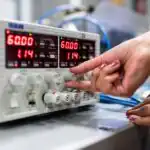
- A functional DC power supply unit.
- Circuit diagrams illustrating power supply components.
- Charts showing different power supply components.
Rationale for the Lesson
This lesson helps pupils understand how electronic devices get their necessary power from the main electricity supply. Understanding power supplies is important because they are fundamental to the operation of almost all electronic equipment we use daily, from phones to computers.
Prerequisite/Previous Knowledge
Pupils have some basic understanding of electricity, current, voltage, and simple electrical circuits from previous lessons.
Lesson Content/Board Summary
POWER SUPPLIES
Definition of Power Supply
A power supply is an electrical device that provides electric power to an electrical load. Its main purpose is to convert electric current from a source to the correct voltage, current, and frequency to power a device.
Component Parts of a Power Supply Unit
A typical DC power supply unit consists of the following main components:
- Transformer
- Rectifier
- Filter
- Voltage Regulator
Functions of Power Supply Unit Components
Each component in a power supply unit performs a specific function:
- Transformer: Steps down or steps up the AC mains voltage to the desired level.
- Rectifier: Converts the alternating current (AC) into pulsating direct current (DC). Common types include half-wave and full-wave rectifiers.
- Filter: Smooths out the pulsating DC output from the rectifier, reducing ripples and making it a more stable DC. Capacitors are commonly used as filter components.
- Voltage Regulator: Maintains a constant DC output voltage despite variations in the input voltage or load current. Common types include Zener diode regulators and integrated circuit (IC) regulators.
Demonstration of DC Power Supply Use
A DC power supply is used to provide a steady, regulated direct current voltage for various electronic circuits and devices. To use a DC power supply, connect the positive and negative terminals to the respective points in the circuit. Adjust the output voltage and current limits as required by the circuit.
Teaching Methods/Instructional Techniques
Discussion, Lecture, Demonstration, Question and Answer, Visual Aids
Instructional Procedures
Step 1: Introduction
Time: 5 minutes
Teaching Skill: Set Induction/Questioning
Teacher’s Activity: The teacher greets the pupils and asks them to recall what they know about electric current and voltage. The teacher then introduces the topic by asking how devices like radios or televisions get their power from the wall socket.
Pupils’ Activity: Pupils respond to the questions and attempt to relate their prior knowledge to the new topic.
Learning Point: Pupils are prepared for the lesson and connect new information to existing knowledge.
Step 2: Definition of Power Supply
Time: 7 minutes
Teaching Skill: Explanation/Definition
Teacher’s Activity: The teacher defines a power supply and explains its general function of converting electrical energy into a suitable form for electronic devices. The definition is written on the board.
Pupils’ Activity: Pupils listen attentively, take notes, and ask questions for clarification.
Learning Point: Pupils understand the basic concept and purpose of a power supply.
Step 3: Component Parts of a Power Supply Unit
Time: 10 minutes
Teaching Skill: Listing/Identification
Teacher’s Activity: The teacher lists and explains the main component parts of a typical DC power supply unit (Transformer, Rectifier, Filter, Voltage Regulator) using charts and circuit diagrams. Each component is pointed out on a physical DC power supply unit if available.
Pupils’ Activity: Pupils observe the charts and physical unit, identify the components, and copy the list into their notebooks.
Learning Point: Pupils can identify and name the major components of a power supply unit.
Step 4: Functions of Power Supply Unit Components
Time: 8 minutes
Teaching Skill: Explanation/Elaboration
Teacher’s Activity: The teacher explains the specific function of each component (transformer, rectifier, filter, voltage regulator) in detail, emphasizing how they work together to convert AC to regulated DC. Examples of where these components are found are given.
Pupils’ Activity: Pupils listen, ask questions about the functions, and take down notes.
Learning Point: Pupils understand the role of each component in the power supply unit.
Step 5: Demonstration of DC Power Supply Use
Time: 7 minutes
Teaching Skill: Demonstration/Practical Application
Teacher’s Activity: The teacher demonstrates how to safely connect and use a DC power supply unit, showing how to adjust voltage and current limits and explaining safety precautions. A simple circuit (e.g., an LED with a resistor) might be powered.
Pupils’ Activity: Pupils observe the demonstration carefully and note the steps and safety procedures.
Learning Point: Pupils learn the practical application and safe handling of a DC power supply.
Step 6: Evaluation/Review
Time: 5 minutes
Teaching Skill: Questioning/Assessment
Teacher’s Activity: The teacher evaluates the learning by asking the following questions:
- Define a power supply.
- Mention any three component parts of a DC power supply unit.
- State the function of a rectifier in a power supply.
- Explain the role of the voltage regulator.
Pupils’ Activity: Pupils answer orally and in writing.
Learning Point: Pupils demonstrate understanding of the lesson.
Step 7: Conclusion
Time: 3 minutes
Teaching Skill: Summarization/Assignment
Teacher’s Activity: The teacher summarizes the key points of the lesson, reiterating the definition of a power supply and the roles of its components. The teacher then gives pupils homework to draw a block diagram of a simple DC power supply unit.
Pupils’ Activity: Pupils listen to the summary and copy the homework.
Learning Point: Pupils reinforce their understanding and are given tasks for further practice.
Lesson Keywords
- Power Supply – An electrical device that supplies electric power to an electrical load.
- Transformer – A device that changes AC voltage levels.
- Rectifier – A circuit that converts AC to pulsating DC.
- Filter – A circuit that smooths out pulsating DC into steady DC.
- Voltage Regulator – A component that maintains a constant output voltage.
Differentiation
For pupils who grasp concepts quickly, the teacher can ask them to research different types of rectifiers or voltage regulators. For pupils who need more support, the teacher can provide simplified diagrams and allow for more direct guidance during the identification of components.
Note for teachers using this lesson plan
Ensure that the DC power supply unit used for demonstration is in good working condition and that safety precautions are strictly observed. Encourage pupils to ask questions and to actively participate in identifying components.


Community Join the conversation Open discussion +