

Class: Primary 5
Term: Third Term
Subject: History
Curriculum Theme:
Previous Lesson: Benefits of the Occupations of the Hausa People
Topic: Traditional Occupations of the People in the State
Content/Learning Area: Traditional Occupations and Description of the various occupations.
Time Allocation: 40 minutes
Performance Objectives
By the end of the lesson, pupils should be able to:
- Cognitive Domain: Define and identify 3 traditional occupations practiced in their state.
- Affective domain: Appreciate the importance of traditional occupations in the state’s economy.
- Psychomotor Domain: Describe the tools and techniques used in specific traditional occupations.
- Social Domain: collaborate with peers to discuss and share information about traditional occupations.
Reference Materials
- Nigeria Primary History book 5
- Relevant charts and pictures of traditional occupations.
- 9 Years Basic Education Curriculum
- Abuja Educational Resource Center Scheme of work
- NAPPS National Unified Scheme of Work
Instructional Materials
To deliver this lesson, the teacher will employ the help of the following materials: Charts and pictures illustrating various traditional occupations, samples or models of tools used in thes occupations (if available), and textbooks.
Rationale for the Lesson
Understanding traditional occupations helps pupils appreciate their cultural heritage and the economic activities that have shaped their state’s history.
Prerequisite/previous Knowledge
Pupils are familiar with the concept of work and different types of jobs people do.
Lesson content
Traditional Occupations of the People in the State
In Nigeria, traditional occupations are key to the economy and culture. People in different regions practice these jobs based on the resources available to them.
Description of the various occupations
Farming
Farming is the main occupation in rural Nigeria. People grow crops like yams, cassava, maize, and beans. Some farmers practice subsistence farming (growing crops for family use), while others engage in commercial farming (selling crops in the market).
Fishing
Fishing is important for people living near rivers and the coast, such as the Niger Delta and Lagos. Various methods like net fishing and spearfishing are used. Fish is a main food source in these communities and plays a big part in their culture.
Cattle Rearing
In northern Nigeria, cattle rearing is common, especially among the Fulani people. Cattle are raised for milk, meat, and hides. The number of cattle a person owns is often seen as a sign of wealth. This occupation is important in the northern economy.
Blacksmithing
Blacksmithing involves making tools, weapons, and other items from metal. It is an old craft that is practiced mostly in northern Nigeria. Blacksmiths create items like hoes, knives, and spears, which are used in everyday life and farming.
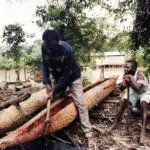
Carving
Carving is the art of shaping wood and other materials into figures or masks. The Igbo people and others use carved objects in ceremonies, festivals, and religious practices. Carving is an important way of preserving culture.
Trading
Trading is a common occupation in cities like Lagos and Onitsha. People trade goods like food, clothes, and crafts. Traders play a major role in Nigeria’s economy by connecting different communities and regions.
Dyeing
Dyeing, especially using indigo, is a traditional occupation in Nigeria. People dye cloth to make beautiful clothes, especially for ceremonies. The dyeing process is an important part of Nigeria’s cultural heritage, it is most common in Yoruba and Igbo communities, with major dyeing centers in cities like Abeokuta and Nnewi. The most famous product of this craft is Aso-Oke, a handwoven fabric that is dyed in intricate patterns.
Teaching Methods
to deliver this lesson, the teacher will adopt the following methods: Discussion, Description, Visual aids, Question and Answer.
Instructional Procedures
Step 1: Introduction
Time: 5 minutes
Teaching Skill: Set Induction
Teacher’s Activity: Begins by asking pupils about the jobs their parents or relatives do.
Pupils’ Activity: Pupils respond by mentioning the jobs their parents or relatives do.
Step 2: Exploring Traditional Occupations
time: 10 minutes
Teaching Skill: Explanation
Teacher’s Activity: Explains what traditional occupations are and provides examples relevant to the state.
Pupils’ Activity: Pupils listen attentively and ask questions for clarification.
Step 3: Describing Tools and Techniques
Time: 10 minutes
teaching Skill: Visual Aids
Teacher’s Activity: Shows pictures or real objects representing tools used in traditional occupations and explains how they are used.
Pupils’ Activity: Pupils observe the materials and describe their uses based on the teacher’s explanation.
Step 4: group Discussion
Time: 10 minutes
Teaching Skill: Discussion
Teacher’s Activity: Divides the class into groups and assigns each group a traditional occupation to discuss its importance and challenges.
Pupils’ Activity: Pupils discuss within their groups and prepare to share their findings with the class.
Step 5: Note-Taking
Time: 3 minutes
Teaching Skill: Explanation
Teacher’s Activity: Summarizes the main points of the lesson on the board.
Pupils’ Activity: Pupils copy the notes into their notebooks.
Step 6: Evaluation/Review
Time: 2 minutes
Teaching skill: Questioning
Teacher’s activity: Asks questions to assess pupils’ understanding of the lesson.
Pupils’ Activity: Pupils answer the questions to demonstrate their understanding.
Objective-aligned checks:
- Define and identify 3 traditional occupations practiced in their state.
- Describe the tools and techniques used in specific traditional occupations.
step 7: Conclusion
Time: 2 minutes
Teaching Skill: Summarization
Teacher’s Activity: Summarizes the lesson and assigns homework.
Pupils’ Activity: Listen to the summary and note the homework assignment.
Lesson Keywords
- Traditional Occupation – Jobs passed down through generations.
- Farming – Cultivating land for crops.
- Fishing – Catching fish from water bodies.
- Cattle Rearing – Raising cattle for products.
- Blacksmithing – shaping metal objects.
- Carving – Creating objects by cutting materials.
- Trading – Exchanging goods and services.
- Dyeing – Coloring fabrics.
Lesson Evaluation
To evaluate the learning, the teacher asks pupils to:
- Name three traditional occupations in their state.
- Describe one tool used in farming.
- Explain why traditional occupations are notable.
Assignment/Homework
- Research and write about a traditional occupation not discussed in class.
- Interview a family member or neighbour who practices a traditional occupation and write a short report.
Differentiation
- For slower learners: Provide simplified notes and one-on-one assistance during group discussions.
- For advanced learners: Encourage them to research the history and evolution of a specific traditional occupation.
- For visual/auditory/kinesthetic learners: Use more visual aids,incorporate storytelling,and allow hands-on activities like drawing or modeling tools.
Note for Teachers
ensure to use local examples and materials to make the lesson more relatable and engaging for the pupils.Encourage pupils to share personal experiences related to traditional occupations.
Community Join the conversation Open discussion +