

Class: Primary two
Term: Second term
Subject: National Values Education
Curriculum Theme: Security Education
Previous Lesson: Identification of Security Agencies, Nigerian Police
Topic: The Nigerian Army
Content/Learning Area: Identifying soldiers, Nigerian Army
Time Allocation: 40 minutes
Performance Objectives
By the end of the lesson, pupils should be able to:
- cognitive Domain:
1. Describe the key features that identify soldiers.2.Explain the importance of the Nigerian Army in protecting our country.
- Affective Domain:
1. Show respect for the Nigerian army and their service.
- Psychomotor Domain:
1. Identify soldiers based on their uniform, equipment, and behaviour.
- Social Domain:
1. Discuss the role of the Nigerian Army in maintaining peace and security.
Reference Materials
- 9 – Years basic Education Curriculum
- Abuja Educational Resource Center scheme of Work
- NAPPS National unified Scheme of work
- Relevant Textbooks
Instructional Materials
To deliver this lesson, the teacher will use the following materials:
- Pictures of soldiers in different uniforms and situations.
- whiteboard or chart paper.
- Markers or crayons.
Rationale for the Lesson
Understanding the Nigerian Army helps pupils appreciate national security and the roles of its members in protecting the country. This fosters patriotism and respect for authority.
Prerequisite/Previous Knowledge
Pupils have a basic understanding of people who protect the country.
Lesson Content
Nigerian Army
The Nigerian Army is a crucial part of our nation’s defense.Its responsible for protecting our country’s borders and keeping the peace.
What is the Nigerian Army?
The Nigerian Army is a branch of the Nigerian Armed Forces that focuses on land warfare. Soldiers are trained to protect Nigeria from threats, both inside and outside the country.
Identifying Soldiers
Soldiers can be identified through various features that distinguish them from civilians. These include:
The following are ways to identify a soldier:
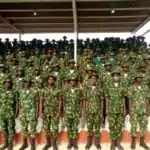
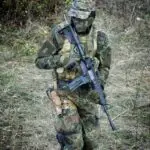
- Uniform: Soldiers wear special uniforms, often camouflage, to blend in with their surroundings.
- Badge or Insignia: These show their rank and unit.
- Headgear: Soldiers wear hats or helmets, often with special markings.
- Equipment: Soldiers carry things like backpacks, weapons, and radios.
- Location: You’ll often find soldiers at military bases, checkpoints, or where they’re needed for security.
- Duties: Soldiers guard important places and take part in parades.
- Behavior: Soldiers are disciplined and follow orders.
- Vehicles: Soldiers use specialized vehicles like armored cars and trucks.
- Training: Soldiers undergo rigorous training to prepare for various missions.
Teaching Methods
To deliver this lesson, the teacher will adopt the following methods: Discussion, Question and Answer, Show and Tell
Instructional Procedures
To deliver this lesson, the teacher will adopt the following steps:
Step 1: Introduction
Time: 5 minutes
Teaching Skill: Set Induction
Teacher’s Activity: Asks pupils what they know about people who protect the country.
Pupils’ Activity: Respond to the teacher’s questions.
Step 2: Description of Key Concepts
Time: 10 minutes
Teaching Skill: Explaining
teacher’s Activity: Explains the role of the nigerian Army.
Pupils’ Activity: Listen attentively and ask questions.
Step 3: Demonstration/Guided Practice
Time: 10 minutes
Teaching Skill: Demonstrating
Teacher’s Activity: Shows pictures of soldiers and points out key identifying features.
Pupils’ Activity: Observe and participate in discussions.
Step 4: Autonomous Practice
Time: 5 minutes
Teaching Skill: Monitoring
Teacher’s Activity: Guides pupils in identifying soldiers from pictures.
Pupils’ Activity: Identify soldiers based on their features.
Step 5: Note-Taking
Time: 5 minutes
Teaching Skill: Note-taking
Teacher’s Activity: Guides pupils in taking notes on key points.
Pupils’ Activity: Write down meaningful information.
Step 6: Evaluation/Review
Time: 5 minutes
Teaching skill: Questioning
teacher’s Activity: Asks evaluation questions.
Pupils’ Activity: Answer the evaluation questions.
Objective-aligned checks:
- Describe the key features that identify soldiers.
- Explain the importance of the Nigerian Army in protecting our country.
- Show respect for the Nigerian army and their service.
Step 7: Conclusion
Time: 5 minutes
Teaching skill: Closure
teacher’s Activity: Summarizes the key points about the Nigerian Army and assigns homework.
Pupils’ Activity: listen to the summary and note the homework assignment.
Lesson Keywords
- Nigerian Army – A branch of the Nigerian Armed Forces responsible for land warfare.
- Soldier – A member of the Nigerian Army.
- Uniform – Special clothing worn by soldiers.
- Insignia – A badge or emblem indicating rank and unit.
- equipment – Items carried by soldiers, such as weapons and radios.
Lesson Evaluation
To evaluate the learning, the teacher asks pupils to:
- What are some ways to identify a soldier?
- Why is the Nigerian Army critically important to Nigeria?
- What are some jobs soldiers do?
- Describe a soldier’s uniform.
- What equipment might a soldier carry?
Observation: Teacher will observe pupils’ participation in discussions and their ability to identify soldiers from pictures.
Assignment/Homework
- Draw a picture of a soldier.
- Write a short paragraph about the role of the Nigerian Army.
Differentiation
- For slower learners: Provide one-on-one assistance and simplified explanations.
- for advanced learners: Encourage them to research more about the Nigerian Army and its various divisions.
- For visual/auditory/kinesthetic learners: Use visual aids, discussions, and role-playing activities to cater to different learning styles.
Note for Teachers
Ensure to use clear and simple language to explain the concepts. Use visual aids extensively to help pupils understand the topic better. Encourage pupils to ask questions and participate actively in discussions.


Community Join the conversation Open discussion +