

Class: Senior Secondary School 1 (SS1, SS 1, SSS1, SSS 1)
Term: 1st Term
Week: 6
Age: 15 years
Duration: 45 minutes
Subject: Technical Drawing
Curriculum Theme: Technical Drawing
Previous Lesson: Lines and Line Work: Bisection and Division of Lines.
Topic: ANGLES AND TRIANGLES
Subject Matter: Types of angles (acute, obtuse, reflex), construction of angles using compasses, division and bisection of angles, accuracy in measuring and drawing angles.
Specific Objectives
By the end of the lesson, pupils should be able to:
Cognitive Domain:
- Define and identify different types of angles (acute, obtuse, reflex).
- Explain the steps involved in constructing angles using compasses.
- State the importance of accuracy in technical drawing.
Affective Domain:
- Appreciate the need for precision and neatness in technical drawing.
- Show interest in learning and applying angle construction techniques.
Psychomotor Domain:
- Construct acute, obtuse, and reflex angles accurately using drawing instruments.
- Bisect given angles accurately using compasses.
- Measure angles with a protractor accurately.
Social Domain:
- Collaborate with peers during practical construction exercises.
Reference Materials
The following resources were used in planning this lesson:
- Nigerian Senior Secondary Education Curriculum for Technical Drawing.
- State Unified Scheme of Work for Technical Drawing (SSS 1).
- Olaitan, A.B. (2010). Technical Drawing for Senior Secondary Schools. University Press PLC.
- Relevant charts and diagrams on angles and their construction.
Instructional Materials
The teacher will teach this lesson with the aid of:
- Models of different types of angles.
- Posters illustrating angle construction and bisection.
- Charts showing examples of acute, obtuse, and reflex angles.
- Compasses, protractors, rulers, pencils, and drawing boards.
Rationale for the Lesson
This lesson helps pupils understand the fundamental concepts of angles, which are building blocks for all geometric constructions in technical drawing. Mastering angle construction and bisection skills is essential for creating accurate and detailed technical drawings, a key requirement in various engineering and design fields.
Prerequisite/Previous Knowledge
Pupils are assumed to have a basic understanding of lines, points, and simple shapes from their Junior Secondary School Introductory Technology lessons.
Lesson Content/Board Summary
ANGLES AND TRIANGLES
Types of Angles
An angle is formed when two lines meet at a point. Angles are measured in degrees.
The following are types of angles:
- Acute Angle: An angle that measures less than 90 degrees.
- Right Angle: An angle that measures exactly 90 degrees.
- Obtuse Angle: An angle that measures more than 90 degrees but less than 180 degrees.
- Straight Angle: An angle that measures exactly 180 degrees.
- Reflex Angle: An angle that measures more than 180 degrees but less than 360 degrees.
- Full Angle/Revolution: An angle that measures exactly 360 degrees.
Construction of Angles using Compasses
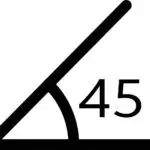
Certain angles can be constructed accurately using only a compass and a straightedge without a protractor. Common angles include 60°, 30°, 90°, 45°, and 120°.
For example, to construct a 60° angle:
- Draw a straight line and mark a point O on it.
- With O as center and any convenient radius, draw an arc to cut the line at point A.
- With A as center and the same radius, draw another arc to cut the first arc at point B.
- Draw a line from O through B. The angle AOB is 60°.
Division and Bisection of Angles
Bisection of an angle means dividing it into two equal parts.
To bisect an angle (e.g., angle PQR):
- With Q as center and any convenient radius, draw an arc to cut QP at A and QR at B.
- With A as center and a radius greater than half of AB, draw an arc.
- With B as center and the same radius, draw another arc to intersect the first arc at point C.
- Draw a line from Q through C. The line QC bisects angle PQR.
Accuracy in Measuring and Drawing Angles
Accuracy is important in technical drawing to ensure that components fit together correctly and designs function as intended.
The following contribute to accuracy:
- Using sharp pencils.
- Using well-maintained drawing instruments.
- Careful handling of instruments.
- Precise marking and drawing of lines and arcs.
- Double-checking measurements.
Teaching Methods/Instructional Techniques
Discussion, Lecture, Demonstration, Question and Answer, Visual Aids
Instructional Procedures
Step 1: Introduction
Time: 5 minutes
Teaching Skill: Set Induction
Teacher’s Activity: The teacher greets the pupils and asks questions about common shapes they see around them, like the corners of a table or the hands of a clock, to introduce the concept of angles. The teacher then introduces the topic: “Angles and Triangles.”
Pupils’ Activity: Pupils respond to questions and listen attentively to the introduction.
Learning Point: Pupils are introduced to the concept of angles and the lesson topic.
Step 2: Explanation of Types of Angles
Time: 8 minutes
Teaching Skill: Explanation/Illustration
Teacher’s Activity: The teacher defines an angle and explains the various types of angles (acute, obtuse, reflex) using charts, models, and real-life examples. The teacher ensures pupils understand the degree ranges for each type.
Pupils’ Activity: Pupils listen, observe the charts and models, and ask questions for clarification. They identify examples of angles in the classroom.
Learning Point: Pupils learn to define and identify different types of angles.
Step 3: Demonstration of Angle Construction
Time: 10 minutes
Teaching Skill: Demonstration/Modelling
Teacher’s Activity: The teacher demonstrates on the whiteboard or drawing board how to construct specific angles (e.g., 60°, 90°, 45°) using only a compass and a straightedge, following the steps outlined in the lesson content. The teacher emphasizes precision.
Pupils’ Activity: Pupils observe the teacher’s demonstration carefully, taking notes on the steps involved.
Learning Point: Pupils observe the practical construction of angles using compasses.
Step 4: Pupils Practice Angle Construction
Time: 7 minutes
Teaching Skill: Guided Practice
Teacher’s Activity: The teacher instructs pupils to practice constructing a 60° angle and a 90° angle on their drawing sheets. The teacher moves around the classroom, providing assistance and correcting errors.
Pupils’ Activity: Pupils attempt to construct the specified angles on their drawing sheets, applying the demonstrated steps.
Learning Point: Pupils gain practical experience in constructing angles.
Step 5: Demonstration of Angle Bisection
Time: 7 minutes
Teaching Skill: Demonstration/Modelling
Teacher’s Activity: The teacher demonstrates how to bisect a given angle using a compass and straightedge. The teacher explains each step clearly and emphasizes the importance of accuracy for an equal division.
Pupils’ Activity: Pupils observe the demonstration of angle bisection and note the procedural steps.
Learning Point: Pupils learn the method for bisecting an angle.
Step 6: Pupils Practice Angle Bisection
Time: 5 minutes
Teaching Skill: Guided Practice
Teacher’s Activity: The teacher instructs pupils to draw an angle and then bisect it using their instruments. The teacher monitors their work and offers support.
Pupils’ Activity: Pupils practice bisecting an angle on their drawing sheets.
Learning Point: Pupils develop the skill of bisecting angles accurately.
Step 7: Evaluation/Review
Time: 5 minutes
Teaching Skill: Questioning/Assessment
Teacher’s Activity: The teacher evaluates the learning by asking the following questions:
- Define an acute angle and an obtuse angle.
- List the steps for constructing a 60-degree angle using a compass and a straightedge.
- Explain what it means to bisect an angle.
- Why is accuracy important when drawing and measuring angles in technical drawing?
Pupils’ Activity: Pupils answer orally and in writing.
Learning Point: Pupils demonstrate understanding of the lesson.
Step 8: Conclusion
Time: 3 minutes
Teaching Skill: Summarization
Teacher’s Activity: The teacher summarizes the key points of the lesson, reiterating the types of angles, methods of construction, and the importance of accuracy. The teacher assigns homework: “Construct an angle of 45 degrees and bisect an angle of 120 degrees.”
Pupils’ Activity: Pupils listen to the summary and copy down the homework assignment.
Learning Point: Pupils review the main concepts of the lesson and have an assignment to reinforce learning.
Lesson Keywords
- Angle – The space between two intersecting lines or surfaces at or close to the point where they meet.
- Acute – An angle less than 90 degrees.
- Obtuse – An angle greater than 90 degrees but less than 180 degrees.
- Reflex – An angle greater than 180 degrees but less than 360 degrees.
- Compasses – A drawing instrument used for drawing circles and arcs.
- Bisect – To divide into two equal parts.
- Protractor – An instrument used for measuring angles.
Differentiation
For pupils who grasp concepts quickly, the teacher can challenge them to construct more complex angles (e.g., 75°, 105°) or divide an angle into four equal parts. For pupils needing more support, the teacher will provide one-on-one guidance during practical sessions and provide simplified step-by-step handouts for angle construction and bisection.
Note for teachers using this lesson plan
Ensure all drawing instruments are available and in good working condition before the lesson. Emphasize practical demonstrations and allow ample time for pupils to practice. Monitor pupils closely during practical activities to correct misconceptions and reinforce proper techniques. Encourage neatness and precision throughout the lesson.


Community Join the conversation Open discussion +