

Class: Primary 5
Term: 3rd Term
Week: 9
Age: 11 years
duration: 40 minutes
Subject: Christian Religion Studies
Previous Lesson: God’s Reward System For Faithful PeopleCurriculum Theme: Christian Religion Studies
Previous Lesson:
Topic: Reward For Faithful Servants
Content/Learning Area: Story of the master and the talents
Performance Objectives
By the end of the lesson, pupils should be able to:
- Cognitive Domain: Explain how God rewards His faithful servants using the parable of the talents.
- Affective Domain: Show appreciation for the value of being diligent and faithful.
- Psychomotor Domain: Dramatize the story of the master and the talents.
- Social Domain: Participate actively in group discussions on how to be faithful in school and at home.
Reference Materials
The following resources were used in planning this lesson:
- 9 Years Basic Education Curriculum
- Abuja Educational Resource Center Scheme of Work
- NAPPS National Unified Scheme of Work
- Online Facts from: Wikipedia – Parable of the Talents
- Relevant Textbooks
instructional materials
The teacher will teach this lesson with the aid of:
- Holy Bible
- Flashcards with Bible verses
- picture chart showing a master giving talents to his servants
- A dramatization script of the parable
- chalkboard and chalk
Rationale for the Lesson
To teach pupils that God rewards those who are faithful and responsible with the gifts and duties entrusted to them.
Prerequisite/Previous Knowledge
Pupils have learned about the importance of obedience and honesty in past Bible stories and lessons.
Lesson Content
Reward For Faithful servants
God is pleased when we use our gifts and responsibilities well. He gives us blessings when we are faithful and do what is right.
Memory Verse: Well done, good and faithful servant; you have been faithful over a few things, I will make you ruler over many things. — Matthew 25:21
Bible Readings
- Matthew 25:14–30
The Parable of the Talents
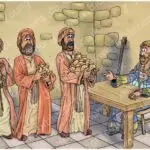
Jesus told a story about a rich man who was going on a journey. He called his three servants and gave them some talents (a type of money). He gave one servant five talents, another two talents, and the third one talent. He gave to each servant according to their ability.
The first servant worked hard and gained five more talents. The second also worked and got two more. But the third servant was lazy. He hid his one talent in the ground and did nothing with it.
When the master came back, he was happy with the first and second servants. He praised them and gave them more responsibilities.But he was angry with the third servant and took away his talent.
Lessons from the Parable
This story teaches us that God wants us to use our talents and gifts well.If we are faithful and hardworking, He will reward us. But if we are lazy and careless, we may lose what we have.
Teaching Methods
To deliver this lesson, the teacher will adopt the following methods: Discussion, Storytelling, Clarification, Dramatization, Question and Answer, visual Aids
Instructional Procedures
To deliver this lesson, the teacher will adopt the following steps:
Step 1: Introduction
Time: 5 mins
Teaching Skill: Set Induction
Teacher’s Activity: Tells a short story of a child who always completes his chores and receives rewards, then connects it to how god rewards His faithful servants.
Pupils’ activity: Pupils listen attentively and answer questions from the teacher.
Learning Point: Pupils understand the value of faithfulness.
Step 2: The Parable of the Talents
Time: 10 mins
Teaching Skill: Storytelling
teacher’s Activity: Reads the story from Matthew 25:14–30, explains the meaning of talents, and highlights the behavior of each servant.
Pupils’ Activity: Pupils follow along, listen and ask questions.
Learning Point: Pupils understand the story and characters.
Step 3: Lessons from the Parable
Time: 8 mins
Teaching Skill: Explanation
Teacher’s Activity: Lists and explains the lessons from the story. Emphasizes how God rewards faithfulness.
Pupils’ Activity: Pupils repeat the lessons and relate them to their own lives.
Learning Point: Learns why faithfulness is critically important to God.
Step 4: Importance of Being Faithful
Time: 5 mins
Teaching Skill: Discussion
Teacher’s Activity: Leads discussion on reasons to be faithful using everyday examples in school, at home, and with friends.
Pupils’ Activity: Pupils share ideas and experiences.Learning Point: Applies the idea of faithfulness in real life.
Step 5: Class Activity
Time: 5 mins
Teaching Skill: Dramatization
Teacher’s Activity: Guides pupils to act out the parable in small groups. Each group represents the three servants and performs their roles.
Pupils’ Activity: Pupils act in groups and respond to their roles.
Learning Point: Understands the consequences of faithfulness.
Step 6: Note Taking
Time: 2 mins
Teaching Skill: Writing
Teacher’s Activity: Writes the key points and memory verse on the board and reads them aloud for pupils to copy.
Pupils’ Activity: Pupils copy the notes neatly into their notebooks.
Learning Point: Reinforces learning through writing.
Step 7: Evaluation
Time: 3 mins
Teaching Skill: Assessment
Teacher’s Activity: Asks oral questions about the story, lessons, and importance of faithfulness.
Pupils’ Activity: Pupils respond to the teacher’s questions orally.
Learning Point: Checks understanding and recall.
Step 8: Conclusion
Time: 2 mins
Teaching Skill: Instructional, Social
Teacher’s Activity: Summarizes the lesson by repeating the memory verse and encouraging pupils to be faithful in all they do. Ends with a short closing prayer.
Pupils’ Activity: Pupils recite the memory verse and join in the closing prayer.
Learning Point: Reinforces learning and spiritual reflection.
Home Task: Write three lessons learned about Reward For Faithful Servants and one suitable way to apply the teaching responsibly.
Lesson Keywords
- Talents – Money or gifts given to people
- Servant – A person who works for a master
- Faithful – Being loyal and doing what is right always
- Reward – A gift or benefit given for good work
- Parable – A short story told by Jesus to teach a lesson
Lesson Evaluation
to evaluate the learning, the teacher asks pupils to:
- Who gave talents to his servants in the Bible story?
- What did the first servant do with his talents?
- What did the lazy servant do?
- Mention two lessons from the story.
- Why should we be faithful in our duties?
- recite the memory verse.
Differentiation
The teacher will support all learners by using simple language, visual aids, role play, and allow group participation for better understanding.
Note for teachers using this lesson plan
Use storytelling to capture interest early and use dramatization to help pupils remember the lesson better. Emphasize God’s joy in seeing faithful children and link the story to practical actions pupils can take.


Community Join the conversation Open discussion +