

Class: Senior Secondary School 1 (SS1 / SSS1)
Term: 3rd Term
Week: 9
Age: 15 years
Duration: 45 minutes
Subject: Garment Making
Curriculum Theme: Trade
Previous Lesson: Flat Patterns.
Topic: FREE HAND METHOD OF CUTTING FABRICS
Subject Matter: Meaning of free hand cutting, Techniques, Merits, Demerits
Specific Objectives
By the end of the lesson, pupils should be able to:
Cognitive Domain:
- Define free hand cutting in garment making.
- State at least three techniques used in free hand cutting.
- List two merits of using the free hand cutting method.
- Mention two demerits associated with free hand cutting.
Affective Domain:
- Appreciate the importance of accuracy in garment cutting.
- Show interest in learning different fabric cutting methods.
Psychomotor Domain:
- Demonstrate basic free hand cutting techniques on a fabric.
- Practice cutting simple fabric shapes using the free hand method.
Social Domain:
- Share ideas with peers on effective cutting practices.
Reference Materials
The following resources were used in planning this lesson:
- 9 Years Basic Education Curriculum (Senior Secondary Education)
- State Unified Scheme of Work for Senior Secondary Schools
- Garment Making for Senior Secondary Schools, Book 1
Instructional Materials
The teacher will teach this lesson with the aid of:
- Fabrics (various types)
- Tailor’s chalk
- Scissors
- Measuring tape
Rationale for the Lesson
This lesson helps pupils understand a fundamental method of cutting fabrics that is often used in basic garment construction. Learning free hand cutting techniques enables pupils to develop precision and confidence in handling fabrics, which is important for their practical skills in garment making.
Prerequisite/Previous Knowledge
Pupils are assumed to have prior knowledge of basic sewing tools and equipment, and different types of fabrics.
Lesson Content/Board Summary
FREE HAND METHOD OF CUTTING FABRICS
Meaning of Free Hand Cutting
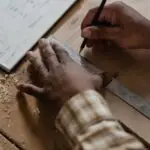
Free hand cutting is a method of cutting fabric directly without the use of a pattern. The design or garment shape is drawn or marked directly onto the fabric, and then cut out. This method relies on the cutter’s skill, experience, and eye for proportion.
Techniques of Free Hand Cutting
The following are common techniques used in free hand cutting:
- Marking directly on the fabric with tailor’s chalk or pencil.
- Folding the fabric to create symmetrical shapes.
- Using existing garment pieces as a guide.
- Estimating measurements and proportions by eye.
Merits of Free Hand Cutting
The following are merits of using the free hand cutting method:
- It saves time as there is no need to prepare a paper pattern.
- It allows for flexibility and immediate adjustments during the cutting process.
- It is suitable for simple garment designs or when working with small pieces of fabric.
- It can be economical as it reduces the need for pattern paper.
Demerits of Free Hand Cutting
The following are demerits of using the free hand cutting method:
- It requires a high level of skill and experience to achieve accuracy.
- It can lead to errors and fabric wastage if not done carefully.
- It is difficult to reproduce identical garments using this method.
- It is not suitable for complex designs or mass production.
Teaching Methods/Instructional Techniques
Discussion, Lecture, Demonstration, Question and Answer, Visual Aids
Instructional Procedures
Step 1: Introduction
Time: 5 minutes
Teaching Skill: Set Induction
Teacher’s Activity: The teacher greets the pupils and reviews the previous lesson briefly. The teacher then asks pupils how they think clothes are cut in tailoring shops, leading them to consider different cutting methods.
Pupils’ Activity: Pupils respond to questions and share their ideas.
Learning Point: Pupils are introduced to the topic and connect it to their prior knowledge.
Step 2: Meaning of Free Hand Cutting
Time: 7 minutes
Teaching Skill: Explanation/Definition
Teacher’s Activity: The teacher explains the meaning of free hand cutting, emphasizing that it involves cutting directly on the fabric without a pattern. The teacher writes the definition on the board.
Pupils’ Activity: Pupils listen attentively, take notes, and ask questions for clarification.
Learning Point: Pupils understand the definition of free hand cutting.
Step 3: Techniques of Free Hand Cutting
Time: 8 minutes
Teaching Skill: Demonstration/Explanation
Teacher’s Activity: The teacher discusses and demonstrates some common techniques of free hand cutting, such as marking directly with chalk and folding fabric for symmetry, using a small fabric piece.
Pupils’ Activity: Pupils observe the demonstration, ask questions, and note the techniques.
Learning Point: Pupils learn about the various techniques involved in free hand cutting.
Step 4: Merits of Free Hand Cutting
Time: 6 minutes
Teaching Skill: Discussion/Brainstorming
Teacher’s Activity: The teacher engages pupils in a discussion about the advantages of using the free hand cutting method, guiding them to identify its benefits. The teacher lists the merits on the board.
Pupils’ Activity: Pupils contribute ideas and write down the merits.
Learning Point: Pupils identify and understand the advantages of free hand cutting.
Step 5: Demerits of Free Hand Cutting
Time: 6 minutes
Teaching Skill: Discussion/Analysis
Teacher’s Activity: The teacher leads a discussion on the disadvantages or challenges associated with free hand cutting, highlighting potential errors and skill requirements. The teacher lists the demerits on the board.
Pupils’ Activity: Pupils participate in the discussion and note the demerits.
Learning Point: Pupils understand the limitations and challenges of free hand cutting.
Step 6: Practical Demonstration and Practice
Time: 8 minutes
Teaching Skill: Practical Application/Observation
Teacher’s Activity: The teacher demonstrates how to cut a simple shape (e.g., a collar, a sleeve opening) free hand on a piece of fabric. The teacher then provides small fabric pieces, chalk, and scissors for pupils to practice cutting simple shapes.
Pupils’ Activity: Pupils observe the teacher’s demonstration and then practice cutting on their own fabric pieces.
Learning Point: Pupils develop practical skills in free hand cutting.
Step 7: Evaluation/Review
Time: 5 minutes
Teaching Skill: Questioning/Assessment
Teacher’s Activity: The teacher evaluates the learning by asking the following questions:
- Define free hand cutting.
- Mention two techniques used in free hand cutting.
- State two merits of free hand cutting.
- List two demerits of free hand cutting.
Pupils’ Activity: Pupils answer orally and in writing.
Learning Point: Pupils demonstrate understanding of the lesson.
Step 8: Conclusion
Time: 5 minutes
Teaching Skill: Summarization/Consolidation
Teacher’s Activity: The teacher summarizes the key points of the lesson, reiterating the meaning, techniques, merits, and demerits of free hand cutting. The teacher gives homework: “Practice free hand cutting of a simple skirt or shirt pattern on an old fabric at home.”
Pupils’ Activity: Pupils listen to the summary and copy the homework.
Learning Point: Pupils consolidate their learning and are given tasks for further practice.
Lesson Keywords
- Free Hand Cutting – Cutting fabric directly without a pattern.
- Techniques – Methods or procedures used to perform a task.
- Merits – Advantages or good points.
- Demerits – Disadvantages or bad points.
Differentiation
For pupils who grasp the concepts quickly, the teacher can encourage them to try cutting more complex shapes or designs. For those who need more support, the teacher can provide additional guidance during the practical session and simplify the shapes they are asked to cut. Peer-to-peer learning can also be encouraged, where more proficient pupils assist their struggling classmates.
Note for teachers using this lesson plan
Teachers should ensure they have enough fabric scraps, chalk, and scissors for all pupils to practice during the practical session. Emphasize safety when using scissors. Encourage pupils to be patient and persistent as free hand cutting requires practice to master.



Community Join the conversation Open discussion +