

Class: Senior Secondary School 1 (SS1 / SSS1)
Term: 3rd Term
Week: 10
Age: 15 years
Duration: 45 minutes
Subject: Garment Making
Curriculum Theme: Trade
Previous Lesson: Free Hand Method Of Cutting Fabrics.
Topic: BODY MEASUREMENT
Subject Matter: Importance of body measurement, Measurement principles, Essential body parts
Specific Objectives
By the end of the lesson, pupils should be able to:
Cognitive Domain:
Instructional Materials
The teacher will teach this lesson with the aid of:
- A measurement diagram showing various body parts.
- Measuring tape.
- Chalk or marker.
- Charts illustrating measurement principles.
Rationale for the Lesson
This lesson helps pupils understand the basic steps required before constructing a garment. Learning how to take accurate body measurements is important for creating clothes that fit well, which is a fundamental skill in garment making and everyday life.
Prerequisite/Previous Knowledge
Pupils have basic knowledge of simple tools used in garment making and the concept of personal hygiene.
Lesson Content/Board Summary
BODY MEASUREMENT
Definition of Body Measurement
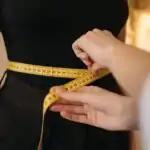
Body measurement refers to the process of taking accurate dimensions of different parts of the human body using a measuring tape. These measurements are used to create well-fitting garments.
Importance of Body Measurement
The following are reasons why body measurement is important:
- It ensures that garments fit the wearer perfectly.
- It helps to achieve comfort when wearing clothes.
- It reduces fabric wastage by cutting the correct size.
- It allows for adjustments and modifications to patterns.
- It is essential for mass production of ready-to-wear garments.
Principles of Taking Body Measurements
The following principles should be observed when taking body measurements:
- The person being measured should stand in a natural, relaxed posture.
- A correct and flexible measuring tape should be used.
- Measurements should be taken over light clothing or undergarments.
- The measuring tape should be held snugly but not too tight or too loose against the body.
- All measurements should be recorded accurately and immediately.
- Measurements should be taken twice to ensure accuracy.
- The person taking the measurement should stand on the right side of the person being measured.
Essential Body Parts for Measurement
The following are essential body parts where measurements are taken for garment making:
- Bust/Chest
- Waist
- Hip
- Shoulder (across back/front)
- Sleeve length
- Armhole
- Neck circumference
- Back length (nape to waist)
- Skirt length (waist to desired length)
- Inseam/Crotch length (for trousers)
Teaching Methods/Instructional Techniques
Discussion, Lecture, Demonstration, Question and Answer, Visual Aids
Instructional Procedures
Step 1: Introduction
Time: 5 minutes
Teaching Skill: Set Induction
Teacher’s Activity: The teacher greets the pupils and asks them to state what makes a dress fit well. The teacher then introduces the topic “Body Measurement” and explains that accurate measurements are the foundation of good garment construction.
Pupils’ Activity: Pupils respond to the teacher’s questions and listen attentively.
Learning Point: Pupils are introduced to the topic and understand its relevance.
Step 2: Definition and Importance of Body Measurement
Time: 8 minutes
Teaching Skill: Explanation/Discussion
Teacher’s Activity: The teacher defines body measurement and explains its importance using the board summary. The teacher encourages pupils to share their own experiences with ill-fitting clothes.
Pupils’ Activity: Pupils listen, contribute to the discussion, and copy notes from the board.
Learning Point: Pupils understand what body measurement is and why it is essential.
Step 3: Principles of Taking Body Measurements
Time: 8 minutes
Teaching Skill: Explanation/Demonstration
Teacher’s Activity: The teacher explains the principles of taking body measurements, demonstrating each point where possible with a measuring tape. The teacher emphasizes the need for accuracy and proper posture.
Pupils’ Activity: Pupils observe the demonstration, ask questions, and take notes.
Learning Point: Pupils learn the correct procedures and guidelines for taking measurements.
Step 4: Essential Body Parts for Measurement
Time: 8 minutes
Teaching Skill: Identification/Visualisation
Teacher’s Activity: The teacher uses a measurement diagram or a chart to point out and name the essential body parts where measurements are taken. The teacher explains the significance of each measurement for different garment types.
Pupils’ Activity: Pupils identify the body parts on the diagram and listen to the explanations.
Learning Point: Pupils can identify the key points on the body for measurement.
Step 5: Practical Demonstration
Time: 6 minutes
Teaching Skill: Demonstration/Modelling
Teacher’s Activity: The teacher demonstrates how to take a few basic measurements (e.g., bust, waist, hip) on a volunteer pupil or a mannequin, emphasizing the principles discussed.
Pupils’ Activity: Pupils observe the practical demonstration carefully.
Learning Point: Pupils see the theoretical principles applied practically.
Step 6: Group Activity/Practice
Time: 5 minutes
Teaching Skill: Group Work/Supervision
Teacher’s Activity: The teacher divides pupils into small groups and provides each group with a measuring tape. Pupils are asked to identify and point out the essential measurement points on each other or a mannequin within their group, under the teacher’s supervision.
Pupils’ Activity: Pupils work in groups to identify measurement points and practice holding the tape.
Learning Point: Pupils reinforce their understanding through practical application and peer interaction.
Step 7: Evaluation/Review
Time: 5 minutes
Teaching Skill: Questioning/Assessment
Teacher’s Activity: The teacher evaluates the learning by asking the following questions:
- What is body measurement?
- State three reasons why accurate body measurement is important.
- Mention two principles to observe when taking body measurements.
- List four essential body parts where measurements are taken for garment making.
Pupils’ Activity: Pupils answer orally and in writing.
Learning Point: Pupils demonstrate understanding of the lesson.
Step 8: Conclusion
Time: 5 minutes
Teaching Skill: Summarization
Teacher’s Activity: The teacher summarizes the key learning points of the lesson, reiterating the importance of accurate body measurement in garment construction. The teacher assigns homework: “List five tools needed for taking body measurements and state their uses.”
Pupils’ Activity: Pupils listen to the summary and copy the homework.
Learning Point: Pupils review the main concepts and receive follow-up tasks.
Lesson Keywords
- Body Measurement – The process of taking dimensions of the human body for garment making.
- Measuring Tape – A flexible tape used for taking body dimensions.
- Accuracy – The quality of being correct, precise, or exact in measurement.
- Posture – The way one holds their body when standing or sitting.
Differentiation
The teacher will provide additional support to pupils who are struggling by offering one-on-one guidance and simplified explanations. Advanced learners will be encouraged to research different types of measurements for specific garments.
Note for teachers using this lesson plan
Teachers should ensure they have a clear measurement diagram or charts. A live demonstration on a pupil or mannequin is highly recommended to make the concepts practical and engaging. Emphasize the hygiene aspect when demonstrating on a live pupil.


Community Join the conversation Open discussion +