

Class: Junior Secondary School 2 (JSS2, JSS 2)
Term: 2nd Term
Week: 3 – 4
Age: 13 years
Duration: 45 minutes
Subject: Basic Science And Technology
Curriculum Theme: Basic Technology
Previous Lesson: Polygons and Their Construction
Topic: Area Of Plane Figures
Subject Matter: Enlargement or reduction of plane figures (regular and irregular), Determination of areas of regular plane figures
Specific Objectives
By the end of the lesson, pupils should be able to:
- Cognitive Domain:
(a) Define plane figures and describe their properties.
(b) Explain the concepts of enlargement and reduction of plane figures.
(c) Calculate the area of regular plane figures using appropriate formulas. - Affective Domain:
(a) Show interest and curiosity in exploring plane figures through drawing and measurement activities.
(b) Appreciate the importance of accurate measurement in daily life. - Psychomotor Domain:
(a) Draw regular and irregular plane figures accurately.
(b) Measure sides and dimensions to determine areas of plane figures. - Social Domain:
(a) Work collaboratively in pairs or groups to compare and discuss areas of plane figures.
(b) Demonstrate respect for peers’ work and ideas during class activities.
Reference Materials
The following resources were used in planning this lesson:
- 9 Years Basic Education Curriculum
- Lagos State Unified Scheme of Work for Junior Secondary Schools
- Math Is Fun – “Area of Plane Figures” https://www.mathsisfun.com/geometry/area.html
- Relevant Textbooks
Instructional Materials
The teacher will teach this lesson with the aid of:
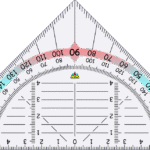
- Ruler, protractor, and compass
- Graph paper and plain paper
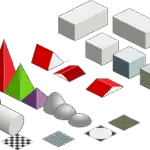
- Chart showing examples of plane figures
- Marker pens and whiteboard
- Models of plane figures (cardboard cut-outs)
Rationale for the Lesson
This lesson equips pupils with knowledge and skills to calculate areas of plane figures, enhancing problem-solving and practical measurement abilities.
Prerequisite/Previous Knowledge
Pupils are expected to have basic knowledge of shapes, counting, and simple measurement techniques from prior lessons.
Lesson Content/Board Summary
Area Of Plane Figures
Enlargement and Reduction of Plane Figures
Enlargement and reduction refer to changing the size of a figure while maintaining its shape. Enlarging a figure increases its dimensions proportionally, whereas reduction decreases them proportionally.
The following are key points about enlargement and reduction:
- Enlargement increases the size of all sides by the same scale factor.
- Reduction decreases the size of all sides by the same scale factor.
- The shape of the figure remains similar after enlargement or reduction.
- Scale factor is the ratio of the new length to the original length.
Determination of Area of Regular Plane Figures
Regular plane figures have equal sides and angles. Examples include squares, rectangles, and equilateral triangles. Calculating their areas involves using standard formulas.
The following are examples and formulas for regular plane figures:
- Square: Area = side × side
- Rectangle: Area = length × breadth
- Equilateral Triangle: Area = (√3/4) × side²
- Parallelogram: Area = base × height
- Trapezium: Area = ½ × (sum of parallel sides) × height
Determination of Area of Irregular Plane Figures
Irregular plane figures do not have equal sides or angles. Their areas can be determined by dividing them into regular shapes or using grid approximation methods.
These include:
- Dividing the figure into squares, rectangles, or triangles and summing their areas.
- Using the counting square method on graph paper.
- Applying approximate formulas if the figure is complex and not easily subdivided.
Teaching Methods/Instructional Techniques
Discussion, Lecture, Demonstration, Visual Aids, Group Work, Guided Practice
Instructional Procedures
To deliver this lesson, the teacher will adopt the following steps:
Step 1: Introduction
Time: 5 minutes
Teaching Skill: Set Induction
Teacher’s Activity: Engage pupils by asking them to identify objects around them that resemble plane figures and review previous lesson on shapes.
Pupils’ Activity: Respond to questions and recall prior knowledge.
Learning Point: Pupils connect prior knowledge of shapes to the current lesson.
Step 2: Explanation of Enlargement and Reduction
Time: 8 minutes
Teaching Skill: Explanation
Teacher’s Activity: Define and explain enlargement and reduction using examples on the board.
Pupils’ Activity: Take notes and copy definitions/examples.
Learning Point: Pupils understand proportional changes in plane figures.
Step 3: Demonstration of Area Calculation for Regular Figures
Time: 10 minutes
Teaching Skill: Demonstration
Teacher’s Activity: Show step-by-step calculation of areas of square, rectangle, and triangle using chart and board examples.
Pupils’ Activity: Follow and copy calculations.
Learning Point: Pupils can calculate areas of regular plane figures.
Step 4: Area of Irregular Figures
Time: 10 minutes
Teaching Skill: Guided Practice
Teacher’s Activity: Illustrate how to divide irregular figures into regular shapes to determine the area.
Pupils’ Activity: Practice dividing figures and calculating areas.
Learning Point: Pupils can determine areas of irregular figures.
Step 5: Note-Taking
Time: 3 minutes
Teaching Skill: Organization
Teacher’s Activity: Guide pupils to summarize key formulas and steps in their notebooks.
Pupils’ Activity: Copy board summary and formulas.
Learning Point: Pupils consolidate knowledge for reference.
Step 6: Evaluation/Review
Time: 5 minutes
Teaching Skill: Questioning and Assessment
Teacher’s Activity: The teacher evaluates the learning by asking the following questions:
- Define enlargement and reduction of plane figures.
- Calculate the area of a square with side 6 cm.
- Determine the area of a rectangle with length 8 cm and breadth 5 cm.
- Explain one method to find the area of an irregular figure.
Pupils’ Activity: Answer questions and solve exercises on paper.
Learning Point: Pupils demonstrate understanding and correct application of formulas.
Step 7: Conclusion
Time: 4 minutes
Teaching Skill: Summarization
Teacher’s Activity: Recap key points and emphasize the importance of accurate measurement and area calculation.
Pupils’ Activity: Listen and ask clarifying questions.
Learning Point: Pupils appreciate the relevance of learning about areas of plane figures.
Lesson Keywords
- Plane Figure – flat shape with boundaries
- Enlargement – increasing size proportionally
- Reduction – decreasing size proportionally
- Area – measure of surface within boundaries
- Regular Figure – shape with equal sides and angles
- Irregular Figure – shape with unequal sides or angles
Differentiation
Provide guided support for slow learners and challenge advanced pupils with complex irregular figures. Use visual aids for visual learners and hands-on activities for kinesthetic learners.
Note for teachers using this lesson plan
Ensure pupils use rulers and graph papers accurately, emphasize understanding of scale factor, and encourage group discussions to foster peer learning.

Community Join the conversation Open discussion +