

Class: Primary Two
Term: Second Term
Subject: History
Curriculum Theme:
Previous Lesson: Geography and Environment II, Major Towns in the State
Topic: Geography and Surroundings: Location of Major Towns
Content/Learning Area: Identifying major towns, Appreciating the meaning of knowing locations, Pointing to and naming major towns, Collaborating in identifying and discussing locations
Time Allocation: 40 minutes
Performance Objectives
By the end of the lesson, pupils should be able to:
- Cognitive Domain:
1. Identify three major towns in the state on a map.
2. Explain the importance of knowing the location of major towns.
- Affective Domain:
1. Develop an gratitude for the significance of knowing the location of major towns in their state.
- Psychomotor Domain:
1. Point to and name major towns correctly on a map.
- Social Domain:
1. Collaborate with classmates in identifying and discussing the location of major towns.
Reference Materials
- 9 – Years Basic Education Curriculum
- Abuja Educational Resource Center Scheme of Work
- NAPPS National Unified Scheme of Work
- Relevant Textbooks
Instructional Materials
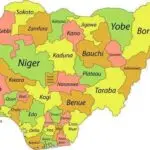
To deliver this lesson, the teacher will use the following materials: A map of the state, Pictures of major towns, Markers or crayons.
Rationale for the Lesson
Understanding location is fundamental to geography. Knowing major towns helps pupils understand their state’s geography and its ancient and cultural significance.
Prerequisite/Previous Knowledge
The teacher will start by asking pupils to name places they know in their state. The teacher will than introduce the lesson by showing a map of the state and asking pupils what they see.
Lesson Content
Location of Major Towns in the State
Knowing where major towns are located helps us understand our state better.It connects history and geography.
What is Location?
Location refers to where something is situated. We can describe it using coordinates, landmarks, or by saying where it is compared to other things.
Major Towns in the State
Thes include:
- Lagos: Lagos is in Lagos State. It’s nigeria’s biggest city and very crucial for the country’s economy. It has busy markets, exciting nightlife, and famous places like the National Museum and Lagos Lagoon.
- Abuja: Abuja is Nigeria’s capital city, located in the Federal Capital Territory (FCT). It’s a modern city with wide roads,parks,and government buildings. Learn more about Abuja.
- Kano: Kano is in Kano State. It’s a big centre for business and making things in northern Nigeria. It’s known for its traditional crafts,busy markets,and old places like the kano city Walls.
- Port Harcourt: Port Harcourt is in Rivers State. It’s a major port city and the center of Nigeria’s oil industry. It has oil refineries, busy markets, and places like the Rivers state Museum.
- Ibadan: Ibadan is in Oyo State.It’s one of Nigeria’s largest cities and a very critically important cultural and historical place. It has traditional markets, a lively arts scene, and places like the University of Ibadan and Mapo Hall.
- Enugu: Enugu is the capital of Enugu State, known for its coal mining history and scenic hills. It’s a significant cultural and commercial center in southeastern Nigeria, featuring landmarks like the Enugu Museum and the Polo Park Mall.
- Kaduna: Kaduna is the capital of Kaduna State, a major commercial and transportation hub in northern Nigeria.It’s known for its diverse industries,educational institutions,and historical sites like the Kaduna National Museum and Lugard Hall.
Teaching methods
To deliver this lesson, the teacher will adopt the following methods: Discussion, Map work, Group activity.
Instructional Procedures
To deliver this lesson, the teacher will adopt the following steps:
Step 1: introduction
Time: 5 minutes
Teaching Skill: Set Induction
Teacher’s Activity: Asks pupils to name places they know.
Pupils’ Activity: Respond to the teacher’s questions.
Step 2: Clarification of Key Concepts
Time: 10 minutes
Teaching Skill: Explanation
Teacher’s Activity: Explains the meaning of location and introduces major towns.
Pupils’ Activity: Listen attentively and ask questions.
Step 3: Presentation/Guided Practice
Time: 10 minutes
Teaching Skill: Presentation
Teacher’s Activity: Points to and names major towns on the map.
Pupils’ Activity: Observe and repeat.
Step 4: Autonomous Practice
Time: 10 minutes
Teaching Skill: Guided Practice
Teacher’s Activity: Guides pupils to identify towns on their own maps.
Pupils’ Activity: Identify and name towns on their maps.
Step 5: Note-Taking
Time: 2 minutes
Teaching Skill: Note-Taking
Teacher’s Activity: Guides pupils to write down key points.
Pupils’ Activity: Write down key points.
Step 6: Evaluation/Review
Time: 3 minutes
Teaching Skill: Questioning
Teacher’s Activity: Asks review questions.
Pupils’ Activity: Answer review questions.
Objective-aligned checks:
- Identify three major towns in the state on a map.
- Explain the importance of knowing the location of major towns.
Step 7: Conclusion
Time: 3 minutes
Teaching Skill: Summarizing
Teacher’s Activity: Summarizes the key points of the lesson.
Pupils’ Activity: Listen attentively and ask questions for clarification.
Lesson Keywords
- Location – Where something is situated.
- Major Towns – Important cities or towns in a state.
- Map – A visual representation of an area.
- State – A region or territory within a country.
- Geography – The study of places and their relationships.
Lesson Evaluation
To evaluate the learning, the teacher asks pupils to:
- Name three major towns in our state.
- Show me the capital city on the map.
- Why is it critically important to know where major towns are?
- What makes a town important?
- How can knowing where towns are help us understand our state’s history?
Assignment/Homework
- Draw a map of your local area and mark critically important places.
- List five major towns in Nigeria and their states.
- Write a short paragraph on why knowing the location of towns is critically important.
Differentiation
- For slower learners: Provide one-on-one assistance and simplified maps with fewer towns to identify.
- For advanced learners: Assign extra activities,such as researching the history and significance of major towns.
- For visual/auditory/kinesthetic learners: Use visual aids like pictures and videos, encourage verbal repetition, and incorporate hands-on activities like drawing maps.
Note for Teachers
Ensure to use local examples and relatable scenarios to explain the importance of knowing the location of major towns. Encourage pupils to share their personal experiences and observations to make the lesson more engaging and relevant.


Community Join the conversation Open discussion +