

Note for teachers using this lesson plan
Before this lesson, prepare coloured cards (red, yellow, green) to represent traffic lights, and gather pictures showing safe and unsafe road behaviours. The central idea is for pupils to understand that traffic lights tell us when to stop and go, and that we must always walk safely on the road, holding an adult’s hand. Ensure a clear, safe space for the drama activity. Successful learning will be observed when pupils can identify traffic light colours and demonstrate simple safe walking actions like stopping at a red light or looking both ways.
Class: Pre-School Level 2
Term: Second Term
Week: 6
Age: 3 years
Duration: 30 minutes
Subject: Health Habits
Curriculum Theme: Health Habits
Previous Lesson: Understanding simple rules at home and school.
Topic: ROAD SAFETY: TRAFFIC LIGHTS AND SAFE WALKING
Subject Matter: Road Safety: Traffic Lights and Safe Walking.
Specific Objectives
By the end of the lesson, pupils should be able to:
Cognitive Domain
- Identify the three colours of a traffic light.
- State what each traffic light colour means (stop, get ready, go).
- Name at least two safe walking rules.
Affective Domain
- Show willingness to obey traffic light signals.
- Appreciate the importance of walking safely on the road.
Psychomotor Domain
- Demonstrate the actions for “stop” and “go” based on traffic light colours.
- Participate in a simple drama showing safe road crossing.
Social Domain
- Practise holding an adult’s hand when crossing the road during role-play.
- Take turns and cooperate during group activities related to road safety.
Reference Materials
- NAPPS National Unified Teaching Scheme for Pre-School Level 2
- Early Childhood Care and Education resources
- Relevant early-years workbooks on Health Habits
Instructional Materials
- Coloured cards (red, yellow, green) to represent traffic lights
- Picture charts showing traffic lights and safe/unsafe road behaviours
- Flash cards with images of children walking safely, crossing roads, using pedestrian bridges
- Storybook or picture book about road safety
- Video clip on traffic lights and safe walking for preschoolers
- Learning stamps related to road safety
Rationale for the Lesson
This lesson is important for 3-year-olds because it teaches them fundamental rules for staying safe around roads, which they encounter daily. Understanding traffic lights and safe walking habits helps prevent accidents and builds a foundation for responsible behaviour as they grow.
Prerequisite/Previous Knowledge
Pupils have some basic understanding of following simple instructions and moving around in their environment.
Lesson Content/Board Summary
ROAD SAFETY: TRAFFIC LIGHTS AND SAFE WALKING
Road Safety means knowing how to stay safe when we are near or on the road.
Traffic Lights
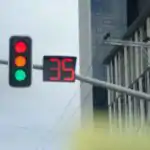
Traffic lights help cars and people know when to stop and when to go. They have three colours:
- Red Light: Means STOP! Do not move.
- Yellow Light: Means GET READY! Be careful.
- Green Light: Means GO! You can move.
Safe Walking Rules
When we walk on the road, we must be safe:
- Always walk on the pavement or the side of the road, not in the middle.
- Before crossing the road, look left, then right, then left again to check for cars.
- Always hold an adult’s hand when crossing the road.
- If there is a pedestrian bridge, use it to cross over the road.
- Never play in the middle of the road. It is very dangerous.
Key Words
- Road: Where cars drive.
- Traffic Light: Lights that tell cars and people when to stop and go.
- Red: Stop.
- Yellow: Get ready.
- Green: Go.
- Safe: Not in danger.
Traffic Light and Safe Walking Song
Tune: “Twinkle, Twinkle Little Star”
Traffic light, traffic light, standing tall,
Tell us what to do for all.
Red light, red light, what do you say?
“STOP, STOP!” right away!
Yellow light, yellow light, what do you say?
“GET READY!” don’t delay!
Green light, green light, what do you say?
“GO, GO!” and walk away!
Look left, look right, before you cross,
Hold a hand, avoid all loss!
Safe walking, safe walking, every day,
Keeps us happy, safe to play!
Actions:
- “Traffic light, standing tall”: Stand tall, point up.
- “Red light, STOP”: Hold up red card, stamp feet.
- “Yellow light, GET READY”: Hold up yellow card, wiggle fingers.
- “Green light, GO”: Hold up green card, march in place.
- “Look left, look right”: Turn head left, then right.
- “Hold a hand”: Hold out hand as if holding an adult’s.
- “Safe walking, happy, safe to play”: Smile, clap hands.
Watch and Learn About Traffic Lights
💡 Teacher Guide for Using This Board Summary
How to teach the content: Introduce road safety by asking pupils if they walk on the road or see cars. Use the coloured cards to explain each traffic light colour and its meaning. Emphasise the actions for stop, get ready, and go. For safe walking rules, use picture charts to show good and bad examples, asking pupils to identify what is safe. Keep explanations very simple and concrete.
What to show or demonstrate: Hold up the red, yellow, and green cards one by one, clearly stating what each means and demonstrating the corresponding action (e.g., stopping for red, marching for green). Demonstrate looking left and right before crossing and holding an imaginary adult’s hand. Use flashcards to illustrate each safe walking rule.
How to use the rhyme/song: Introduce the “Traffic Light and Safe Walking Song” after explaining the traffic light colours and basic walking rules. Sing it slowly first, demonstrating the actions. Repeat the song several times, encouraging pupils to join in the singing and actions. This helps reinforce the concepts through movement and repetition.
How to use the video: Introduce the video as a fun way to learn more about traffic lights. Play the video, encouraging pupils to watch and listen. After watching, discuss what they saw and heard, focusing on the colours and their meanings. Ask them to practise the actions shown in the video or sung in our classroom song.
What to watch for: Observe if pupils can correctly identify the colours and their meanings. Watch for their participation in actions and their ability to follow simple instructions during the role-play. Correct any misconceptions about playing on the road or crossing without an adult.
Teaching Methods/Instructional Techniques
Play-based Learning, Demonstration, Guided Practice, Songs and Rhymes, Storytelling, Picture Talk, Question and Answer, Role-play, Imitation, Manipulation of Objects, Practical Activity.
Instructional Procedures
Step 1: Introduction
Time: 3 minutes
Teaching Skill: Engagement/Recall
Teacher’s Activity: The teacher greets the pupils and starts with a familiar song. The teacher then asks pupils if they have ever walked on a road or seen cars moving. The teacher introduces the topic of “Road Safety” and how to be safe when walking.
Pupils’ Activity: Pupils respond to greetings and questions. They listen attentively as the teacher introduces the topic.
Learning Point: Pupils are introduced to the concept of road safety.
Step 2: Presentation of Traffic Lights
Time: 5 minutes
Teaching Skill: Explanation/Visual Aid
Teacher’s Activity: The teacher shows pictures of traffic lights and introduces the three colours: red, yellow, and green. The teacher explains what each colour means using simple words and actions.
Pupils’ Activity: Pupils observe the pictures, listen to the teacher, and repeat the names of the colours and their meanings (e.g., “Red means STOP!”).
Learning Point: Pupils identify traffic light colours and their basic meanings.
Step 3: Demonstration and Practice of Traffic Light Actions
Time: 4 minutes
Teaching Skill: Demonstration/Imitation
Teacher’s Activity: The teacher holds up coloured cards (red, yellow, green) one by one and demonstrates the action for each colour (e.g., stop, get ready, go). The teacher encourages pupils to imitate the actions.
Pupils’ Activity: Pupils watch the teacher and practise the actions for “stop,” “get ready,” and “go” as the teacher flashes the coloured cards.
Learning Point: Pupils physically associate colours with actions.
Step 4: Rhyme/Song Reinforcement
Time: 5 minutes
Teaching Skill: Musicality/Repetition
Teacher’s Activity: The teacher introduces the “Traffic Light and Safe Walking Song,” singing it with actions. The teacher encourages pupils to sing along and perform the actions.
Pupils’ Activity: Pupils listen, sing along, and perform the actions of the song, reinforcing the meanings of the traffic light colours and safe walking steps.
Learning Point: Pupils reinforce learning through song and movement.
Step 5: Presentation of Safe Walking Rules
Time: 4 minutes
Teaching Skill: Picture Talk/Discussion
Teacher’s Activity: The teacher uses picture charts and flash cards to show various safe walking rules (e.g., walking on the pavement, looking left and right, holding an adult’s hand, using a pedestrian bridge, not playing on the road). The teacher explains each rule simply.
Pupils’ Activity: Pupils observe the pictures, listen to the explanations, and identify safe behaviours shown in the pictures.
Learning Point: Pupils learn important rules for walking safely on the road.
Step 6: Drama/Role-play Activity
Time: 5 minutes
Teaching Skill: Role-play/Guided Practice
Teacher’s Activity: The teacher organises a simple drama or role-play where pupils pretend to be pedestrians or cars. The teacher uses the coloured cards as traffic lights and guides pupils to practise crossing the road safely (e.g., looking both ways, holding hands, stopping for red light).
Pupils’ Activity: Pupils participate in the drama, acting out safe walking and crossing behaviours under the teacher’s guidance.
Learning Point: Pupils apply safe road behaviours in a practical scenario.
Step 7: Evaluation/Review
Time: 4–5 minutes
Teaching Skill: Questioning/Assessment
Teacher’s Activity: The teacher checks pupils’ understanding through short questions and practical tasks.
- What colour means STOP on a traffic light?
- What colour means GO?
- Show me how you look before crossing the road.
- What should you always do with an adult when crossing the road?
Pupils’ Activity: Pupils respond orally and demonstrate the required skill where appropriate.
Learning Point: Pupils demonstrate understanding of the lesson.
Step 8: Conclusion
Time: 1 minute
Teaching Skill: Summarisation/Encouragement
Teacher’s Activity: The teacher briefly reminds pupils about the importance of road safety and praises them for their participation. The teacher encourages them to always remember and practise safe road habits.
Pupils’ Activity: Pupils listen and acknowledge the importance of road safety.
Learning Point: Pupils are encouraged to apply learned safety habits.
Lesson Keywords
- Road: A path for vehicles and people.
- Safety: Being protected from danger or harm.
- Traffic Light: A signal with red, yellow, and green lights to control traffic.
- Stop: To not move.
- Go: To move forward.
- Pavement: A path for people to walk on, usually at the side of a road.
Differentiation
- Support: For pupils who are struggling, the teacher can provide more one-on-one repetition of the traffic light colours and meanings. Use larger, clearer pictures. Allow them to simply point to the correct colour or action. Provide hand-over-hand guidance during the drama activity.
- Extension: For pupils who grasp the concepts quickly, the teacher can ask them to identify other things that might be on the road (e.g., bicycles, motorcycles) and discuss how to be safe around them. They can also lead a small group in demonstrating a safe crossing or traffic light sequence.
Community Join the conversation Open discussion +