

Note for teachers using this lesson plan
Before the lesson, prepare charts or flashcards showing clear pictures of the human body and its parts. Ensure you have enough space for pupils to stand and perform actions. The central idea is for pupils to identify and name major body parts on themselves and others. Observe pupils pointing to and naming body parts correctly as a sign of successful learning.
Class: Pre-School Level 2
Term: First Term
Week: 1
Age: 3 years
Duration: 30 minutes
Subject: Health Habits
Curriculum Theme: Health Habits
Previous Lesson:
Topic: Parts of the Human Body: Identification
Subject Matter: Identifying Parts of the Human Body: The Head, Neck, Chest, Elbow, etc.
Specific Objectives
By the end of the lesson, pupils should be able to:
Cognitive Domain
- Identify at least five parts of the human body.
- Name at least three parts of the human body when pointed to.
Affective Domain
- Listen attentively as the teacher names body parts.
- Show interest in learning about their own body.
Psychomotor Domain
- Point to specific body parts on themselves or a picture.
- Perform actions related to body parts (e.g., touching their head, waving their arms).
Social Domain
- Actively participate in group activities and songs.
- Take turns in identifying body parts.
Reference Materials
- NAPPS National Unified Teaching Scheme for Pre-School Level 2
- Early Childhood Care and Education (ECCE) resources
- Relevant early-years workbook/textbook on Health Habits
Instructional Materials
- Large chart posters showing a picture of the human body
- Flashcards with pictures of individual body parts (e.g., head, hand, leg)
- Picture books featuring children and their body parts
- Dolls or puppets
- A mirror (optional, for self-identification)
Rationale for the Lesson
Learning about body parts is fundamental for 3-year-olds as it builds self-awareness and helps them understand how their body works. This knowledge is crucial for communication, expressing needs, understanding personal hygiene, and ensuring their safety. It also lays the foundation for future health education.
Prerequisite/Previous Knowledge
Pupils are generally aware of their own body and may already know a few common body parts like their eyes or hands from daily interactions.
Lesson Content/Board Summary
Parts of the Human Body: Identification
Our body has many important parts that help us do different things. Let’s learn some of them:
- Head: The top part of our body where our brain, eyes, nose, mouth, and ears are.
- Neck: Connects our head to our body and helps our head turn.
- Chest: The front part of our body, where our heart and lungs are.
- Arms: We have two arms, connected to our shoulders. We use them for holding, lifting, and waving.
- Hands: At the end of our arms, with fingers. We use our hands to touch, clap, and pick things up.
- Legs: We have two legs, which help us stand, walk, run, and jump.
- Feet: At the bottom of our legs, with toes. Our feet help us balance and move around.
- Elbow: The joint in the middle of our arm that allows it to bend.
- Knee: The joint in the middle of our leg that allows it to bend.
Key Words
- Head – The top part of our body.
- Neck – Connects the head to the body.
- Chest – The front part of the body.
- Arm – Used for holding and waving.
- Leg – Used for walking and running.
My Body Parts Song
Tune: “Twinkle, Twinkle Little Star”
Lyrics:
My head, my head, I can touch my head.
My neck, my neck, it turns around.
My chest, my chest, it goes up and down.
My arms, my arms, I can wave them all around.
My legs, my legs, they help me to stand.
My feet, my feet, they walk on the land.
My eyes, my ears, my nose, my mouth,
These are my body parts, all around!
Actions: Touch head, turn neck from side to side, pat chest, wave arms, stand up, tap feet, point to eyes/ears/nose/mouth as named.
Watch and Practise
💡 Teacher Guide for Using This Board Summary
How to teach the content: Begin by pointing to your own body parts and naming them clearly. Use the large body chart to show each part. Encourage pupils to repeat the names after you. Emphasize the key words by writing them clearly on the board or showing flashcards.
What to show or demonstrate: Use the body chart or a doll/puppet to clearly show each body part. Demonstrate the actions for each part (e.g., turning your neck, waving your arms, bending your elbow). Ask pupils to touch their own corresponding body parts as you name them.
How to use the rhyme/song: Introduce the “My Body Parts Song” by singing it slowly with clear actions. Repeat the song several times, encouraging pupils to join in with both singing and actions. Gradually increase the pace as pupils become more familiar with it.
How to use the video: Introduce the video as “The Body Parts Song.” Ask pupils to watch carefully and try to do the actions shown in the video. After watching, discuss the body parts they saw and practised, reinforcing the names and actions.
What to watch for: Observe if pupils are able to point to the correct body part when named and if they can repeat the names. Look for pupils who might be shy and gently encourage their participation.
Teaching Methods/Instructional Techniques
- Play-based Learning
- Demonstration
- Guided Practice
- Songs and Rhymes
- Picture Talk
- Question and Answer
- Imitation
- Practical Activity
- Repetition
Instructional Procedures
Step 1: Introduction
Time: 3 minutes
Teaching Skill: Greeting/Engaging
Teacher’s Activity: The teacher greets the pupils warmly and leads a simple “Good Morning” song. The teacher then asks pupils what they know about their own bodies.
Pupils’ Activity: Pupils respond to greetings and share simple ideas about their body (e.g., “I have hands”).
Learning Point: Pupils are engaged and ready for the lesson.
Step 2: Presentation of Topic
Time: 4 minutes
Teaching Skill: Explaining/Visual Aid Use
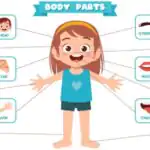
Teacher’s Activity: The teacher introduces the topic “Parts of the Human Body” using a large chart poster showing a child’s body. The teacher points to the head and says, “This is a head.”
Pupils’ Activity: Pupils observe the chart and listen as the teacher introduces the topic and names the first body part.
Learning Point: Pupils understand the topic for the day.
Step 3: Identification and Naming
Time: 6 minutes
Teaching Skill: Naming/Repetition
Teacher’s Activity: The teacher points to different body parts on the chart (head, neck, chest, arms, hands, legs, feet, elbow, knee), names each one clearly, and asks pupils to repeat the name after her. The teacher also points to her own body parts.
Pupils’ Activity: Pupils repeat the names of the body parts after the teacher and try to point to the corresponding parts on their own bodies.
Learning Point: Pupils learn to identify and name major body parts.
Step 4: Guided Practice (Actions)
Time: 5 minutes
Teaching Skill: Demonstration/Imitation
Teacher’s Activity: The teacher calls out a body part (e.g., “Touch your head!”) and demonstrates the action. The teacher encourages pupils to touch their own body parts. The teacher also uses flashcards for quick identification.
Pupils’ Activity: Pupils listen to the teacher’s instructions and touch the named body parts on themselves. They also identify body parts on flashcards.
Learning Point: Pupils reinforce identification through physical action.
Step 5: Song/Rhyme Reinforcement
Time: 4 minutes
Teaching Skill: Singing/Movement
Teacher’s Activity: The teacher leads the pupils in singing the “My Body Parts Song” with actions. The teacher sings slowly at first, then repeats the song a few times, encouraging full participation.
Pupils’ Activity: Pupils sing along with the teacher and perform the actions for each body part mentioned in the song.
Learning Point: Pupils enjoy learning and reinforce body part identification through song and movement.
Step 6: Video Reinforcement
Time: 3 minutes
Teaching Skill: Media Use/Observation
Teacher’s Activity: The teacher plays the “The Body Parts Song” video. She encourages pupils to watch, listen, and perform the actions shown in the video.
Pupils’ Activity: Pupils watch the video and try to sing along and perform the actions for the body parts.
Learning Point: Pupils get another visual and auditory reinforcement of body parts.
Step 7: Evaluation/Review
Time: 4–5 minutes
Teaching Skill: Questioning/Assessment
Teacher’s Activity: The teacher checks pupils’ understanding through short questions and practical tasks.
- “Point to your head.”
- “What is this part called?” (pointing to an arm)
- “Show me your feet.”
- “Can you name two parts of your body?”
Pupils’ Activity: Pupils respond orally and demonstrate the required skill where appropriate.
Learning Point: Pupils demonstrate understanding of the lesson.
Step 8: Conclusion
Time: 1 minute
Teaching Skill: Summarizing/Praising
Teacher’s Activity: The teacher praises the pupils for their active participation and good learning. She briefly recaps that they learned about different parts of their body. She reminds them to always take care of their bodies.
Pupils’ Activity: Pupils listen and respond to the teacher’s praise.
Learning Point: Pupils feel encouraged and remember the main lesson point.
Lesson Keywords
- Body – The whole physical structure of a person.
- Head – The top part of the body, where the face is.
- Neck – The part that connects the head to the body.
- Arm – The part of the body from the shoulder to the hand.
- Leg – The part of the body from the hip to the foot, used for standing and walking.
- Hand – The end part of the arm, used for grasping.
- Foot – The end part of the leg, used for standing and walking.
Differentiation
- Support: For pupils who are struggling, provide more one-on-one repetition, use hand-over-hand guidance to help them point, and focus on only 2-3 key body parts. Use larger, clearer pictures.
- Extension: For pupils who quickly grasp the concepts, introduce more specific body parts (e.g., wrist, ankle, cheek, chin) or ask them to identify parts on a friend. Ask about the simple functions of the body parts (e.g., “What do we do with our hands?”).
Community Join the conversation Open discussion +