

Class: Senior Secondary School 1 (SS1, SS 1, SSS1, SSS 1)
Term: 3rd Term
Week: 3
Age: 15 years
Duration: 45 minutes
Subject: Physics
Curriculum Theme: Physics
Previous Lesson: Fluids at Rest and in Motion.
Topic: PHYSICS IN TECHNOLOGY
Subject Matter: Units in industry, importance of correct measurement units, electrical continuity testing, constructing a simple continuity tester, solar energy, solar panels or solar collectors for energy supply, constructing a simple solar collector to heat water
Specific Objectives
By the end of the lesson, pupils should be able to:
Cognitive Domain:
- Identify common units used in industry.
- State the importance of correct measurement units.
- Explain the concept of electrical continuity testing.
- Discuss the uses of solar energy.
Affective Domain:
- Appreciate the role of physics in technological advancements.
- Demonstrate carefulness and safety while handling electrical components.
Psychomotor Domain:
- Construct a simple continuity tester.
- Assemble a basic solar collector to heat water.
Social Domain:
- Collaborate effectively in groups during practical activities.
Reference Materials
The following resources were used in planning this lesson:
- 9 Years Basic Education Curriculum for Senior Secondary Schools.
- State Unified Scheme of Work for Physics, SSS 1.
- Anyanwu, J.U. (2018). New School Physics for Senior Secondary Schools. Learn Africa Plc.
- https://www.physicsclassroom.com
- https://www.sciencebuddies.org
Instructional Materials
The teacher will teach this lesson with the aid of:
- Wires
- Small bulb/LED
- Battery
- Switch
- Insulating tape
- Cardboard/foil
- Transparent cover (e.g., cling film or glass sheet)
- Black container (e.g., plastic bottle cut in half, painted black)
- Thermometer (optional)
- Charts illustrating industrial measurement units and solar panels.
Rationale for the Lesson
This lesson helps pupils understand how physics principles are applied in real-world technology. It enables them to connect theoretical knowledge to practical applications like industrial measurements, electrical testing, and renewable energy, which are important for daily life and future careers.
Prerequisite/Previous Knowledge
Pupils have basic knowledge of electricity, simple circuits, heat transfer, and different forms of energy from previous lessons.
Lesson Content/Board Summary
Physics in Technology
Units in Industry
Units are standard measures used to quantify physical quantities in various industrial processes. Correct units ensure accuracy, precision, and consistency in production and quality control.
Common units used in industry include:
- Length: Metre (m), Millimetre (mm), Kilometre (km)
- Mass: Kilogram (kg), Gram (g), Tonne (t)
- Time: Second (s), Minute (min), Hour (h)
- Temperature: Celsius (°C), Kelvin (K)
- Electric Current: Ampere (A)
- Voltage: Volt (V)
- Resistance: Ohm (Ω)
Importance of Correct Measurement Units
Using correct measurement units is important for several reasons:
- Ensures safety in manufacturing and operation of machines.
- Guarantees quality and reliability of products.
- Facilitates international trade and communication.
- Prevents errors and costly mistakes in engineering projects.
- Allows for accurate data recording and analysis.
Electrical Continuity Testing
Electrical continuity testing is the process of checking if an electrical path is complete or broken. A continuous path allows current to flow, while a broken path (open circuit) prevents current flow. This test is used to identify faults in wires, switches, and other electrical components.
Constructing a Simple Continuity Tester
A simple continuity tester can be made using a battery, a small bulb/LED, wires, and a switch. When the test probes touch a continuous path, the circuit is completed, and the bulb lights up.
Steps to construct a simple continuity tester:
- Connect one end of a wire to the positive terminal of the battery.
- Connect the other end of this wire to one terminal of the switch.
- Connect a second wire from the other terminal of the switch to one terminal of the bulb/LED.
- Connect a third wire from the other terminal of the bulb/LED to the negative terminal of the battery.
- Ensure all connections are secure, using tape if necessary.
- Extend two wires from the circuit to serve as test probes.
Solar Energy and its Applications
Solar energy is radiant light and heat from the Sun that is harnessed using a range of ever-evolving technologies such as solar heating, photovoltaics, solar thermal energy, solar architecture, and artificial photosynthesis.
Uses of solar energy include:
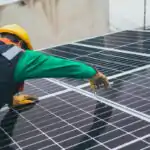
- Generating electricity using solar panels (photovoltaic cells).
- Heating water for domestic and industrial use (solar collectors).
- Drying agricultural products.
- Powering calculators and small electronic devices.
- Providing light through solar-powered lamps.
Constructing a Simple Solar Collector to Heat Water
A simple solar collector can be made to demonstrate how solar energy heats water. It typically involves a black container to absorb sunlight, covered with a transparent material to trap heat.
Steps to construct a simple solar collector:
- Paint a container (e.g., a plastic bottle) black to maximize heat absorption.
- Fill the black container with water.
- Place the container inside a larger box lined with foil to reflect more sunlight onto the container.
- Cover the top of the box with a transparent material (e.g., cling film or glass) to create a greenhouse effect, trapping heat.
- Place the setup in direct sunlight and observe the temperature change of the water over time (using a thermometer if available).
Teaching Methods/Instructional Techniques
Discussion, Lecture, Demonstration, Question and Answer, Practical Activity, Visual Aids
Instructional Procedures
Step 1: Introduction
Time: 5 minutes
Teaching Skill: Set Induction
Teacher’s Activity: The teacher greets the pupils and asks them to mention some technologies they use daily, such as mobile phones, cars, or cooking appliances. The teacher then relates these to the underlying physics principles and introduces the topic: Physics in Technology.
Pupils’ Activity: Pupils respond by mentioning various technologies and listen attentively to the teacher’s introduction.
Learning Point: Pupils are introduced to the relevance of physics in technology and the lesson topic.
Step 2: Units in Industry and their Importance
Time: 7 minutes
Teaching Skill: Explanation/Discussion
Teacher’s Activity: The teacher explains what industrial measurement units are and lists common units for quantities like length, mass, and current. The teacher then discusses the importance of using correct units in industrial applications, using charts as visual aids.
Pupils’ Activity: Pupils identify common units and discuss why accurate measurements are important.
Learning Point: Pupils understand various industrial units and their significance.
Step 3: Electrical Continuity Testing
Time: 8 minutes
Teaching Skill: Explanation/Demonstration
Teacher’s Activity: The teacher explains the concept of electrical continuity and why it is tested. The teacher demonstrates a pre-assembled simple continuity tester and shows how it works by testing a piece of wire and then an open circuit.
Pupils’ Activity: Pupils observe the demonstration and ask questions to clarify their understanding of continuity testing.
Learning Point: Pupils grasp the principle and application of electrical continuity testing.
Step 4: Constructing a Simple Continuity Tester
Time: 10 minutes
Teaching Skill: Practical/Guidance
Teacher’s Activity: The teacher divides pupils into groups and provides materials (wires, bulb/LED, battery, switch, tape). The teacher guides each group through the steps of constructing their own simple continuity tester, ensuring safety and correct connections.
Pupils’ Activity: Pupils, in groups, construct their continuity testers under the teacher’s supervision and test them.
Learning Point: Pupils develop practical skills in building a simple electrical device.
Step 5: Solar Energy and its Applications
Time: 7 minutes
Teaching Skill: Lecture/Discussion
Teacher’s Activity: The teacher defines solar energy and discusses its various applications, such as electricity generation and water heating, using charts of solar panels as visual aids. The teacher encourages pupils to share examples of solar energy use they have observed.
Pupils’ Activity: Pupils listen, contribute examples, and discuss the benefits of solar energy.
Learning Point: Pupils understand solar energy as a renewable resource and its practical uses.
Step 6: Constructing a Simple Solar Collector
Time: 8 minutes
Teaching Skill: Practical/Demonstration
Teacher’s Activity: The teacher provides materials for constructing a simple solar collector (black container, transparent cover, foil, water). The teacher demonstrates the steps for assembling it and places it in direct sunlight, explaining how it works to heat water.
Pupils’ Activity: Pupils observe the construction, participate in setting up the collector, and discuss the principles of heat absorption and trapping.
Learning Point: Pupils learn how a simple solar collector works to harness solar energy for heating.
Step 7: Evaluation/Review
Time: 5 minutes
Teaching Skill: Questioning/Assessment
Teacher’s Activity: The teacher evaluates the learning by asking the following questions:
- Mention three common units used in industry.
- State two reasons why correct measurement units are important.
- Explain what electrical continuity testing is.
- List three applications of solar energy.
Pupils’ Activity: Pupils answer orally and in writing.
Learning Point: Pupils demonstrate understanding of the lesson.
Step 8: Conclusion
Time: 3 minutes
Teaching Skill: Summarization
Teacher’s Activity: The teacher summarizes the key learning points of the lesson, reiterating the importance of physics in various technologies, from precise measurements to renewable energy solutions. The teacher assigns homework, asking pupils to research other applications of physics in technology.
Pupils’ Activity: Pupils listen to the summary and copy the assigned homework.
Learning Point: Pupils consolidate their understanding and are encouraged to explore further.
Lesson Keywords
- Units – Standard measures used to quantify physical quantities.
- Continuity – The state of being unbroken or continuous, allowing electrical current to flow.
- Solar Energy – Radiant light and heat from the Sun harnessed for various uses.
- Photovoltaics – Technology that converts sunlight directly into electricity using solar cells.
- Solar Collector – A device designed to absorb sunlight and convert it into heat.
Differentiation
For pupils who grasp concepts quickly, the teacher can challenge them to explain the underlying physics principles of the continuity tester or solar collector in more detail. For pupils needing more support, the teacher will provide closer supervision during practical activities and simplify explanations, using more visual cues and hands-on guidance.
Note for teachers using this lesson plan
Ensure all electrical components are safe and appropriate for school use. Emphasize safety precautions during practical sessions, especially when handling batteries and wires. Encourage teamwork and active participation from all pupils. The solar collector activity may require sunlight; plan accordingly or use a strong lamp as an alternative for demonstration.


Community Join the conversation Open discussion +