

Class: Senior Secondary School 1 (SS1, SS 1, SSS1, SSS 1)
Term: 2nd Term
Week: 8
Age: 15 years
Duration: 45 minutes
Subject: Physics
Curriculum Theme: Physics
Previous Lesson: Electric Fields, Lines of Force, Current and Potential Difference.
Topic: ELECTRIC FIELD
Subject Matter: Electric circuit, electric conduction through materials, Ohm’s law, electrical work done in a circuit, building series and parallel circuits, using ammeter and voltmeter, identifying resistors and basic circuit symbols
Specific Objectives
By the end of the lesson, pupils should be able to:
Cognitive Domain:
- Define an electric circuit and state Ohm’s law.
- Identify basic electric circuit symbols and components.
- Explain electric conduction through different materials.
- Compute simple electrical work done in a circuit using given values.
Affective Domain:
- Appreciate the importance of understanding electric circuits in daily life.
- Show interest in safely handling electrical components during practical activities.
Psychomotor Domain:
- Assemble simple series and parallel electric circuits.
- Correctly use an ammeter and voltmeter to measure current and voltage.
Social Domain:
- Collaborate effectively in groups to build and test electric circuits.
Reference Materials
The following resources were used in planning this lesson:
- 9 Years Basic Education Curriculum for Physics (Senior Secondary)
- State Unified Scheme of Work for Physics SSS 1
- New School Physics by P.N. Okeke and M.W. Anyakoha
- https://www.physicsclassroom.com/class/circuits/Lesson-1/Electric-Circuits
- https://www.khanacademy.org/science/physics/circuits-topic
Instructional Materials
The teacher will teach this lesson with the aid of:
- Electric cell/battery
- Connecting wires
- Key/switch
- Ammeter
- Voltmeter
- Resistors
- Bulbs
- Circuit diagram chart
Rationale for the Lesson
Understanding electric circuits is important because electricity powers many devices we use daily. This lesson helps pupils understand how circuits work, how to build them, and the fundamental laws governing them, which is useful for practical applications and further studies in science and technology.
Prerequisite/Previous Knowledge
Pupils should have basic knowledge of electricity, including the concept of current, voltage, and resistance. They should also be familiar with simple electrical devices.
Lesson Content/Board Summary
Basic Electric Circuits and Ohm’s Law
1. Electric Circuit
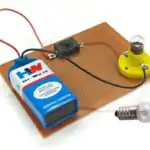
An electric circuit is a complete path through which electric current flows. It typically consists of a power source (e.g., cell), connecting wires, a switch, and a load (e.g., bulb or resistor).
2. Electric Conduction Through Materials
Materials can be classified based on their ability to conduct electricity:
- Conductors: Materials that allow electric current to flow easily through them due to the presence of free electrons. Examples include metals (copper, aluminum), graphite, and electrolytes.
- Insulators: Materials that do not allow electric current to flow easily through them because they lack free electrons. Examples include rubber, plastic, wood, and glass.
3. Basic Circuit Symbols and Components
The following are common electrical circuit symbols:
- Cell:
- Battery (multiple cells):
- Switch (open):
- Resistor:
- Bulb/Lamp:
- Ammeter (measures current):
- Voltmeter (measures voltage):
- Connecting Wire:
4. Ohm’s Law
Ohm’s Law states that the current (I) flowing through a conductor between two points is directly proportional to the voltage (V) across the two points, provided the temperature and other physical conditions remain constant.
The relationship is given by the formula:
V = IR
Where:
- V = Voltage (potential difference) in Volts (V)
- I = Current in Amperes (A)
- R = Resistance in Ohms (Ω)
5. Series and Parallel Circuits
Components in a circuit can be connected in two basic ways:
- Series Circuit:
- Components are connected end-to-end, forming a single path for current to flow.
- The current is the same through each component.
- The total voltage across the circuit is the sum of voltages across individual components.
- The total resistance is the sum of individual resistances (Rtotal = R1 + R2 + …).
- Parallel Circuit:
- Components are connected across each other, providing multiple paths for current to flow.
- The voltage across each branch is the same.
- The total current from the source is the sum of currents in each branch.
- The reciprocal of the total resistance is the sum of the reciprocals of individual resistances (1/Rtotal = 1/R1 + 1/R2 + …).
6. Ammeter and Voltmeter Usage
- Ammeter: Used to measure electric current. It must be connected in series with the component through which the current is to be measured.
- Voltmeter: Used to measure electric potential difference (voltage). It must be connected in parallel across the component whose voltage is to be measured.
7. Electrical Work Done in a Circuit
Electrical work done (W) in a circuit is the energy converted from electrical potential energy to another form (e.g., heat, light). It can be calculated using the following formulas:
- W = VIt (Voltage × Current × Time)
- W = I²Rt (Current² × Resistance × Time)
- W = (V²/R)t (Voltage² / Resistance × Time)
The unit for electrical work done is the Joule (J).
Teaching Methods/Instructional Techniques
Discussion, Lecture, Demonstration, Question and Answer, Visual Aids
Instructional Procedures
Step 1: Introduction
Time: 5 minutes
Teaching Skill: Set Induction
Teacher’s Activity: The teacher initiates the lesson by asking pupils about their daily experiences with electricity and the devices they use that run on electricity. The teacher then introduces the topic: Basic Electric Circuits and Ohm’s Law.
Pupils’ Activity: Pupils respond by mentioning various electrical appliances and their uses. They listen attentively as the teacher introduces the topic.
Learning Point: Pupils recall prior knowledge of electricity and are prepared for the new topic.
Step 2: Electric Circuit and Conduction
Time: 10 minutes
Teaching Skill: Explanation/Illustration
Teacher’s Activity: The teacher defines an electric circuit, explaining its basic components. The teacher then explains electric conduction, differentiating between conductors and insulators with relevant examples.
Pupils’ Activity: Pupils listen, take notes, and ask questions for clarification. They identify examples of conductors and insulators.
Learning Point: Pupils understand what an electric circuit is and how materials conduct or resist electricity.
Step 3: Circuit Symbols and Ohm’s Law
Time: 10 minutes
Teaching Skill: Visualisation/Explanation
Teacher’s Activity: Using a circuit diagram chart, the teacher introduces and explains basic circuit symbols for components like cells, switches, resistors, and meters. The teacher then states and explains Ohm’s Law (V=IR), defining each variable and its unit.
Pupils’ Activity: Pupils observe the symbols, identify them, and copy the symbols and Ohm’s Law into their notebooks. They ask questions to understand the relationship between voltage, current, and resistance.
Learning Point: Pupils learn to identify circuit symbols and understand the fundamental relationship described by Ohm’s Law.
Step 4: Building Series Circuits
Time: 8 minutes
Teaching Skill: Demonstration/Practical Activity
Teacher’s Activity: The teacher demonstrates how to build a simple series circuit using an electric cell, connecting wires, a switch, a bulb, an ammeter, and a voltmeter. The teacher guides pupils to assemble their own simple series circuits in groups, demonstrating the correct connection of meters.
Pupils’ Activity: Pupils observe the teacher’s demonstration and then work in groups to assemble series circuits, taking care to connect the ammeter in series and the voltmeter in parallel.
Learning Point: Pupils gain practical skills in assembling series circuits and correctly using measuring instruments.
Step 5: Building Parallel Circuits
Time: 7 minutes
Teaching Skill: Demonstration/Practical Activity
Teacher’s Activity: The teacher demonstrates how to build a simple parallel circuit, highlighting the differences in connection compared to a series circuit. The teacher then guides pupils to assemble their own simple parallel circuits in groups.
Pupils’ Activity: Pupils observe the teacher’s demonstration and then work in groups to assemble parallel circuits, noting the different current paths.
Learning Point: Pupils gain practical skills in assembling parallel circuits and understand their characteristics.
Step 6: Electrical Work Done
Time: 5 minutes
Teaching Skill: Explanation/Formula Derivation
Teacher’s Activity: The teacher explains the concept of electrical work done in a circuit. The teacher introduces and explains the formulas for calculating electrical work (W = VIt, W = I²Rt, W = (V²/R)t) and their units.
Pupils’ Activity: Pupils listen attentively, copy the formulas, and ask questions regarding their application.
Learning Point: Pupils understand how to calculate the electrical energy converted in a circuit.
Step 7: Evaluation/Review
Time: 5 minutes
Teaching Skill: Questioning/Assessment
Teacher’s Activity: The teacher evaluates the learning by asking the following questions:
- Define an electric circuit.
- State Ohm’s Law.
- List three basic circuit symbols and their corresponding components.
- Differentiate between a conductor and an insulator, giving one example for each.
- How is an ammeter connected in a circuit to measure current?
Pupils’ Activity: Pupils answer orally and in writing.
Learning Point: Pupils demonstrate understanding of the lesson.
Step 8: Conclusion
Time: 2 minutes
Teaching Skill: Summarisation/Assignment
Teacher’s Activity: The teacher summarizes the key points of the lesson, reinforcing the understanding of electric circuits, Ohm’s Law, and practical circuit building. The teacher assigns homework, such as drawing circuit diagrams or solving simple problems involving Ohm’s Law and electrical work.
Pupils’ Activity: Pupils listen to the summary and copy down the assigned homework.
Learning Point: Pupils consolidate their learning and prepare for further practice.
Lesson Keywords
- Electric Circuit – A complete path through which electric current flows.
- Ohm’s Law – States that the current through a conductor between two points is directly proportional to the voltage across the two points.
- Conductor – A material that allows electric current to flow easily through it.
- Insulator – A material that does not allow electric current to flow easily through it.
- Series Circuit – A circuit where components are connected end-to-end along a single path.
- Parallel Circuit – A circuit where components are connected across each other, creating multiple paths for current.
- Ammeter – An instrument used to measure electric current, connected in series.
- Voltmeter – An instrument used to measure electric potential difference (voltage), connected in parallel.
- Resistor – An electrical component that limits or regulates the flow of electrical current.
- Electrical Work – The energy converted from electrical potential energy to another form of energy in an electric circuit.
Differentiation
The teacher will provide additional support for struggling pupils through one-on-one explanations and simplified diagrams. Advanced pupils will be challenged with more complex circuit problems and encouraged to explore the applications of circuits in real-world scenarios.
Note for teachers using this lesson plan
Ensure all electrical components are in good working condition and safety precautions are observed during practical sessions. Emphasize the practical applications of circuit knowledge and encourage pupils to think critically about how electricity powers devices around them.
Community Join the conversation Open discussion +