

Class: Senior Secondary School 1 (SS1, SS 1, SSS1, SSS 1)
Term: 3rd Term
Week: 8
Age: 15 years
Duration: 45 minutes
Subject: Physics
Curriculum Theme: Physics
Previous Lesson: Linear Momentum.
Topic: MECHANICAL ENERGY
Subject Matter: Application of mechanical energy, machines, force ratio, velocity ratio, efficiency, types of machines as levers pulleys inclined plane wedge screw wheel and axle gear wheels, demonstrating a lever as a simple machine, practical applications of machines
Specific Objectives
By the end of the lesson, pupils should be able to:
Cognitive Domain:
- Define mechanical energy and a machine.
- Explain the terms force ratio, velocity ratio, and efficiency.
- List different types of simple machines.
Affective Domain:
- Appreciate the importance of machines in making work easier.
- Develop an interest in observing and identifying machines in their environment.
Psychomotor Domain:
- Demonstrate the working principle of a lever as a simple machine.
- Calculate force ratio, velocity ratio, and efficiency using given values.
Social Domain:
- Collaborate with peers to identify practical applications of machines.
Reference Materials
The following resources were used in planning this lesson:
- 9 Years Basic Education Curriculum for Senior Secondary Schools.
- State Unified Scheme of Work for Senior Secondary School Physics.
- New School Physics by M.W. Anyakoha.
Instructional Materials
The teacher will teach this lesson with the aid of:
- A lever setup (e.g., ruler, pivot, weights).
- Weights.
- Pulley (optional).
- Inclined plane board.
- Charts showing different types of simple machines.
- Ruler.
- Chalkboard.
Rationale for the Lesson
This lesson helps pupils understand how devices around them make tasks simpler and faster. It enables them to identify various machines and grasp the basic scientific principles behind their operation, which is useful in everyday life.
Prerequisite/Previous Knowledge
Pupils should have a basic understanding of force, work, and energy from previous lessons.
Lesson Content/Board Summary
MECHANICAL ENERGY AND MACHINES
Definition of Mechanical Energy
Mechanical energy is the energy an object possesses due to its motion (kinetic energy) or its position (potential energy). It is the sum of kinetic and potential energy.
Definition of a Machine
A machine is any device that helps to make work easier, faster, or more convenient by changing the magnitude, direction, or point of application of a force.
Terms Associated with Machines
The following are important terms when studying machines:
- Force Ratio (Mechanical Advantage, MA): This is the ratio of the load (output force) to the effort (input force).
MA = Load / Effort - Velocity Ratio (VR): This is the ratio of the distance moved by the effort to the distance moved by the load.
VR = Distance moved by effort / Distance moved by load - Efficiency (η): This is the ratio of the useful work done by the machine (work output) to the total work put into the machine (work input), expressed as a percentage.
Efficiency = (Work output / Work input) × 100%
Types of Simple Machines
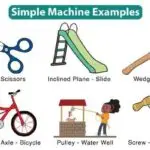
The following are common types of simple machines:
- Levers
- Pulleys
- Inclined Plane
- Wedge
- Screw
- Wheel and Axle
- Gear Wheels
Demonstration of a Lever as a Simple Machine
A lever consists of a rigid bar that pivots around a fixed point called the fulcrum. By applying a small effort at one end, a larger load can be moved at the other end, illustrating how machines multiply force or change its direction.
Practical Applications of Machines
Machines are applied in various ways in daily life, including:
- Opening a bottle with a bottle opener (lever).
- Lifting heavy objects with a crowbar (lever).
- Raising a flag on a flagpole (pulley).
- Cutting wood with an axe (wedge).
- Driving a car up a ramp (inclined plane).
- Tightening a bolt with a spanner (lever/wheel and axle).
Teaching Methods/Instructional Techniques
Discussion, Lecture, Demonstration, Question and Answer, Visual Aids
Instructional Procedures
Step 1: Introduction
Time: 5 minutes
Teaching Skill: Set Induction
Teacher’s Activity: The teacher greets the pupils and asks them to mention any tools or devices they use at home or school that make work easier. The teacher then introduces the topic “Mechanical Energy and Machines” by linking it to their responses.
Pupils’ Activity: Pupils respond to the teacher’s questions and listen attentively to the introduction.
Learning Point: Pupils are introduced to the concept of machines and their relevance.
Step 2: Definition of Mechanical Energy and Machines
Time: 8 minutes
Teaching Skill: Explanation/Definition
Teacher’s Activity: The teacher defines mechanical energy and explains what a machine is, providing simple examples. The definitions are written on the board.
Pupils’ Activity: Pupils listen, take notes, and ask questions for clarification.
Learning Point: Pupils understand the basic definitions of mechanical energy and a machine.
Step 3: Explanation of Force Ratio, Velocity Ratio, and Efficiency
Time: 10 minutes
Teaching Skill: Explanation/Calculation
Teacher’s Activity: The teacher explains the terms force ratio (mechanical advantage), velocity ratio, and efficiency. The teacher writes the formulas for each on the board and gives simple numerical examples for calculation.
Pupils’ Activity: Pupils copy the definitions and formulas, and attempt the examples.
Learning Point: Pupils learn how to define and calculate force ratio, velocity ratio, and efficiency.
Step 4: Types of Simple Machines
Time: 5 minutes
Teaching Skill: Listing/Categorization
Teacher’s Activity: The teacher lists and briefly describes the different types of simple machines, using charts or real-life examples where possible.
Pupils’ Activity: Pupils observe the charts, listen, and note down the types of simple machines.
Learning Point: Pupils identify various types of simple machines.
Step 5: Demonstration of a Lever
Time: 7 minutes
Teaching Skill: Demonstration/Observation
Teacher’s Activity: Using a ruler, pivot, and weights, the teacher demonstrates how a lever works as a simple machine, showing how a small effort can lift a larger load. The teacher explains the fulcrum, effort, and load points.
Pupils’ Activity: Pupils observe the demonstration, describe the input and output forces, and ask questions.
Learning Point: Pupils understand the working principle and components of a lever.
Step 6: Practical Applications of Machines
Time: 5 minutes
Teaching Skill: Discussion/Application
Teacher’s Activity: The teacher leads a discussion on practical applications of machines in everyday life, encouraging pupils to identify examples from their homes and communities.
Pupils’ Activity: Pupils contribute examples and discuss the applications of machines.
Learning Point: Pupils relate machine concepts to real-world scenarios.
Step 7: Evaluation/Review
Time: 5 minutes
Teaching Skill: Questioning/Assessment
Teacher’s Activity: The teacher evaluates the learning by asking the following questions:
- Define a machine.
- State the formula for calculating velocity ratio.
- Mention three types of simple machines.
- Explain how a lever makes work easier.
Pupils’ Activity: Pupils answer orally and in writing.
Learning Point: Pupils demonstrate understanding of the lesson.
Step 8: Conclusion
Time: 5 minutes
Teaching Skill: Summarization/Assignment
Teacher’s Activity: The teacher summarizes the key points of the lesson, emphasizing the importance of machines. The teacher then assigns homework, which includes finding five examples of simple machines used at home and identifying their type.
Pupils’ Activity: Pupils listen to the summary and copy the homework assignment.
Learning Point: Pupils consolidate their understanding and prepare for further learning.
Lesson Keywords
- Mechanical Energy – The sum of an object’s kinetic and potential energy.
- Machine – A device that makes work easier by changing force magnitude or direction.
- Force Ratio – The ratio of load to effort (also called Mechanical Advantage).
- Velocity Ratio – The ratio of distance moved by effort to distance moved by load.
- Efficiency – The ratio of work output to work input, expressed as a percentage.
- Lever – A simple machine consisting of a rigid bar pivoting on a fulcrum.
Differentiation
For pupils who grasp concepts quickly, the teacher can provide more complex problems involving calculations of efficiency or combined machines. For pupils needing more support, the teacher can provide simplified diagrams, additional one-on-one explanations, and focus on identifying machines and their basic functions.
Note for teachers using this lesson plan
Teachers should ensure all instructional materials are prepared before the lesson. Emphasize practical demonstrations and real-life examples to make the concepts relatable. Encourage active participation and critical thinking by asking open-ended questions during discussions.



Community Join the conversation Open discussion +