

Class: Senior Secondary School 1 (SS1, SS 1, SSS1, SSS 1)
Term: 1st Term
Week: 3
Age: 15 years
Duration: 45 minutes
Subject: Physics
Curriculum Theme: Physics
Previous Lesson: Position, Distance and Displacement on the x-y Coordinate System.
Topic: TIME
Subject Matter: Concept of time, time interval, ways of measuring time, use of stop clocks and stop watches, estimating and recording time for simple events
Specific Objectives
By the end of the lesson, pupils should be able to:
Cognitive Domain:
- Define time and time interval.
- Identify various devices used to measure time.
- Explain the procedure for using stop clocks and stop watches.
Affective Domain:
- Appreciate the importance of accurate time measurement in daily life and scientific experiments.
- Develop an interest in observing and recording time for different events.
Psychomotor Domain:
- Demonstrate the correct use of stop clocks and stop watches to measure time intervals.
- Accurately record estimated and measured time for simple events.
Social Domain:
- Collaborate effectively with peers during practical time measurement activities.
Reference Materials
The following resources were used in planning this lesson:
- 9 Years Basic Education Curriculum for Physics (Senior Secondary Education)
- State Unified Scheme of Work for Senior Secondary School Physics
- New School Physics for Senior Secondary Schools by M.W. Anyakoha
- Physics for Senior Secondary Schools by P.N. Okeke
Instructional Materials
The teacher will teach this lesson with the aid of:
- Stop watch
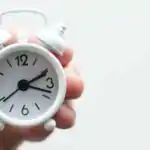
- Stop clock
- Wall clock
- Timer apps (optional)
- Activity cards
Rationale for the Lesson
Understanding time helps pupils manage their daily activities better and is fundamental for scientific experiments. Learning to measure time accurately is an important skill for everyday life and further studies in physics, enabling pupils to understand concepts of speed, acceleration, and frequency.
Prerequisite/Previous Knowledge
Pupils have a basic understanding of measurement, units, and simple physical quantities from their Junior Secondary School science classes.
Lesson Content/Board Summary
TIME
Concept of Time
Time is the continuous sequence of existence and events that occurs in apparently irreversible succession from the past, through the present, to the future. It is a fundamental physical quantity, often measured in units like seconds, minutes, hours, and days.
Time Interval
A time interval is the duration or period between two specific points or events in time. It represents the length of time an event lasts or the period between two occurrences.
Ways of Measuring Time
Time can be measured using various devices. These include:
- Wall clocks
- Wristwatches
- Stop clocks
- Stop watches
- Digital timers
- Sundials (historical)
- Atomic clocks (highly precise, used in scientific research)
Using Stop Clocks and Stop Watches
Stop clocks and stop watches are instruments used for measuring time intervals with precision, typically for short durations. They are started at the beginning of an event and stopped at its end. The display shows the elapsed time.
The steps for using a stop watch typically involve:
- Pressing the start button at the beginning of the event.
- Pressing the stop button at the end of the event.
- Reading the recorded time interval from the display.
- Pressing the reset button to clear the display for the next measurement.
Estimating and Recording Time for Simple Events
Estimating time involves making a reasonable guess of how long an event will take based on experience or observation. Recording time accurately involves noting the start and stop times and calculating the duration, often to the nearest significant figure of the measuring device. Proper recording includes stating the unit of measurement (e.g., seconds, minutes).
Teaching Methods/Instructional Techniques
Discussion, Lecture, Demonstration, Question and Answer, Visual Aids
Instructional Procedures
Step 1: Introduction
Time: 5 minutes
Teaching Skill: Set Induction
Teacher’s Activity: The teacher greets the pupils and asks questions to activate prior knowledge, such as: “What time do you usually wake up?”, “How long does it take you to get to school?”, “What devices do you use to know the time?”.
Pupils’ Activity: Pupils respond to the teacher’s questions, sharing their experiences with time.
Learning Point: Pupils recall basic concepts related to time and its importance in daily life.
Step 2: Explanation of Time and Time Interval
Time: 7 minutes
Teaching Skill: Explanation/Definition
Teacher’s Activity: The teacher explains the concept of time as a fundamental quantity and defines time interval using simple, relatable examples. The teacher writes key definitions on the board.
Pupils’ Activity: Pupils listen attentively, ask questions for clarity, and copy notes from the board.
Learning Point: Pupils understand the definitions of time and time interval.
Step 3: Identification of Time Measuring Devices
Time: 7 minutes
Teaching Skill: Classification/Identification
Teacher’s Activity: The teacher displays various time-measuring devices (wall clock, wrist watch, stop watch, stop clock, timer app on a phone) and asks pupils to identify them and state their uses. The teacher highlights the differences between clocks (for continuous time) and stop watches/clocks (for time intervals).
Pupils’ Activity: Pupils identify the devices, mention their uses, and observe their differences.
Learning Point: Pupils can identify and differentiate between various time-measuring instruments.
Step 4: Demonstration of Stop Clocks and Stop Watches
Time: 8 minutes
Teaching Skill: Demonstration/Modelling
Teacher’s Activity: The teacher demonstrates how to correctly use a stop clock and a stop watch to measure a short time interval (e.g., timing how long it takes to clap 10 times, or for a pupil to walk across the classroom). The teacher emphasizes starting, stopping, and resetting procedures.
Pupils’ Activity: Pupils observe the demonstration carefully and ask questions about the operation of the devices.
Learning Point: Pupils understand the practical steps involved in using stop clocks and stop watches.
Step 5: Practical Activity – Measuring Simple Events
Time: 10 minutes
Teaching Skill: Practical Application/Supervision
Teacher’s Activity: The teacher divides pupils into small groups and provides each group with a stop watch (or encourages use of timer apps). The teacher provides activity cards with simple events to time (e.g., “Time how long it takes to write your name 5 times,” “Time how long it takes a pendulum to swing 10 times”). The teacher supervises and assists as needed.
Pupils’ Activity: Pupils, in groups, carry out the practical activities, using the stop watches to measure and record time intervals.
Learning Point: Pupils gain hands-on experience in measuring time intervals for simple events.
Step 6: Estimating and Recording Time
Time: 3 minutes
Teaching Skill: Guidance/Reinforcement
Teacher’s Activity: The teacher guides pupils on how to estimate time before measuring and how to record their measurements accurately, including units. The teacher may ask groups to share their estimated and measured times for an activity.
Pupils’ Activity: Pupils discuss their estimates and recorded times, learning the importance of accuracy and proper notation.
Learning Point: Pupils learn to estimate and record time measurements correctly.
Step 7: Evaluation/Review
Time: 5 minutes
Teaching Skill: Questioning/Assessment
Teacher’s Activity: The teacher evaluates the learning by asking the following questions:
- Define time and time interval.
- Mention three devices used to measure time.
- Explain the steps involved in using a stop watch to measure a time interval.
- State one importance of accurate time measurement in a scientific experiment.
Pupils’ Activity: Pupils answer orally and in writing.
Learning Point: Pupils demonstrate understanding of the lesson.
Step 8: Conclusion
Time: 3 minutes
Teaching Skill: Summarization/Assignment
Teacher’s Activity: The teacher summarizes the main points of the lesson, re-emphasizing the importance of time and accurate measurement. The teacher gives an assignment: “List five daily activities and estimate the time they take. Then, measure the actual time for two of these activities using a timer and compare your estimates with the actual times.”
Pupils’ Activity: Pupils listen to the summary and copy the assignment.
Learning Point: Pupils consolidate their learning and prepare for further practice.
Lesson Keywords
- Time – The continuous progression of existence and events.
- Time interval – The duration between two points in time.
- Stop clock – A device used to measure time intervals, often with a large dial.
- Stop watch – A handheld device used to measure time intervals, typically digitally.
- Measurement – The process of determining the size, quantity, or extent of something.
- Duration – The length of time that something continues or lasts.
Differentiation
For pupils who grasp concepts quickly, the teacher can provide more complex events to time or challenge them to calculate average times from multiple measurements. For pupils needing more support, the teacher can provide one-on-one guidance during practical activities and simplify instructions, focusing on basic identification and operation.
Note for teachers using this lesson plan
Ensure that enough functional stop clocks or stop watches are available for practical activities. If physical devices are limited, encourage pupils to use timer apps on their mobile phones under supervision. Emphasize safety during practical activities and ensure clear instructions are given for each task. Encourage pupils to discuss their results and any discrepancies observed.

Community Join the conversation Open discussion +